QUESTION IMAGE
Question
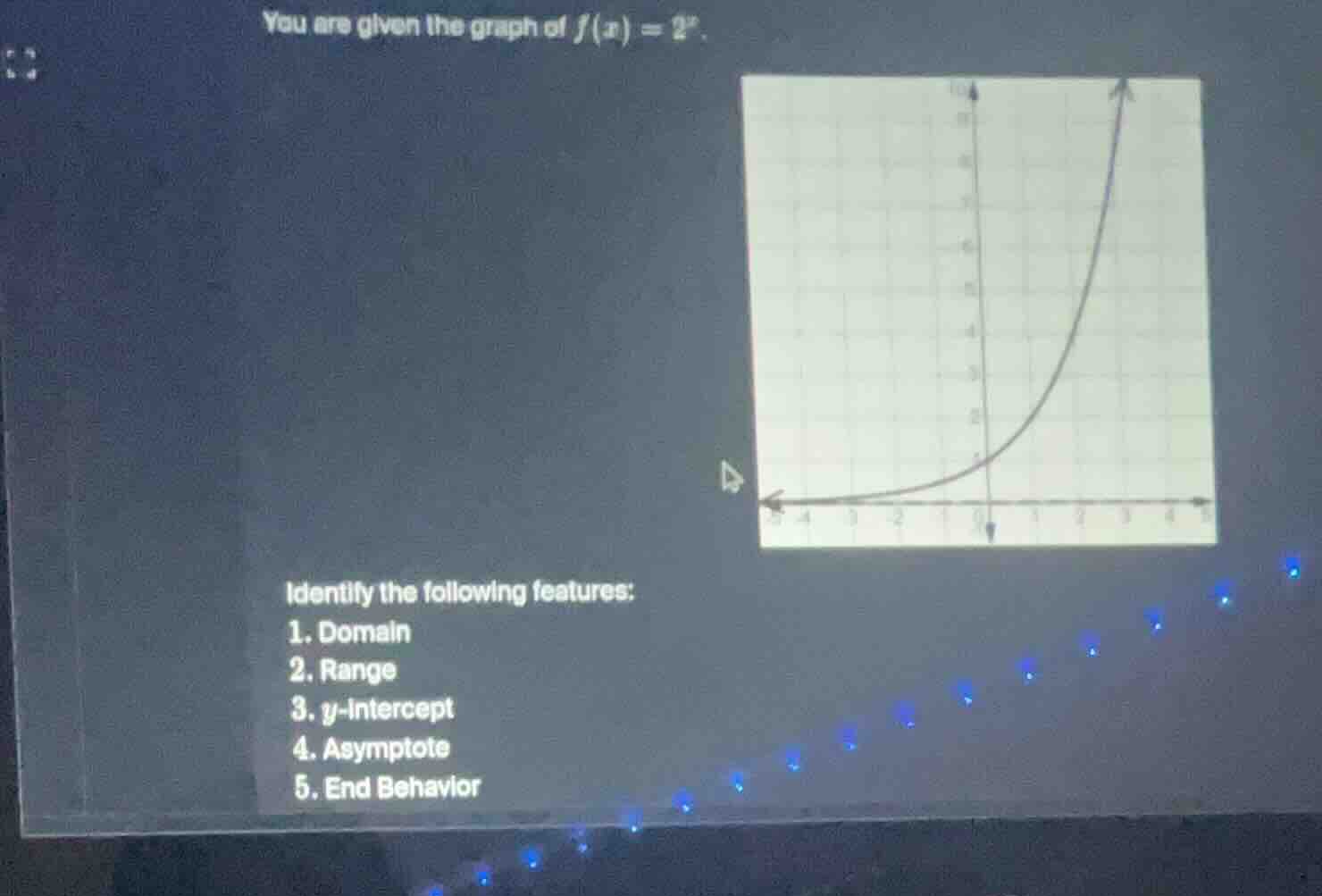
you are given the graph of \\(f(x) = 2^x\\).
identify the following features:
- domain
- range
- \\(y\\)-intercept
- asymptote
- end behavior
Identify the domain
The function is \(f(x) = 2^x\).
The exponent \(x\) can be any real number.
Thus, the domain is all real numbers.
In interval notation, this is written as \((-\infty, \infty)\).
Identify the range
Since \(2^x > 0\) for all real \(x\), the outputs are strictly positive.
Using the Real Numbers concept, the range consists of all positive real numbers.
In interval notation, this is written as \((0, \infty)\).
Find the y-intercept
The \(y\)-intercept occurs where \(x = 0\).
Evaluating the function:
The \(y\)-intercept is at the point \((0, 1)\).
Determine the asymptote
As \(x \to -\infty\), \(2^x \to 0\).
The graph approaches but never touches the \(x\)-axis.
Thus, the horizontal asymptote is the line \(y = 0\).
Describe the end behavior
We analyze the behavior of \(f(x)\) as \(x\) becomes extremely large or small:
As \(x \to \infty\), \(f(x) \to \infty\).
As \(x \to -\infty\), \(f(x) \to 0\).

Snap & solve any problem in the app
Get step-by-step solutions on Sovi AI
Photo-based solutions with guided steps
Explore more problems and detailed explanations
Question 1
The domain is \((-\infty, \infty)\) (all real numbers).
Question 2
The range is \((0, \infty)\) (all positive real numbers).
Question 3
The \(y\)-intercept is \((0, 1)\).
Question 4
The asymptote is the horizontal line \(y = 0\).
Question 5
The end behavior is:
As \(x \to \infty\), \(f(x) \to \infty\).
As \(x \to -\infty\), \(f(x) \to 0\).