QUESTION IMAGE
Question
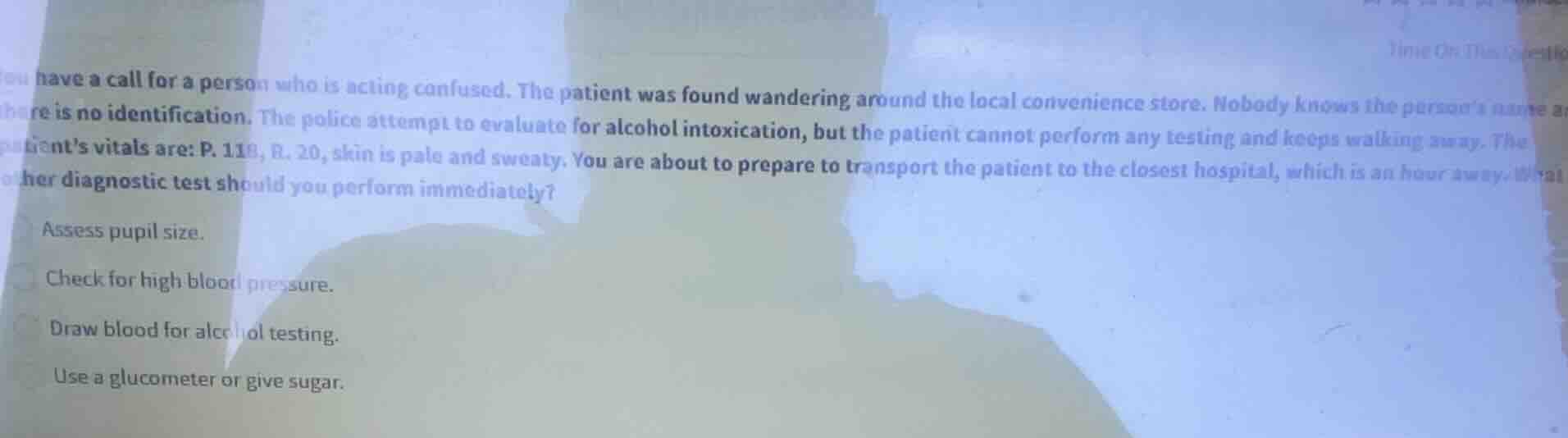
you have a call for a person who is acting confused. the patient was found wandering around the local convenience store. nobody knows the persons name and there is no identification. the police attempt to evaluate for alcohol intoxication, but the patient cannot perform any testing and keeps walking away. the patients vitals are: p. 118, r. 20, skin is pale and sweaty. you are about to prepare to transport the patient to the closest hospital, which is an hour away. what other diagnostic test should you perform immediately?
assess pupil size.
check for high blood pressure.
draw blood for alcohol testing.
use a glucometer or give sugar.
Analyze the clinical presentation
The patient presents with confusion, wandering, pale and sweaty skin (diaphoresis), and tachycardia (Pulse 118). These signs are classic physiological indicators of hypoglycemia, where the sympathetic nervous system is activated to release epinephrine in response to low blood glucose levels.
Evaluate immediate diagnostic needs
Using the Altered Mental Status Management and Hypoglycemia Pathophysiology knowledge points
Before initiating a long transport (one hour away), it is critical to rule out or treat hypoglycemia, which is a rapidly reversible cause of altered mental status. Checking blood glucose with a glucometer or empirically administering sugar is the immediate standard of care.
Rule out other options
- Assessing pupil size is part of a neurological exam but does not immediately identify or treat a rapidly reversible metabolic cause.
- Checking for high blood pressure is a routine vital sign but does not address the immediate life threat of potential severe hypoglycemia.
- Drawing blood for alcohol testing is typically not in the prehospital scope of practice for determining immediate treatment, and treating potential hypoglycemia takes priority over legal or diagnostic alcohol testing.

Snap & solve any problem in the app
Get step-by-step solutions on Sovi AI
Photo-based solutions with guided steps
Explore more problems and detailed explanations
- Assess pupil size.
- Check for high blood pressure.
- Draw blood for alcohol testing.
- Use a glucometer or give sugar. (Correct answer)