QUESTION IMAGE
Question
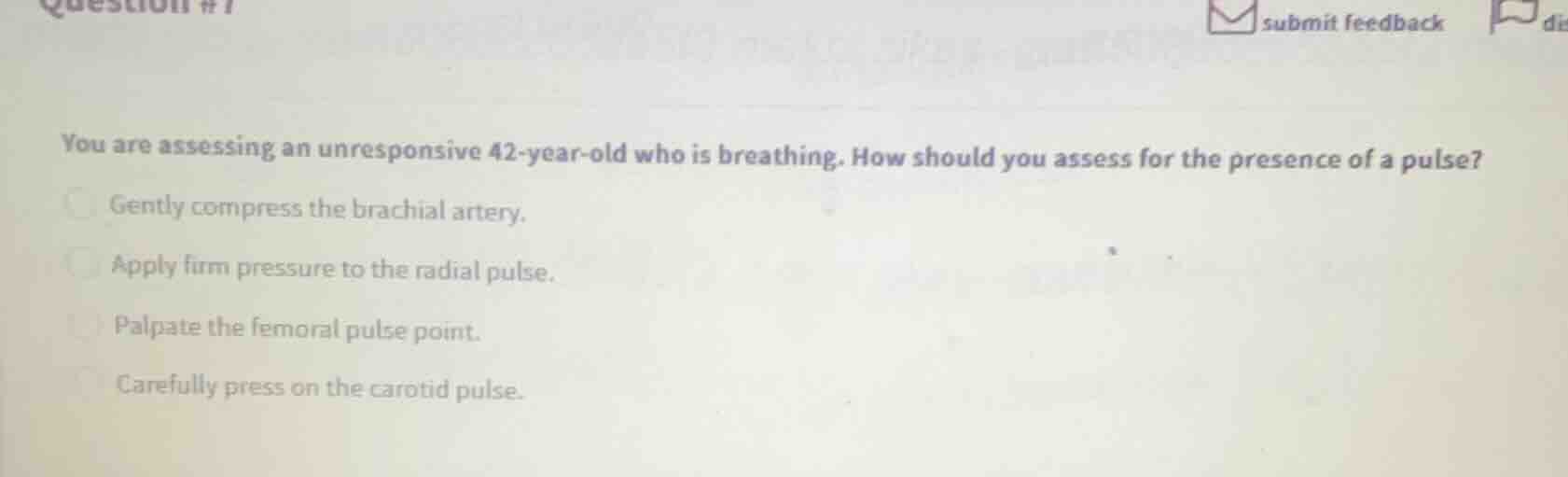
you are assessing an unresponsive 42-year-old who is breathing. how should you assess for the presence of a pulse?
gently compress the brachial artery.
apply firm pressure to the radial pulse.
palpate the femoral pulse point.
carefully press on the carotid pulse.
<pre_analysis>
{
"quality": "clear",
"question_count": 1,
"skills_matched": [
"direct_cot",
"multiple_choice_formatter",
"explain_then_answer",
"tutor"
],
"needs_drawing": false,
"concepts_used": [
"Medical Terminology"
],
"new_concepts": [
"Patient Assessment Protocols",
"Circulatory Assessment"
],
"current_concepts": [
"Medical Terminology",
"Patient Assessment Protocols",
"Circulatory Assessment"
]
}
</pre_analysis>
<reasoning>
Identify patient presentation
The patient is an unresponsive 42-year-old adult who is breathing. In emergency care, assessing an unresponsive adult requires checking a central pulse to quickly and accurately determine perfusion status.
Evaluate pulse points
For unresponsive adults, the carotid artery is the primary site used to assess for a pulse because it is a central artery and remains palpable at lower blood pressures than peripheral arteries (like the radial artery).
Compare the options
- Gently compress the brachial artery: Used primarily for infants, not adults.
- Apply firm pressure to the radial pulse: Used for responsive adults; may be absent in shock or low perfusion states.
- Palpate the femoral pulse point: A central pulse, but less accessible and not the primary choice over the carotid in a standard initial assessment.
- Carefully press on the carotid pulse: The standard protocol for assessing a pulse in an unresponsive adult.
Apply medical terminology
Using Medical Terminology, we identify the carotid artery in the neck as the standard anatomical site for central pulse checks in unresponsive adult patients.
</reasoning>
<answer>
<mcq-option>Gently compress the brachial artery.</mcq-option>
<mcq-option>Apply firm pressure to the radial pulse.</mcq-option>
<mcq-option>Palpate the femoral pulse point.</mcq-option>
<mcq-correct>Carefully press on the carotid pulse.</mcq-correct>
</answer>
<post_analysis>
{
"subject": "Natural Science",
"question_type": "Multiple Choice",
"knowledge_point": [
"Natural Science",
"Medicine and Health",
"Emergency Medical Services"
]
}
</post_analysis>
Snap & solve any problem in the app
Get step-by-step solutions on Sovi AI
Photo-based solutions with guided steps
Explore more problems and detailed explanations
<pre_analysis>
{
"quality": "clear",
"question_count": 1,
"skills_matched": [
"direct_cot",
"multiple_choice_formatter",
"explain_then_answer",
"tutor"
],
"needs_drawing": false,
"concepts_used": [
"Medical Terminology"
],
"new_concepts": [
"Patient Assessment Protocols",
"Circulatory Assessment"
],
"current_concepts": [
"Medical Terminology",
"Patient Assessment Protocols",
"Circulatory Assessment"
]
}
</pre_analysis>
<reasoning>
Identify patient presentation
The patient is an unresponsive 42-year-old adult who is breathing. In emergency care, assessing an unresponsive adult requires checking a central pulse to quickly and accurately determine perfusion status.
Evaluate pulse points
For unresponsive adults, the carotid artery is the primary site used to assess for a pulse because it is a central artery and remains palpable at lower blood pressures than peripheral arteries (like the radial artery).
Compare the options
- Gently compress the brachial artery: Used primarily for infants, not adults.
- Apply firm pressure to the radial pulse: Used for responsive adults; may be absent in shock or low perfusion states.
- Palpate the femoral pulse point: A central pulse, but less accessible and not the primary choice over the carotid in a standard initial assessment.
- Carefully press on the carotid pulse: The standard protocol for assessing a pulse in an unresponsive adult.
Apply medical terminology
Using Medical Terminology, we identify the carotid artery in the neck as the standard anatomical site for central pulse checks in unresponsive adult patients.
</reasoning>
<answer>
<mcq-option>Gently compress the brachial artery.</mcq-option>
<mcq-option>Apply firm pressure to the radial pulse.</mcq-option>
<mcq-option>Palpate the femoral pulse point.</mcq-option>
<mcq-correct>Carefully press on the carotid pulse.</mcq-correct>
</answer>
<post_analysis>
{
"subject": "Natural Science",
"question_type": "Multiple Choice",
"knowledge_point": [
"Natural Science",
"Medicine and Health",
"Emergency Medical Services"
]
}
</post_analysis>