QUESTION IMAGE
Question
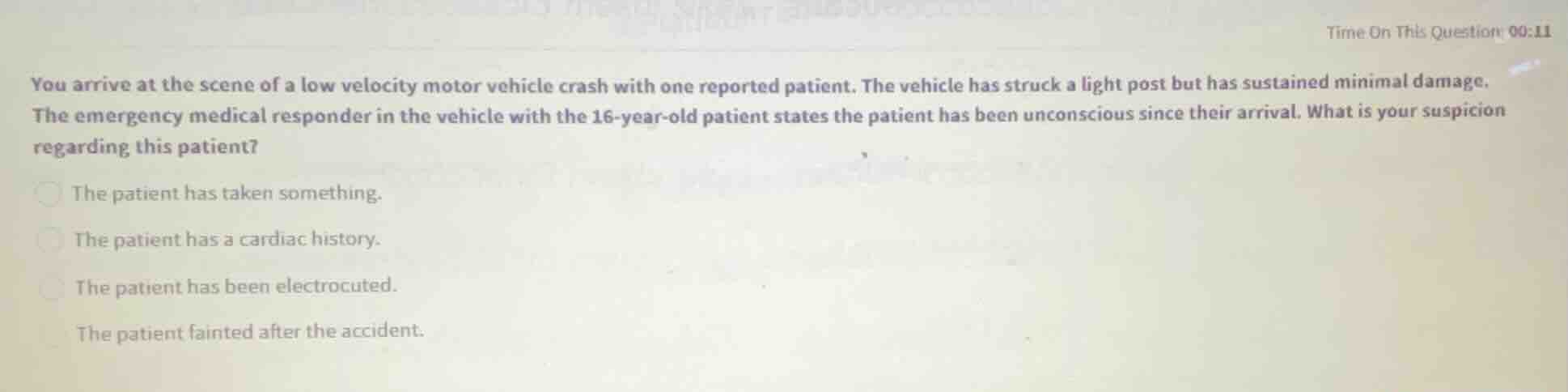
you arrive at the scene of a low velocity motor vehicle crash with one reported patient. the vehicle has struck a light post but has sustained minimal damage. the emergency medical responder in the vehicle with the 16-year-old patient states the patient has been unconscious since their arrival. what is your suspicion regarding this patient?
the patient has taken something.
the patient has a cardiac history.
the patient has been electrocuted.
the patient fainted after the accident.
Analyze the mechanism of injury (MOI)
The dispatch is for a low-velocity motor vehicle crash (MVC) with minimal vehicle damage (striking a light post). This indicates a very low mechanism of injury, which is highly unlikely to cause immediate, prolonged unconsciousness in a 16-year-old patient due to physical trauma alone.
Evaluate the clinical presentation
The emergency medical responder reports that the 16-year-old patient has been unconscious since their arrival. Because the physical impact (low-velocity, minimal damage) does not match the severe clinical presentation (prolonged unconsciousness), a medical or toxicological event must be highly suspected as the primary cause of both the unconsciousness and the subsequent low-speed collision.
Assess the differential options
Using the Toxicological Emergencies knowledge point
- The patient has taken something: A toxicological emergency (such as an overdose or substance ingestion) is a common medical cause for sudden unconsciousness in teenagers, which can lead to a low-speed drift or crash. This aligns perfectly with the mismatch between the low-severity crash and the high-severity altered mental status.
- The patient has a cardiac history: While possible, sudden cardiac arrest or severe cardiac events leading to prolonged unconsciousness are statistically rare in a 16-year-old compared to toxicological causes.
- The patient has been electrocuted: There is no indication of downed power lines or electrical contact; striking a light post does not automatically imply vehicle electrification.
- The patient fainted after the accident: Fainting (syncope) typically results in a rapid return to consciousness once supine, rather than prolonged unconsciousness lasting from before the responder's arrival through the transport unit's arrival.
Formulate the clinical suspicion
When the mechanism of injury is insufficient to explain a patient's severe clinical status, EMS providers must suspect an underlying medical or toxicological emergency that precipitated the event. Therefore, the most reasonable suspicion is that the patient has taken something (ingested a substance or experienced a toxicological emergency).

Snap & solve any problem in the app
Get step-by-step solutions on Sovi AI
Photo-based solutions with guided steps
Explore more problems and detailed explanations
- (A) The patient has taken something. (Correct answer)
- (B) The patient has a cardiac history.
- (C) The patient has been electrocuted.
- (D) The patient fainted after the accident.