QUESTION IMAGE
Question
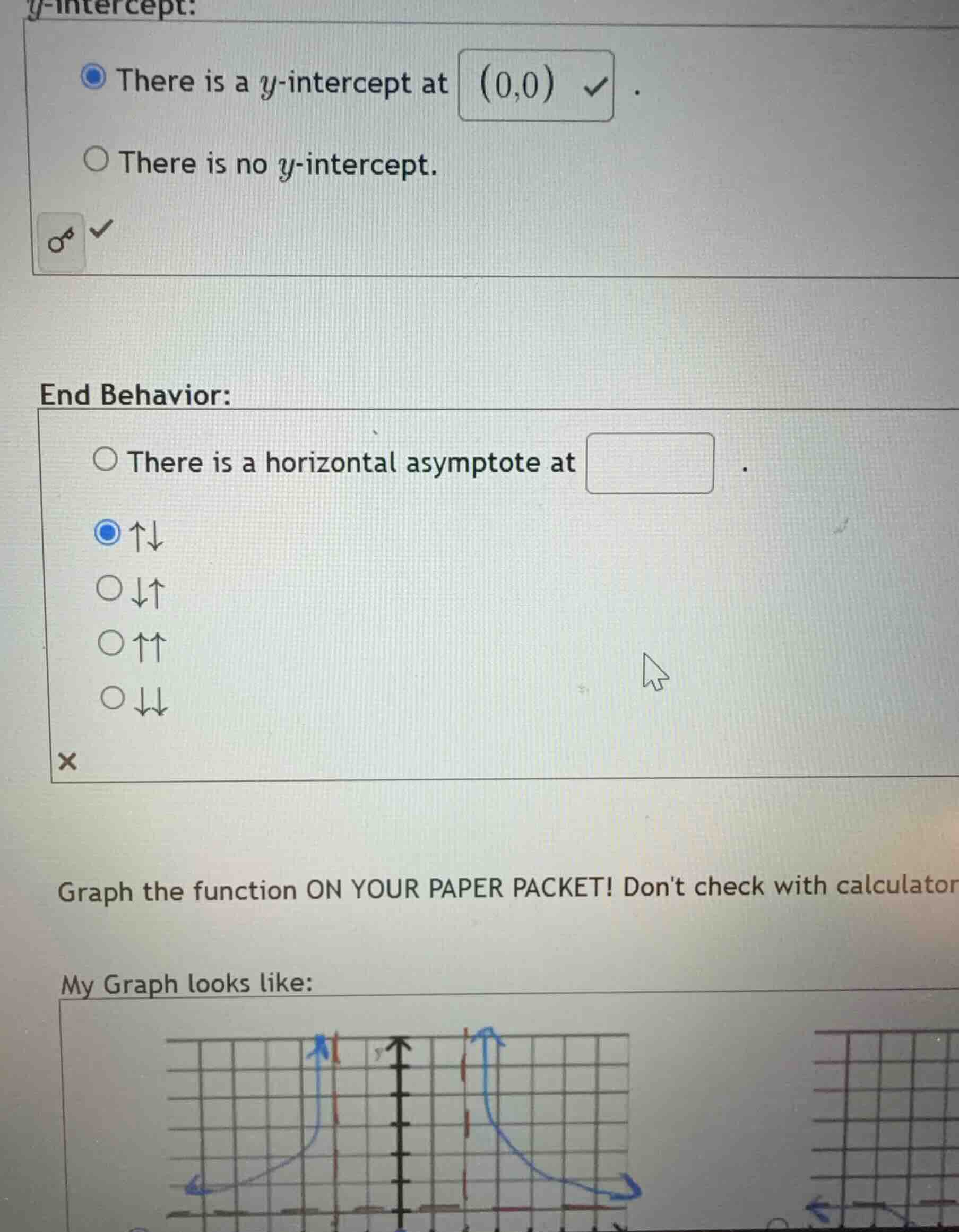
y-intercept:
there is a y-intercept at (0,0).
there is no y-intercept.
end behavior:
there is a horizontal asymptote at .
↑↓
↓↑
↑↑
↓↓
graph the function on your paper packet! dont check with calculator
my graph looks like:
🆕 New Concept Discovered: End Behavior of Rational Functions
How a graph behaves at its far left and far right ends.
Step 1: Identify the function type from the graph
The graph shown is a rational function with vertical asymptotes (indicated by the dashed red lines) and a horizontal asymptote.
To determine the end behavior, we look at what happens to the function's output values (\(y\)-values) as the input values (\(x\)-values) head towards positive infinity (\(\infty\)) and negative infinity (\(-\infty\)).
Step 2: Analyze the far-left and far-right behavior
Looking at the blue curves on the graph:
- As we follow the graph to the far left (\(x \to -\infty\)), the curve flattens out and approaches the horizontal line \(y = 0\) (the x-axis).
- As we follow the graph to the far right (\(x \to \infty\)), the curve also flattens out and approaches the horizontal line \(y = 0\).
Because the graph approaches a specific constant value on both ends rather than shooting up to \(\infty\) or down to \(-\infty\), the end behavior is defined by a horizontal asymptote.
Step 3: Determine the horizontal asymptote equation
The horizontal line that the graph approaches on both the far left and the far right is the x-axis, which has the equation:
Therefore, the correct option under "End Behavior" is:
"There is a horizontal asymptote at" with the value \(0\) (or \(y = 0\) depending on the input format, typically just the number \(0\) or the equation \(y=0\)).

Snap & solve any problem in the app
Get step-by-step solutions on Sovi AI
Photo-based solutions with guided steps
Explore more problems and detailed explanations
Select the first option:
- There is a horizontal asymptote at
0(ory = 0)