QUESTION IMAGE
Question
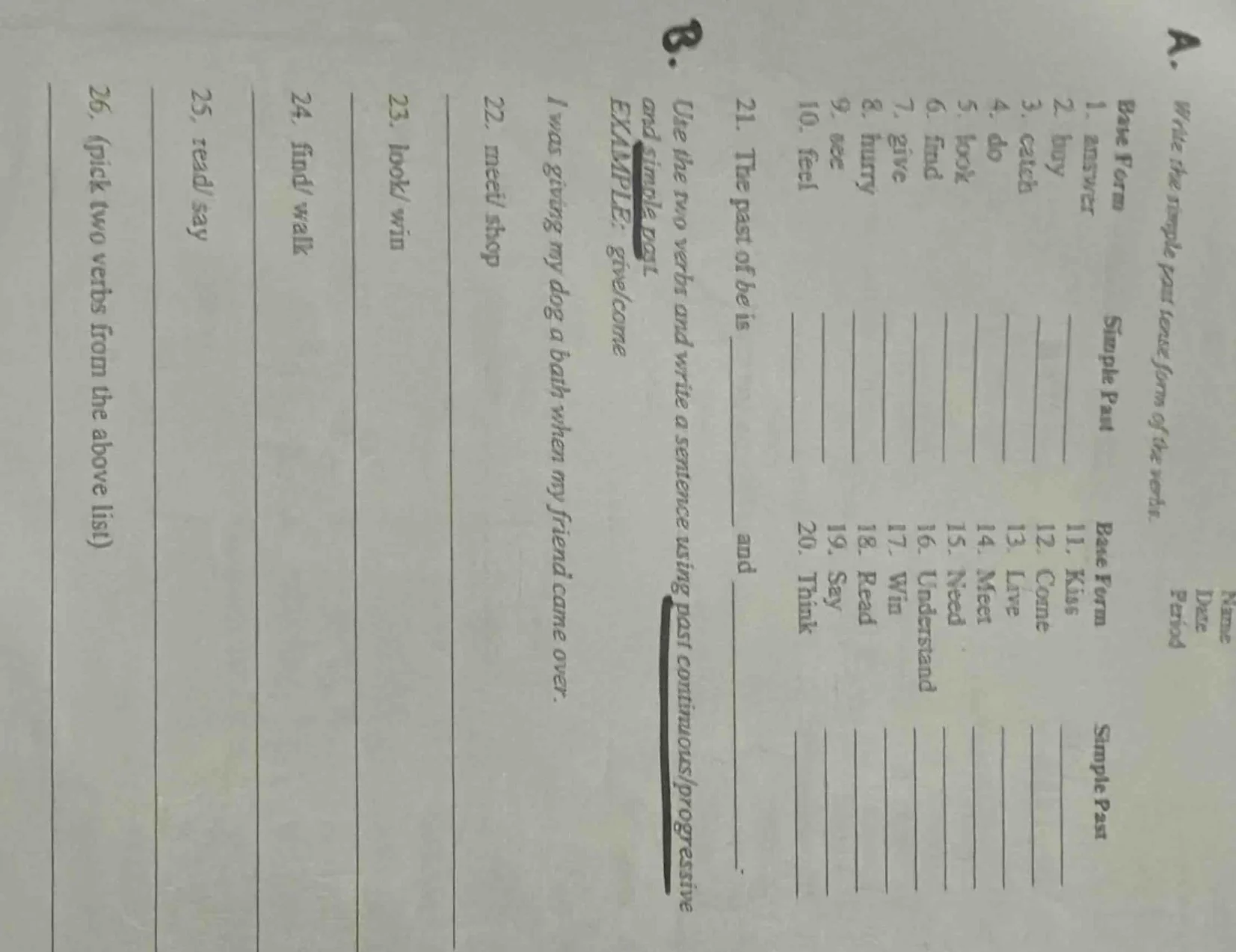
a. write the simple past tense form of the verb.
base form\tsimple past\tbase form\tsimple past
- answer\t\t11. kiss\t
- buy\t\t12. come\t
- catch\t\t13. live\t
- do\t\t14. meet\t
- book\t\t15. need\t
- find\t\t16. understand\t
- give\t\t17. win\t
- hurry\t\t18. read\t
- see\t\t19. say\t
- feel\t\t20. think\t
- the past of be is ____ and ____.
b. use the two verbs and write a sentence using past continuous/progressive and simple past.
example: give/come
i was giving my dog a bath when my friend came over.
- meet/ shop
- look/ win
- find/ walk
- read/ say
- (pick two verbs from the above list)
Part A: Writing Simple Past Tense of Verbs
1. Answer
Base Form: answer
Simple Past: answered
2. Buy
Base Form: buy
Simple Past: bought
3. Catch
Base Form: catch
Simple Past: caught
4. Do
Base Form: do
Simple Past: did
5. Book
Base Form: book
Simple Past: booked
6. Find
Base Form: find
Simple Past: found
7. Give
Base Form: give
Simple Past: gave
8. Hurry
Base Form: hurry
Simple Past: hurried
9. See
Base Form: see
Simple Past: saw
10. Feel
Base Form: feel
Simple Past: felt
11. Kiss
Base Form: kiss
Simple Past: kissed
12. Come
Base Form: come
Simple Past: came
13. Live
Base Form: live
Simple Past: lived
14. Meet
Base Form: meet
Simple Past: met
15. Need
Base Form: need
Simple Past: needed
16. Understand
Base Form: understand
Simple Past: understood
17. Win
Base Form: win
Simple Past: won
18. Read
Base Form: read
Simple Past: read (pronounced /red/)
19. Say
Base Form: say
Simple Past: said
20. Think
Base Form: think
Simple Past: thought
Part B: Using Verbs in Past Continuous/Progressive + Simple Past
21. The past of “be” is was (for singular subjects: I, he, she, it) and were (for plural subjects: we, you, they).
22. Meet/Shop
Sentence: I was shopping when I met my friend at the mall.
23. Look/Win
Sentence: She was looking at the game when her team won.
24. Find/Walk
Sentence: He was walking in the park when he found a lost dog.
25. Read/Say
Sentence: I was reading a book when my teacher said it was time to stop.
26. Pick two verbs (e.g., “give” and “come” from the example):
Sentence: I was giving my dog a bath when my friend came over. (matches the example structure)
Key Notes:
- Simple Past: Irregular verbs (e.g., buy → bought, do → did) follow unique patterns, while regular verbs add -ed (e.g., book → booked).
- Past Continuous: Uses “was/were + verb-ing” to show an ongoing action interrupted by a simple past event (e.g., was shopping + met).

Snap & solve any problem in the app
Get step-by-step solutions on Sovi AI
Photo-based solutions with guided steps
Explore more problems and detailed explanations
Part A: Writing Simple Past Tense of Verbs
1. Answer
Base Form: answer
Simple Past: answered
2. Buy
Base Form: buy
Simple Past: bought
3. Catch
Base Form: catch
Simple Past: caught
4. Do
Base Form: do
Simple Past: did
5. Book
Base Form: book
Simple Past: booked
6. Find
Base Form: find
Simple Past: found
7. Give
Base Form: give
Simple Past: gave
8. Hurry
Base Form: hurry
Simple Past: hurried
9. See
Base Form: see
Simple Past: saw
10. Feel
Base Form: feel
Simple Past: felt
11. Kiss
Base Form: kiss
Simple Past: kissed
12. Come
Base Form: come
Simple Past: came
13. Live
Base Form: live
Simple Past: lived
14. Meet
Base Form: meet
Simple Past: met
15. Need
Base Form: need
Simple Past: needed
16. Understand
Base Form: understand
Simple Past: understood
17. Win
Base Form: win
Simple Past: won
18. Read
Base Form: read
Simple Past: read (pronounced /red/)
19. Say
Base Form: say
Simple Past: said
20. Think
Base Form: think
Simple Past: thought
Part B: Using Verbs in Past Continuous/Progressive + Simple Past
21. The past of “be” is was (for singular subjects: I, he, she, it) and were (for plural subjects: we, you, they).
22. Meet/Shop
Sentence: I was shopping when I met my friend at the mall.
23. Look/Win
Sentence: She was looking at the game when her team won.
24. Find/Walk
Sentence: He was walking in the park when he found a lost dog.
25. Read/Say
Sentence: I was reading a book when my teacher said it was time to stop.
26. Pick two verbs (e.g., “give” and “come” from the example):
Sentence: I was giving my dog a bath when my friend came over. (matches the example structure)
Key Notes:
- Simple Past: Irregular verbs (e.g., buy → bought, do → did) follow unique patterns, while regular verbs add -ed (e.g., book → booked).
- Past Continuous: Uses “was/were + verb-ing” to show an ongoing action interrupted by a simple past event (e.g., was shopping + met).