QUESTION IMAGE
Question
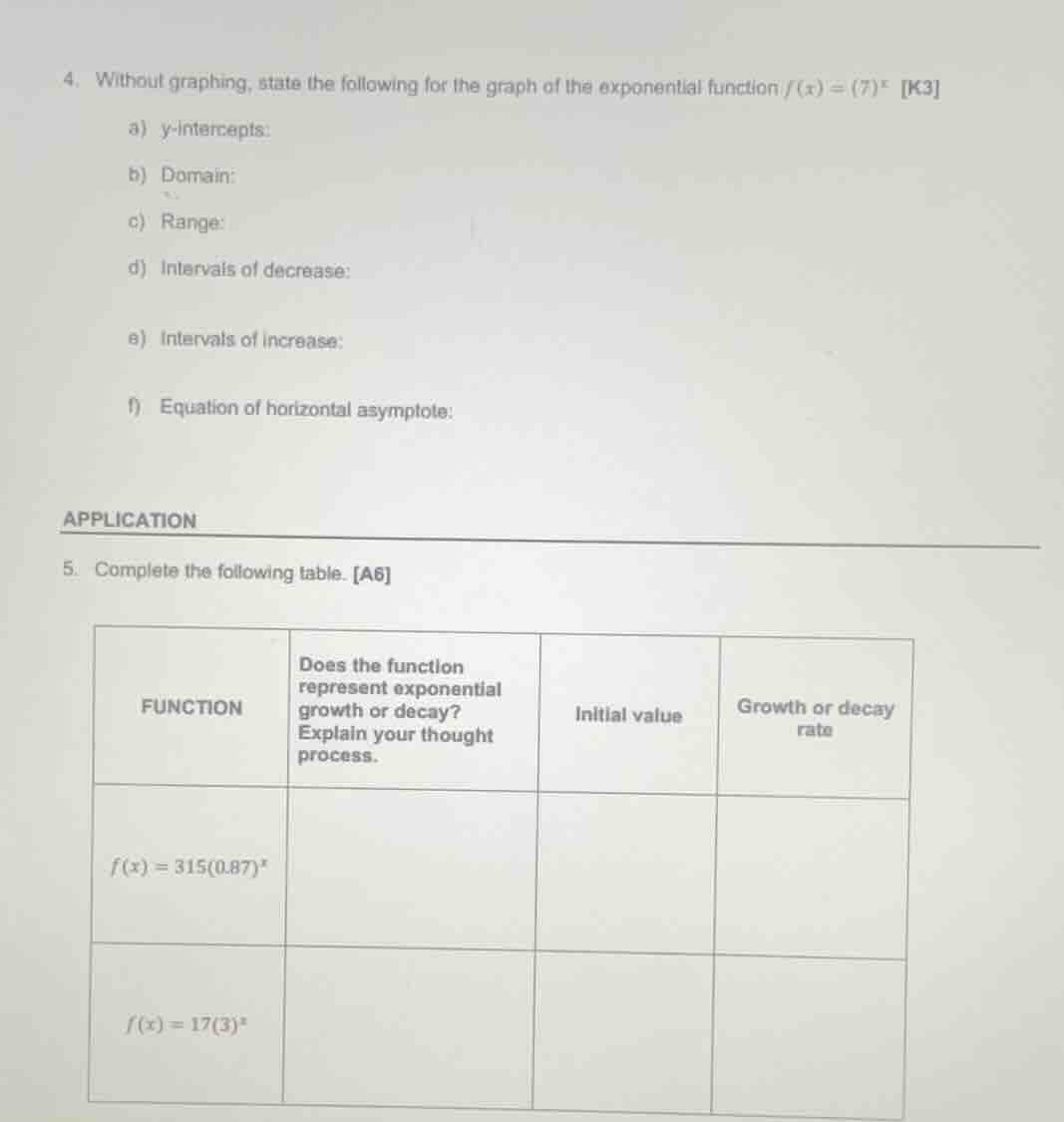
- without graphing, state the following for the graph of the exponential function \\(f(x) = (7)^x\\) k3
a) y-intercepts:
b) domain:
c) range:
d) intervals of decrease:
e) intervals of increase:
f) equation of horizontal asymptote:
application
- complete the following table. a6
| function | does the function represent exponential growth or decay? explain your thought process. | initial value | growth or decay rate |
|---|---|---|---|
| \\(f(x) = 17(3)^x\\) |
Analyze the exponential function properties
Using the Exponent Rules knowledge point, we analyze the function \(f(x) = (7)^x\).
- The y-intercept occurs when \(x = 0\):
So, the y-intercept is \((0, 1)\).
- The domain of any basic exponential function \(f(x) = b^x\) (where \(b > 0\)) is all real numbers:
- Since \(7^x > 0\) for all real \(x\), the range is:
- Since the base \(b = 7 > 1\), the function is strictly increasing.
- Interval of decrease: None
- Interval of increase: \((-\infty, \infty)\)
- As \(x \to -\infty\), \(7^x \to 0\). Thus, the horizontal asymptote is:
Analyze the first table row
We analyze the function \(f(x) = 315(0.87)^x\), which is in the form \(f(x) = a(b)^x\).
- Growth or Decay: Since the base \(b = 0.87\) is between \(0\) and \(1\) (\(0 < b < 1\)), it represents exponential decay.
- Initial Value: The initial value \(a\) is the value when \(x = 0\):
- Growth or Decay Rate: The decay rate \(r\) is found using \(b = 1 - r\):
Analyze the second table row
We analyze the function \(f(x) = 17(3)^x\), which is in the form \(f(x) = a(b)^x\).
- Growth or Decay: Since the base \(b = 3\) is greater than \(1\) (\(b > 1\)), it represents exponential growth.
- Initial Value: The initial value \(a\) is the value when \(x = 0\):
- Growth or Decay Rate: The growth rate \(r\) is found using \(b = 1 + r\):

Snap & solve any problem in the app
Get step-by-step solutions on Sovi AI
Photo-based solutions with guided steps
Explore more problems and detailed explanations
Question 4
a) y-intercept: \((0, 1)\) (or \(y = 1\))
b) Domain: \((-\infty, \infty)\) (or \(\{x \in \mathbb{R}\}\))
c) Range: \((0, \infty)\) (or \(\{y \in \mathbb{R} \mid y > 0\}\))
d) Intervals of decrease: None
e) Intervals of increase: \((-\infty, \infty)\)
f) Equation of horizontal asymptote: \(y = 0\)
Question 5
| FUNCTION | Does the function represent exponential growth or decay? Explain your thought process. | Initial value | Growth or decay rate |
|---|---|---|---|
| \(f(x) = 17(3)^x\) | Growth, because the base \(3\) is greater than \(1\). | \(17\) | \(200\%\) growth rate (since \(3 - 1 = 2\)) |