QUESTION IMAGE
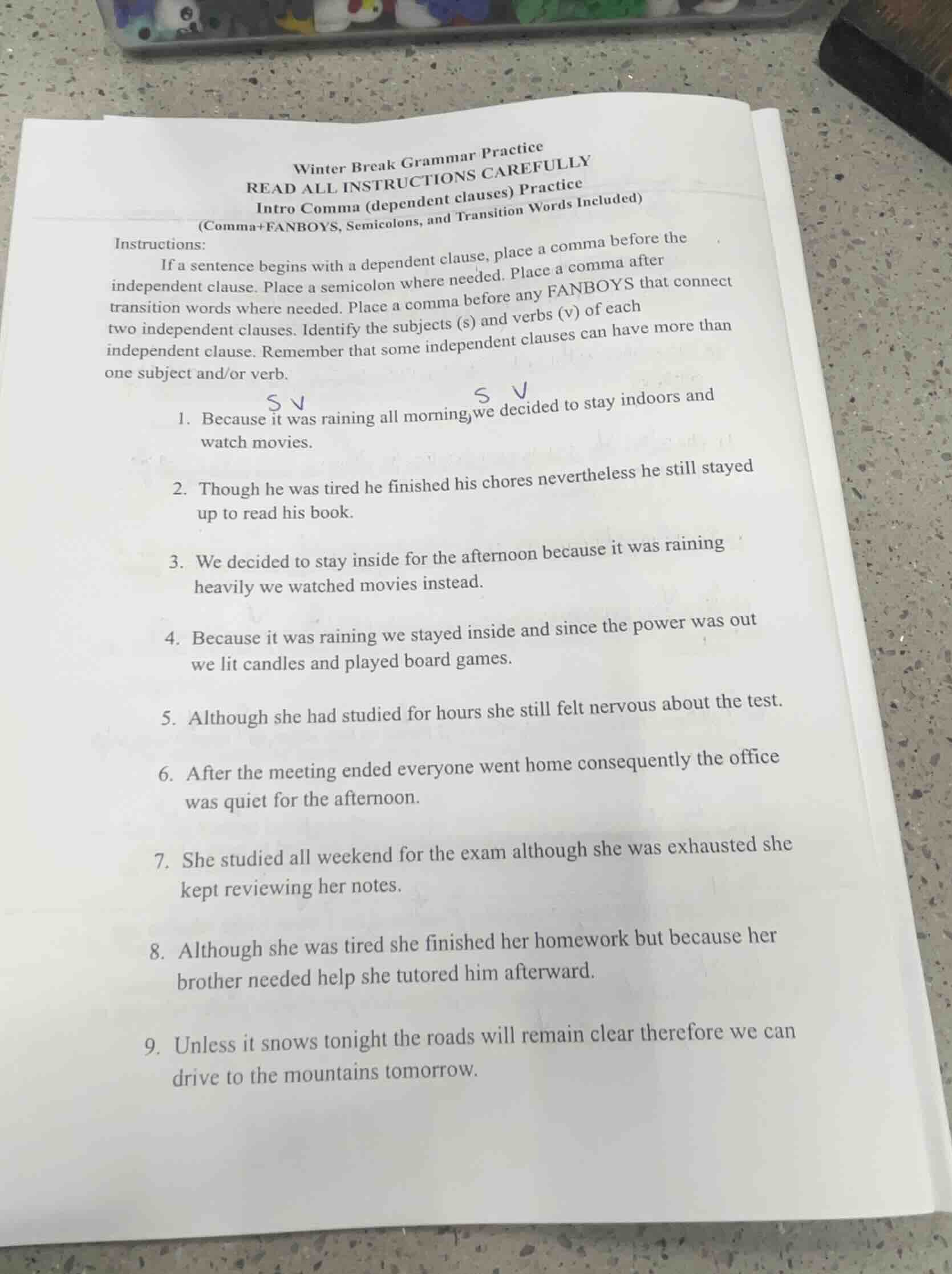
Question
winter break grammar practice
read all instructions carefully
intro comma (dependent clauses) practice
(comma+fanboys, semicolons, and transition words included)
instructions:
if a sentence begins with a dependent clause, place a comma before the
independent clause. place a semicolon where needed. place a comma after
transition words where needed. place a comma before any fanboys that connect
two independent clauses. identify the subjects (s) and verbs (v) of each
independent clause. remember that some independent clauses can have more than
one subject and/or verb.
- because it was raining all morning we decided to stay indoors and
watch movies.
- though he was tired he finished his chores nevertheless he still stayed
up to read his book.
- we decided to stay inside for the afternoon because it was raining
heavily we watched movies instead.
- because it was raining we stayed inside and since the power was out
we lit candles and played board games.
- although she had studied for hours she still felt nervous about the test.
- after the meeting ended everyone went home consequently the office
was quiet for the afternoon.
- she studied all weekend for the exam although she was exhausted she
kept reviewing her notes.
- although she was tired she finished her homework but because her
brother needed help she tutored him afterward.
- unless it snows tonight the roads will remain clear therefore we can
drive to the mountains tomorrow.
Let's solve these grammar problems one by one by following the instructions (placing commas, semicolons, identifying subjects (s) and verbs (v) of independent clauses):
Problem 1:
- Original: Because it was raining all morning we decided to stay indoors and watch movies.
- Analysis: The sentence starts with a dependent clause ("Because it was raining all morning"). So we place a comma after the dependent clause, before the independent clause. Also, identify subjects and verbs:
- Dependent clause: subject (it), verb (was raining)
- Independent clause: subject (we), verb (decided, watch)
- Corrected: Because it was raining all morning, we decided to stay indoors and watch movies.
(s: it (dependent), we (independent); v: was raining (dependent), decided, watch (independent))
Problem 2:
- Original: Though he was tired he finished his chores nevertheless he still stayed up to read his book.
- Analysis:
- "Though he was tired" is a dependent clause, so place a comma after it.
- "nevertheless" is a transition word, and we have two independent clauses here: "he finished his chores" and "he still stayed up to read his book". So we can use a semicolon before "nevertheless" (or rephrase, but following the instruction, place semicolon where needed between independent clauses connected by transition words). Also, identify subjects and verbs:
- Dependent clause: subject (he), verb (was)
- Independent clause 1: subject (he), verb (finished)
- Independent clause 2: subject (he), verb (stayed, read)
- Corrected: Though he was tired, he finished his chores; nevertheless, he still stayed up to read his book.
(s: he (dependent), he (independent 1), he (independent 2); v: was (dependent), finished (independent 1), stayed, read (independent 2))
Problem 3:
- Original: We decided to stay inside for the afternoon because it was raining heavily we watched movies instead.
- Analysis:
- "because it was raining heavily" is a dependent clause (but it's in the middle here? Wait, no, the two independent clauses are "We decided to stay inside for the afternoon" and "we watched movies instead", with a dependent clause in between. Wait, actually, the structure has two independent clauses: "We decided to stay inside for the afternoon" and "we watched movies instead", with a dependent clause "because it was raining heavily" (but maybe the main issue is separating the two independent clauses. So we use a semicolon between "heavily" and "we" since they are two independent clauses. Also, identify subjects and verbs:
- Independent clause 1: subject (we), verb (decided)
- Dependent clause: subject (it), verb (was raining)
- Independent clause 2: subject (we), verb (watched)
- Corrected: We decided to stay inside for the afternoon because it was raining heavily; we watched movies instead.
(s: we (independent 1), it (dependent), we (independent 2); v: decided (independent 1), was raining (dependent), watched (independent 2))
Problem 4:
- Original: Because it was raining we stayed inside and since the power was out we lit candles and played board games.
- Analysis:
- Two dependent clauses: "Because it was raining" and "since the power was out". So place commas after each dependent clause, and separate the two independent clauses ("we stayed inside" and "we lit candles and played board games")? Wait, no, the structure is: Dependent clause 1 + independent clause 1 + Dependent clause 2 + independent clause 2. So:
- After "Because it was raining", place a comma.
- After…

Snap & solve any problem in the app
Get step-by-step solutions on Sovi AI
Photo-based solutions with guided steps
Explore more problems and detailed explanations
Let's solve these grammar problems one by one by following the instructions (placing commas, semicolons, identifying subjects (s) and verbs (v) of independent clauses):
Problem 1:
- Original: Because it was raining all morning we decided to stay indoors and watch movies.
- Analysis: The sentence starts with a dependent clause ("Because it was raining all morning"). So we place a comma after the dependent clause, before the independent clause. Also, identify subjects and verbs:
- Dependent clause: subject (it), verb (was raining)
- Independent clause: subject (we), verb (decided, watch)
- Corrected: Because it was raining all morning, we decided to stay indoors and watch movies.
(s: it (dependent), we (independent); v: was raining (dependent), decided, watch (independent))
Problem 2:
- Original: Though he was tired he finished his chores nevertheless he still stayed up to read his book.
- Analysis:
- "Though he was tired" is a dependent clause, so place a comma after it.
- "nevertheless" is a transition word, and we have two independent clauses here: "he finished his chores" and "he still stayed up to read his book". So we can use a semicolon before "nevertheless" (or rephrase, but following the instruction, place semicolon where needed between independent clauses connected by transition words). Also, identify subjects and verbs:
- Dependent clause: subject (he), verb (was)
- Independent clause 1: subject (he), verb (finished)
- Independent clause 2: subject (he), verb (stayed, read)
- Corrected: Though he was tired, he finished his chores; nevertheless, he still stayed up to read his book.
(s: he (dependent), he (independent 1), he (independent 2); v: was (dependent), finished (independent 1), stayed, read (independent 2))
Problem 3:
- Original: We decided to stay inside for the afternoon because it was raining heavily we watched movies instead.
- Analysis:
- "because it was raining heavily" is a dependent clause (but it's in the middle here? Wait, no, the two independent clauses are "We decided to stay inside for the afternoon" and "we watched movies instead", with a dependent clause in between. Wait, actually, the structure has two independent clauses: "We decided to stay inside for the afternoon" and "we watched movies instead", with a dependent clause "because it was raining heavily" (but maybe the main issue is separating the two independent clauses. So we use a semicolon between "heavily" and "we" since they are two independent clauses. Also, identify subjects and verbs:
- Independent clause 1: subject (we), verb (decided)
- Dependent clause: subject (it), verb (was raining)
- Independent clause 2: subject (we), verb (watched)
- Corrected: We decided to stay inside for the afternoon because it was raining heavily; we watched movies instead.
(s: we (independent 1), it (dependent), we (independent 2); v: decided (independent 1), was raining (dependent), watched (independent 2))
Problem 4:
- Original: Because it was raining we stayed inside and since the power was out we lit candles and played board games.
- Analysis:
- Two dependent clauses: "Because it was raining" and "since the power was out". So place commas after each dependent clause, and separate the two independent clauses ("we stayed inside" and "we lit candles and played board games")? Wait, no, the structure is: Dependent clause 1 + independent clause 1 + Dependent clause 2 + independent clause 2. So:
- After "Because it was raining", place a comma.
- After "since the power was out", place a comma.
- Also, identify subjects and verbs:
- Dependent clause 1: subject (it), verb (was raining)
- Independent clause 1: subject (we), verb (stayed)
- Dependent clause 2: subject (power), verb (was)
- Independent clause 2: subject (we), verb (lit, played)
- Corrected: Because it was raining, we stayed inside and since the power was out, we lit candles and played board games.
(s: it (dependent 1), we (independent 1), power (dependent 2), we (independent 2); v: was raining (dependent 1), stayed (independent 1), was (dependent 2), lit, played (independent 2))
Problem 5:
- Original: Although she had studied for hours she still felt nervous about the test.
- Analysis: "Although she had studied for hours" is a dependent clause, so place a comma after it. Identify subjects and verbs:
- Dependent clause: subject (she), verb (had studied)
- Independent clause: subject (she), verb (felt)
- Corrected: Although she had studied for hours, she still felt nervous about the test.
(s: she (dependent), she (independent); v: had studied (dependent), felt (independent))
Problem 6:
- Original: After the meeting ended everyone went home consequently the office was quiet for the afternoon.
- Analysis:
- "After the meeting ended" is a dependent clause, place a comma after it.
- "consequently" is a transition word, and we have two independent clauses: "everyone went home" and "the office was quiet for the afternoon". So use a semicolon before "consequently". Also, identify subjects and verbs:
- Dependent clause: subject (meeting), verb (ended)
- Independent clause 1: subject (everyone), verb (went)
- Independent clause 2: subject (office), verb (was)
- Corrected: After the meeting ended, everyone went home; consequently, the office was quiet for the afternoon.
(s: meeting (dependent), everyone (independent 1), office (independent 2); v: ended (dependent), went (independent 1), was (independent 2))
Problem 7:
- Original: She studied all weekend for the exam although she was exhausted she kept reviewing her notes.
- Analysis:
- "although she was exhausted" is a dependent clause, place a comma after it.
- Two independent clauses: "She studied all weekend for the exam" and "she kept reviewing her notes". So use a semicolon before "although"? Wait, no, "although she was exhausted" is a dependent clause in the middle? Wait, the structure is: Independent clause 1 + Dependent clause + Independent clause 2. So:
- Independent clause 1: "She studied all weekend for the exam" (subject: she, verb: studied)
- Dependent clause: "although she was exhausted" (subject: she, verb: was)
- Independent clause 2: "she kept reviewing her notes" (subject: she, verb: kept, reviewing)
- So place a semicolon before the dependent clause? Wait, no, the dependent clause is "although she was exhausted", so we need to separate the two independent clauses. Wait, actually, the correct way is: She studied all weekend for the exam; although she was exhausted, she kept reviewing her notes. But maybe the instruction is to place comma after dependent clause, so:
- Wait, the original sentence: "She studied all weekend for the exam although she was exhausted she kept reviewing her notes." So the two independent clauses are "She studied all weekend for the exam" and "she kept reviewing her notes", with a dependent clause "although she was exhausted" in between. So we can place a semicolon after "exam" and a comma after "exhausted".
- Corrected: She studied all weekend for the exam; although she was exhausted, she kept reviewing her notes.
(s: she (independent 1), she (dependent), she (independent 2); v: studied (independent 1), was (dependent), kept, reviewing (independent 2))
Problem 8:
- Original: Although she was tired she finished her homework but because her brother needed help she tutored him afterward.
- Analysis:
- "Although she was tired" is a dependent clause, place a comma after it.
- "because her brother needed help" is a dependent clause, place a comma after it.
- "but" is a FANBOYS (coordinating conjunction) connecting two independent clauses: "she finished her homework" and "she tutored him afterward". So place a comma before "but". Also, identify subjects and verbs:
- Dependent clause 1: subject (she), verb (was)
- Independent clause 1: subject (she), verb (finished)
- Dependent clause 2: subject (brother), verb (needed)
- Independent clause 2: subject (she), verb (tutored)
- Corrected: Although she was tired, she finished her homework, but because her brother needed help, she tutored him afterward.
(s: she (dependent 1), she (independent 1), brother (dependent 2), she (independent 2); v: was (dependent 1), finished (independent 1), needed (dependent 2), tutored (independent 2))
Problem 9:
- Original: Unless it snows tonight the roads will remain clear therefore we can drive to the mountains tomorrow.
- Analysis:
- "Unless it snows tonight" is a dependent clause, place a comma after it.
- "therefore" is a transition word, and we have two independent clauses: "the roads will remain clear" and "we can drive to the mountains tomorrow". So use a semicolon before "therefore". Also, identify subjects and verbs:
- Dependent clause: subject (it), verb (snows)
- Independent clause 1: subject (roads), verb (will remain)
- Independent clause 2: subject (we), verb (can drive)
- Corrected: Unless it snows tonight, the roads will remain clear; therefore, we can drive to the mountains tomorrow.
(s: it (dependent), roads (independent 1), we (independent 2); v: snows (dependent), will remain (independent 1), can drive (independent 2))
Final Answers (Corrected Sentences with Punctuation and Subject-Verb Identification):
- Because it was raining all morning, we decided to stay indoors and watch movies.
(s: it, we; v: was raining, decided, watch)
- Though he was tired, he finished his chores; nevertheless, he still stayed up to read his book.
(s: he, he, he; v: was, finished, stayed, read)
- We decided to stay inside for the afternoon because it was raining heavily; we watched movies instead.
[SSE Completed, Client Connection Error][SSE onError error]