QUESTION IMAGE
Question
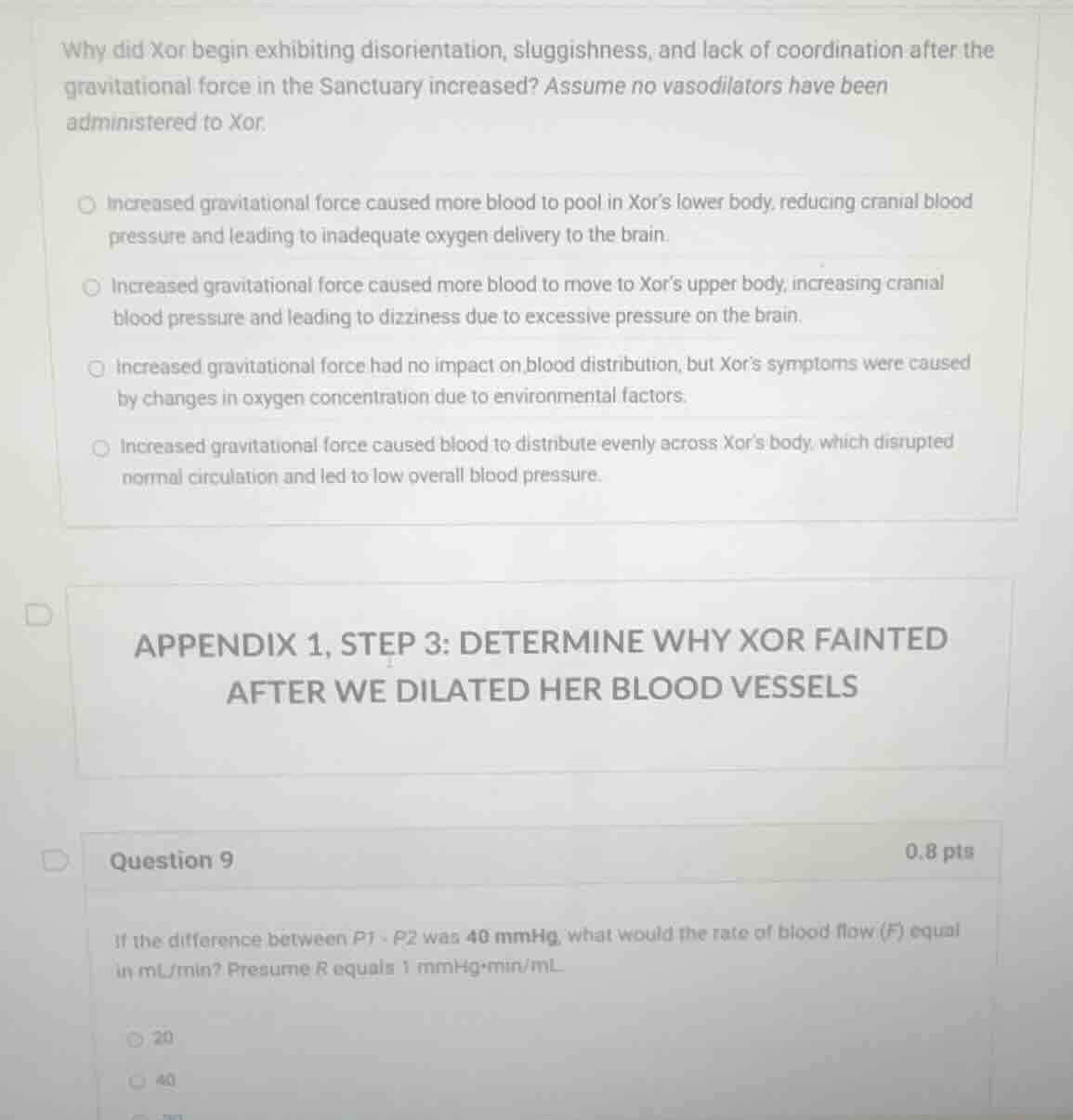
why did xor begin exhibiting disorientation, sluggishness, and lack of coordination after the gravitational force in the sanctuary increased? assume no vasodilators have been administered to xor.
- increased gravitational force caused more blood to pool in xors lower body, reducing cranial blood pressure and leading to inadequate oxygen delivery to the brain.
- increased gravitational force caused more blood to move to xors upper body, increasing cranial blood pressure and leading to dizziness due to excessive pressure on the brain.
- increased gravitational force had no impact on blood distribution, but xors symptoms were caused by changes in oxygen concentration due to environmental factors.
- increased gravitational force caused blood to distribute evenly across xors body, which disrupted normal circulation and led to low overall blood pressure.
appendix 1, step 3: determine why xor fainted after we dilated her blood vessels
question 9
0.8 pts
if the difference between \\(p_1 - p_2\\) was \\(40\text{ mmhg}\\), what would the rate of blood flow (\\(f\\)) equal in \text{ml/min}? presume \\(r\\) equals \\(1\text{ mmhg}\cdot\text{min/ml}\\).
- 20
- 40
Analyze gravity's effect on blood distribution
Using the Gravitational Physiology and Hydrostatic Pressure Gradient knowledge points
An increase in gravitational force acts downward on the body. This increases the hydrostatic pressure gradient, pulling mobile fluids (blood) toward the lowest parts of the body (pooling in the lower extremities).
Determine the physiological consequences of pooling
Using the Gravitational Physiology knowledge point
When blood pools in the lower body, venous return to the heart decreases, leading to a drop in cardiac output and arterial blood pressure. Consequently, cranial blood pressure drops, reducing oxygen delivery to the brain and causing disorientation, sluggishness, and lack of coordination. This matches the first option.
Apply hemodynamics formula for blood flow
Using the Hemodynamics and Ohm's Law of Blood Flow knowledge points
The relationship between blood flow \(F\), pressure difference \(\Delta P = P_1 - P_2\), and vascular resistance \(R\) is given by:
Calculate the rate of blood flow
Using the Hemodynamics knowledge point
Given \(\Delta P = 40\text{ mmHg}\) and \(R = 1\text{ mmHg}\cdot\text{min/mL}\):
This matches the option \(40\).

Snap & solve any problem in the app
Get step-by-step solutions on Sovi AI
Photo-based solutions with guided steps
Explore more problems and detailed explanations
Question 1
- (A) Increased gravitational force caused more blood to pool in Xor's lower body, reducing cranial blood pressure and leading to inadequate oxygen delivery to the brain. (Correct answer)
- (B) Increased gravitational force caused more blood to move to Xor's upper body, increasing cranial blood pressure and leading to dizziness due to excessive pressure on the brain.
- (C) Increased gravitational force had no impact on blood distribution, but Xor's symptoms were caused by changes in oxygen concentration due to environmental factors.
- (D) Increased gravitational force caused blood to distribute evenly across Xor's body, which disrupted normal circulation and led to low overall blood pressure.
Question 2
- (A) 20
- (B) 40 (Correct answer)