QUESTION IMAGE
Question
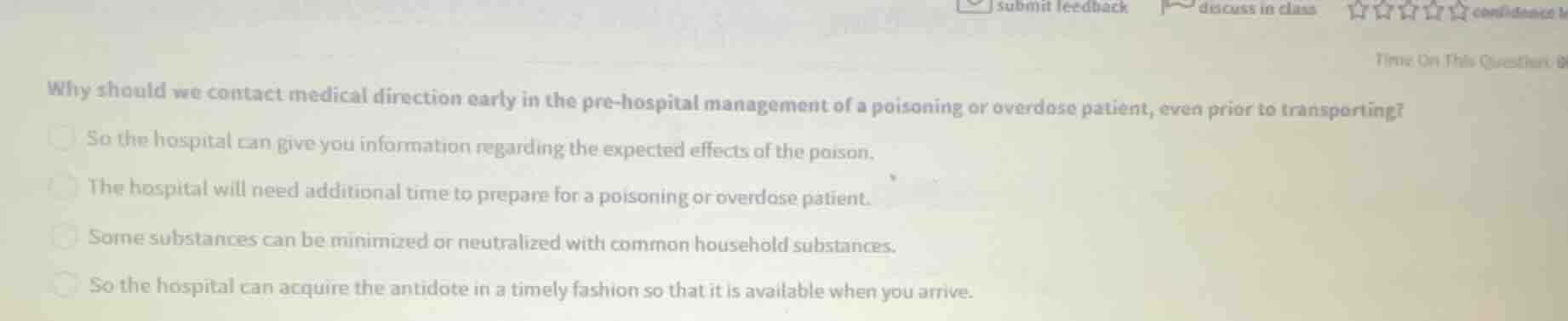
why should we contact medical direction early in the pre-hospital management of a poisoning or overdose patient, even prior to transporting?
so the hospital can give you information regarding the expected effects of the poison.
the hospital will need additional time to prepare for a poisoning or overdose patient.
some substances can be minimized or neutralized with common household substances.
so the hospital can acquire the antidote in a timely fashion so that it is available when you arrive.
Analyze the clinical scenario
In pre-hospital emergency care, managing a poisoning or overdose patient requires rapid coordination with medical direction and the receiving facility. Poisoning cases often involve specific toxins or drugs that have targeted antidotes (such as naloxone for opioids, acetylcysteine for acetaminophen, or physostigmine/atropine for specific toxidromes).
Evaluate the role of early notification
Contacting medical direction and the receiving hospital early—especially prior to transport—serves a critical logistical and therapeutic purpose. Many hospital pharmacies do not keep large quantities of rare antidotes readily available in the emergency department, or they may need to retrieve them from a central pharmacy or another unit. Early notification allows the hospital to locate, prepare, and have the specific antidote ready immediately upon the patient's arrival, minimizing treatment delays.
Assess the given options
- Option 1: "So the hospital can give you information regarding the expected effects of the poison." While information sharing occurs, EMS providers are already trained in toxidromes, and Poison Control is typically the primary source for detailed toxicological profiles rather than basic medical direction.
- Option 2: "The hospital will need additional time to prepare for a poisoning or overdose patient." This is too general; hospitals are always prepared to receive emergency patients. The specific bottleneck is the medication/antidote itself.
- Option 3: "Some substances can be minimized or neutralized with common household substances." Neutralizing poisons with household substances is generally outdated, dangerous, and contraindicated in modern pre-hospital protocols.
- Option 4: "So the hospital can acquire the antidote in a timely fashion so that it is available when you arrive." This directly addresses the critical clinical need for specific antidote preparation to prevent delays in definitive care.

Snap & solve any problem in the app
Get step-by-step solutions on Sovi AI
Photo-based solutions with guided steps
Explore more problems and detailed explanations
- (A) So the hospital can give you information regarding the expected effects of the poison.
- (B) The hospital will need additional time to prepare for a poisoning or overdose patient.
- (C) Some substances can be minimized or neutralized with common household substances.
- (D) So the hospital can acquire the antidote in a timely fashion so that it is available when you arrive. (Correct answer)