QUESTION IMAGE
Question
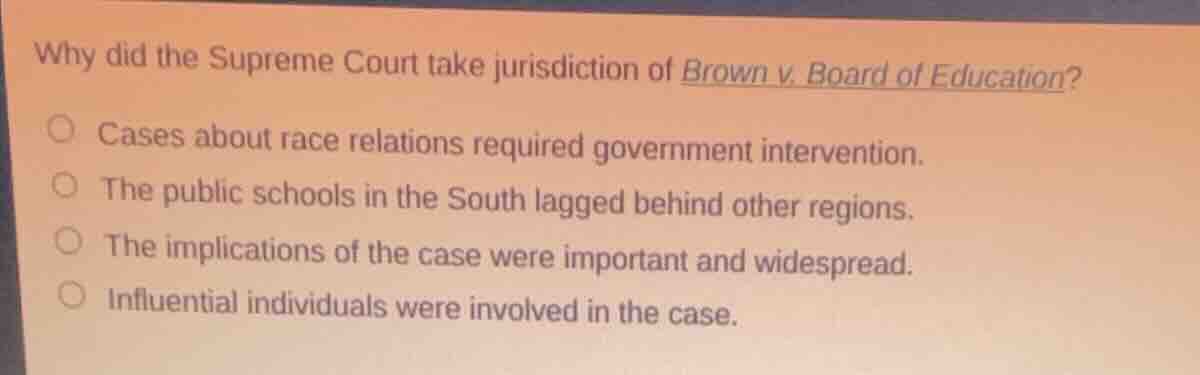
why did the supreme court take jurisdiction of brown v. board of education?
cases about race relations required government intervention.
the public schools in the south lagged behind other regions.
the implications of the case were important and widespread.
influential individuals were involved in the case.
Understand the Supreme Court's role
The Supreme Court of the United States is selective about the cases it hears. Under its appellate jurisdiction, it typically grants a writ of certiorari only for cases that present significant federal constitutional questions or have broad national implications.
Analyze the case of Brown v. Board of Education
Brown v. Board of Education (1954) challenged the constitutionality of state-sponsored racial segregation in public schools under the Equal Protection Clause of the Fourteenth Amendment. This issue affected millions of students and families across multiple states, making its legal and social implications exceptionally widespread and important.
Evaluate the given options
- Option 1: "Cases about race relations required government intervention." This is too broad and legally imprecise; the Court addresses specific constitutional violations rather than general social relations.
- Option 2: "The public schools in the South lagged behind other regions." While educational disparities existed, the Court's jurisdiction was based on the constitutional question of segregation ("separate but equal"), not regional academic performance.
- Option 3: "The implications of the case were important and widespread." This aligns directly with the criteria the Supreme Court uses to select cases of national significance that require a definitive constitutional ruling.
- Option 4: "Influential individuals were involved in the case." The Court does not take cases based on the personal influence of the individuals involved, but rather on the legal questions presented.

Snap & solve any problem in the app
Get step-by-step solutions on Sovi AI
Photo-based solutions with guided steps
Explore more problems and detailed explanations
- (A) Cases about race relations required government intervention.
- (B) The public schools in the South lagged behind other regions.
- (C) The implications of the case were important and widespread. (Correct answer)
- (D) Influential individuals were involved in the case.