QUESTION IMAGE
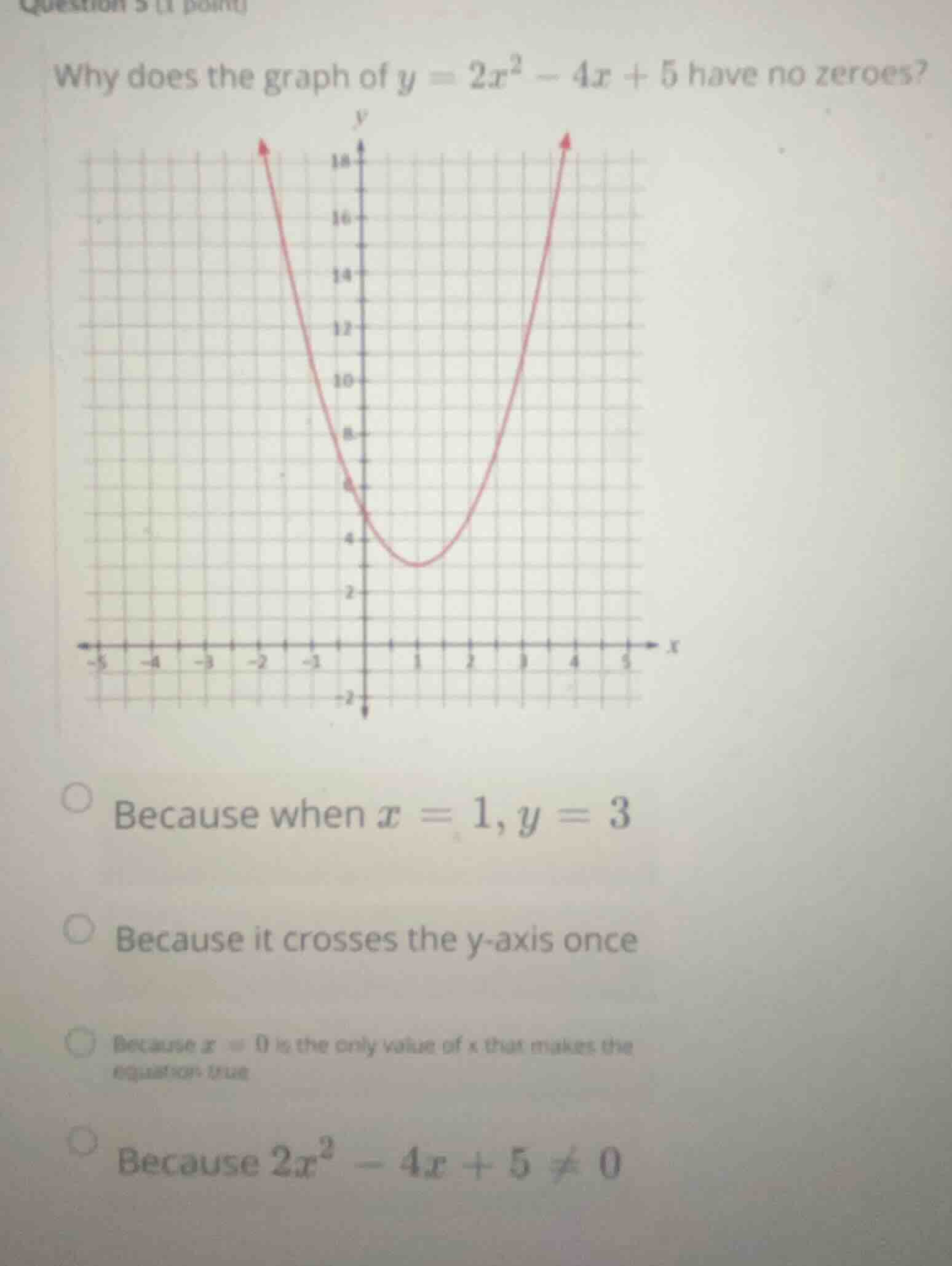
Question
why does the graph of (y = 2x^2 - 4x + 5) have no zeroes?
because when (x = 1, y = 3)
because it crosses the y-axis once
because (x = 0) is the only value of x that makes the equation true
because (2x^2 - 4x + 5 \
eq 0)
Identify the definition of zeroes
Using the Quadratic Relations knowledge point
$$
\text{Zeroes of } y = f(x) \text{ occur where } f(x) = 0.
$$
Analyze the given equation
Using the Quadratic Relations knowledge point
$$
y = 2x^2 - 4x + 5
$$
Evaluate the condition for no zeroes
Using the Quadratic Relations knowledge point
$$
2x^2 - 4x + 5
eq 0 \quad \forall x \in \mathbb{R}
$$
Match with the given options
Using the Quadratic Relations knowledge point
$$
\text{Option 4: "Because } 2x^2 - 4x + 5
eq 0\text{" matches the algebraic condition.}
$$

Snap & solve any problem in the app
Get step-by-step solutions on Sovi AI
Photo-based solutions with guided steps
Explore more problems and detailed explanations
- Because when \(x = 1, y = 3\)
- Because it crosses the y-axis once
- Because \(x = 0\) is the only value of x that makes the equation true
- **Because \(2x^2 - 4x + 5
eq 0\) (Correct answer)**