QUESTION IMAGE
Question
why government?
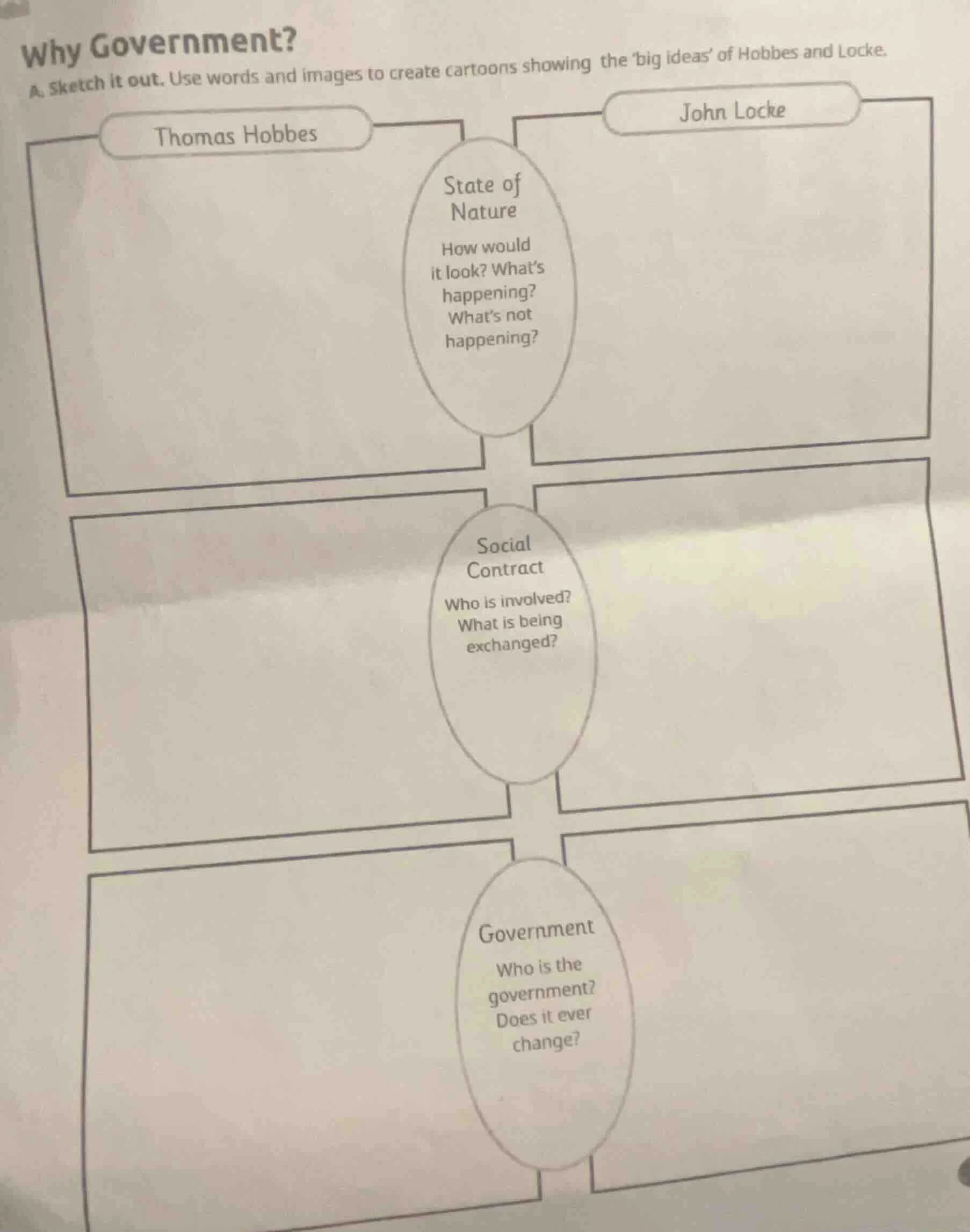
a. sketch it out. use words and images to create cartoons showing the big ideas of hobbes and locke.
thomas hobbes john locke
state of
nature
how would
it look? whats
happening?
whats not
happening?
social
contract
who is involved?
what is being
exchanged?
government
who is the
government?
does it ever
change?
Brief Explanations
This outlines the core contrasting ideas of Hobbes and Locke:
- Hobbes viewed the pre-government state as a violent, lawless chaos, justifying an absolute, unchallengeable monarch to impose order.
- Locke saw the pre-government state as mostly peaceful, with inherent natural rights, leading to a limited, elected government that can be replaced if it fails to protect those rights. The images visualize each thinker's core assumptions about human nature and the role of government.

Snap & solve any problem in the app
Get step-by-step solutions on Sovi AI
Photo-based solutions with guided steps
Explore more problems and detailed explanations
Thomas Hobbes
- State of Nature:
- Image: A chaotic scene with people fighting over food, weapons drawn, no shared spaces or cooperation.
- Words: "War of all against all" — constant violence, no safety, no property rights, no trust. No organized trade, laws, or community support.
- Social Contract:
- Image: A group of people handing over swords to a single, towering figure (a monarch).
- Words: People + Absolute Monarch. People give up all individual power/rights; monarch provides safety/order.
- Government:
- Image: An unchallenged, crowned ruler on a throne, with no checks on their power.
- Words: Absolute monarch (single ruler). No legal right to overthrow; government is permanent unless ruler fails to protect safety (rarely justifiable).
John Locke
- State of Nature:
- Image: People farming, trading goods, and helping each other, with occasional small conflicts.
- Words: Peaceful, free, equal. People have natural rights (life, liberty, property). No formal laws, so conflicts are resolved informally but can turn messy. No centralized protection of rights.
- Social Contract:
- Image: People signing a document together, with a small group of elected officials standing nearby.
- Words: People + Elected Leaders. People give up small amounts of power to leaders; leaders protect natural rights.
- Government:
- Image: Elected leaders meeting in a council, with a door labeled "Recall" on the wall.
- Words: Elected representative government. Government can be overthrown if it violates natural rights (fails its core purpose).