QUESTION IMAGE
Question
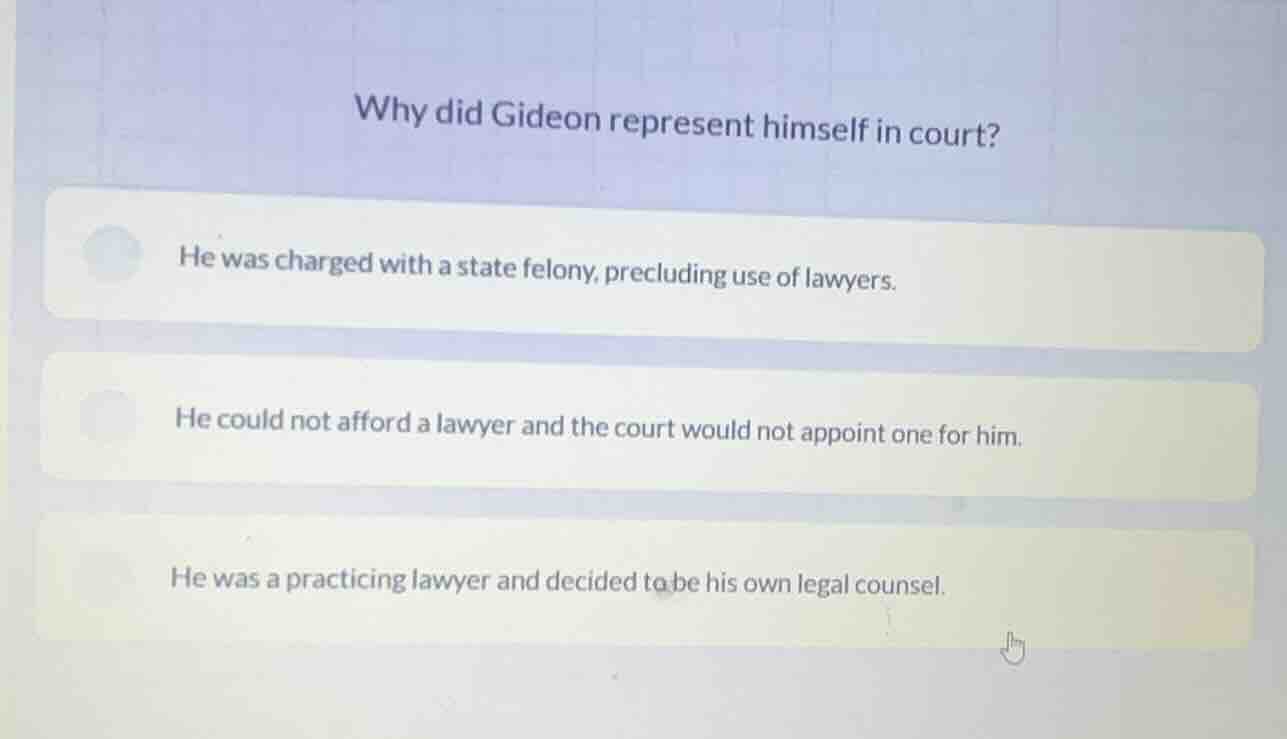
why did gideon represent himself in court?
he was charged with a state felony, precluding use of lawyers.
he could not afford a lawyer and the court would not appoint one for him.
he was a practicing lawyer and decided to be his own legal counsel.
Analyze the historical context of Gideon v. Wainwright
Using the Gideon v. Wainwright and Right to Counsel knowledge points
Clarence Earl Gideon was charged with breaking and entering in Florida, which was a state felony. At his trial in 1961, he requested that the court appoint an attorney to represent him because he was indigent and could not afford legal counsel.
Evaluate the court's response and Florida law
Using the Right to Counsel knowledge point
Under Florida state law at the time, the court was only required to appoint counsel for indigent defendants in capital (death penalty) cases. Because Gideon's charge was a non-capital felony, the trial judge denied his request for a court-appointed lawyer.
Determine the reason for self-representation
Using the Gideon v. Wainwright knowledge point
Because Gideon lacked the financial means to hire a private attorney and the state court refused to appoint one for him, he was forced to represent himself at his trial, which ultimately led to his conviction and his subsequent landmark appeal to the Supreme Court.

Snap & solve any problem in the app
Get step-by-step solutions on Sovi AI
Photo-based solutions with guided steps
Explore more problems and detailed explanations
- (A) He was charged with a state felony, precluding use of lawyers.
- (B) He could not afford a lawyer and the court would not appoint one for him. (Correct answer)
- (C) He was a practicing lawyer and decided to be his own legal counsel.