QUESTION IMAGE
Question
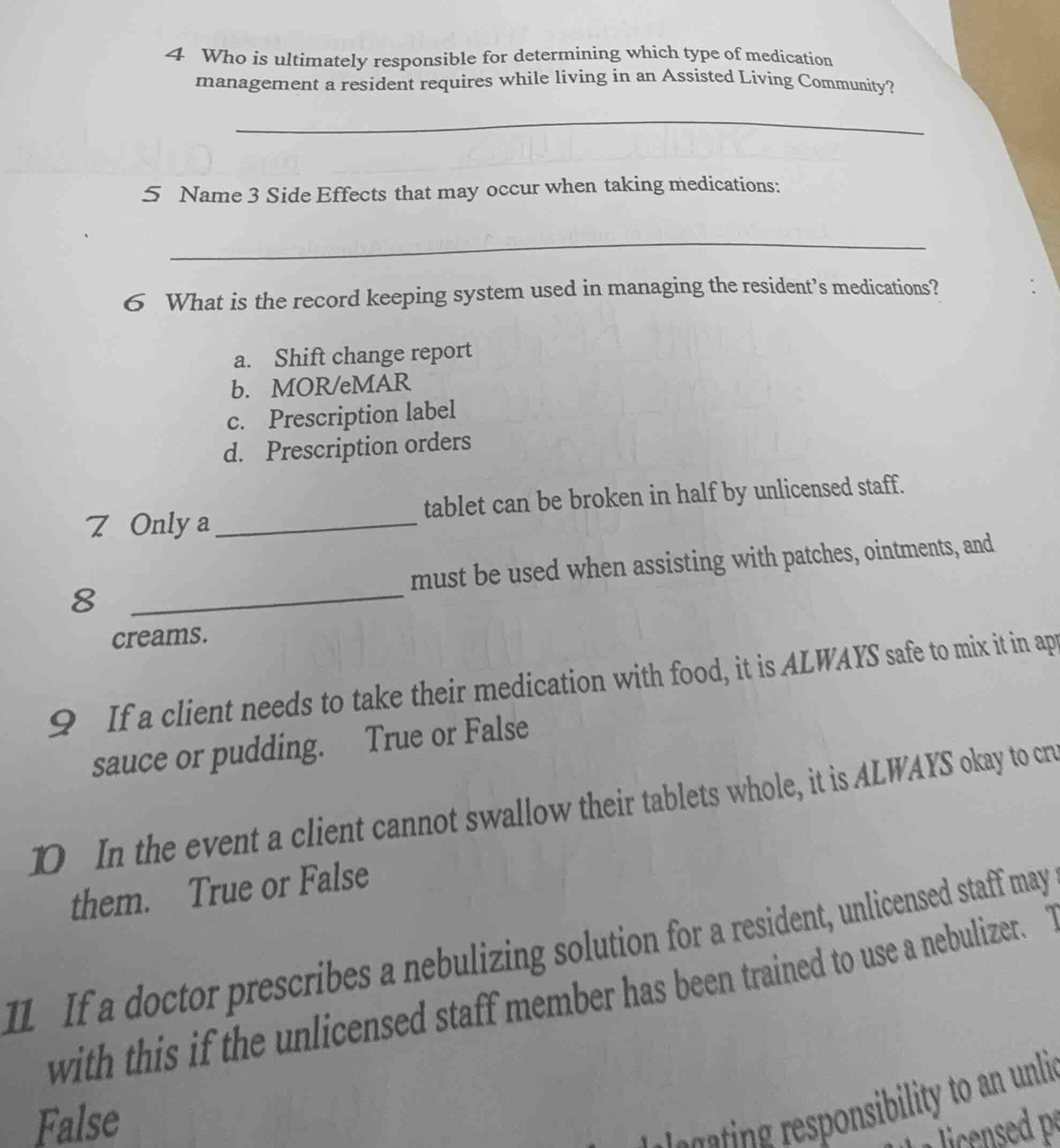
4 who is ultimately responsible for determining which type of medication management a resident requires while living in an assisted living community?
5 name 3 side effects that may occur when taking medications:
6 what is the record keeping system used in managing the residents medications?
a. shift change report
b. mor/emar
c. prescription label
d. prescription orders
7 only a \\_\\_\\_\\_\\_\\_\\_\\_\\_\\_ tablet can be broken in half by unlicensed staff.
8 \\_\\_\\_\\_\\_\\_\\_\\_\\_\\_ must be used when assisting with patches, ointments, and creams.
9 if a client needs to take their medication with food, it is always safe to mix it in applesauce or pudding. true or false
10 in the event a client cannot swallow their tablets whole, it is always okay to crush them. true or false
11 if a doctor prescribes a nebulizing solution for a resident, unlicensed staff may assist with this if the unlicensed staff member has been trained to use a nebulizer. true or false
Identify regulatory responsibilities
Under Assisted Living Facility Regulations, a resident's licensed healthcare practitioner (physician) is ultimately responsible for determining the level of medication assistance or management required.
List common side effects
Using Medication Management principles, common side effects of medications include nausea, drowsiness, and dizziness.
Determine record keeping system
The standard system for documenting medication administration in assisted living is the Medication Observation Record (MOR) or Electronic Medication Administration Record (eMAR).
Identify tablet splitting rules
Only a scored tablet can be broken in half by unlicensed staff, as scoring ensures equal active ingredient distribution.
Identify topical application safety
Gloves must be worn when assisting with transdermal patches, ointments, and creams to prevent accidental absorption by staff.
Evaluate food mixing safety
Mixing medications with food is not always safe; some drugs interact with specific foods or require precise delivery. Thus, the statement is False.
Evaluate tablet crushing safety
Crushing is not always safe, especially for extended-release or enteric-coated tablets. Thus, the statement is False.
Evaluate nebulizer delegation safety
Unlicensed staff can only assist with nebulizers if the task is properly delegated by a licensed nurse and they are trained. Thus, the statement is True.

Snap & solve any problem in the app
Get step-by-step solutions on Sovi AI
Photo-based solutions with guided steps
Explore more problems and detailed explanations
Question 4
The resident's physician (or licensed healthcare practitioner).
Question 5
- Nausea
- Drowsiness
- Dizziness
Question 6
- a. Shift change report
- b. MOR/eMAR (Correct answer)
- c. Prescription label
- d. Prescription orders
Question 7
scored
Question 8
Gloves
Question 9
False
Question 10
False
Question 11
True