QUESTION IMAGE
Question
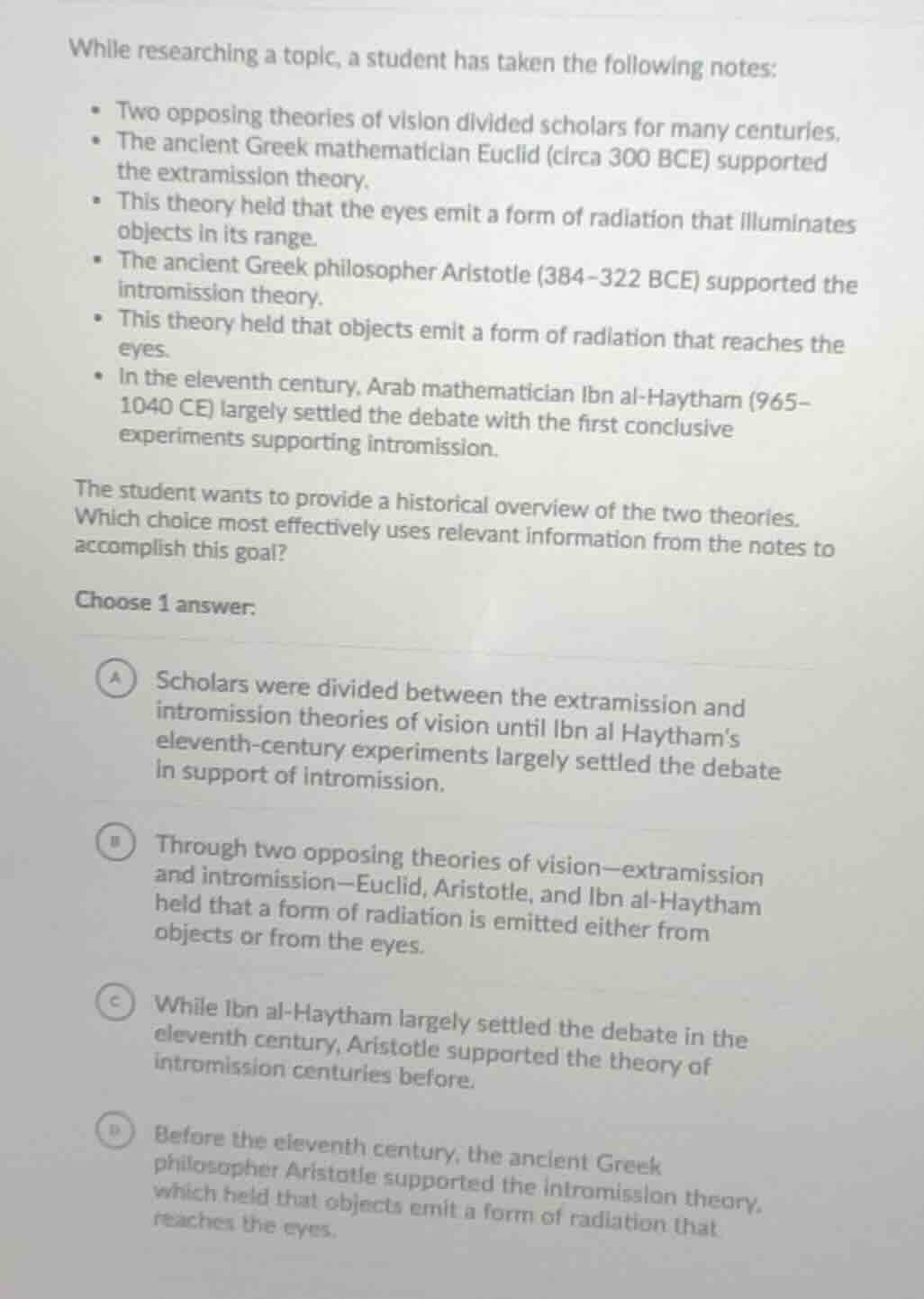
while researching a topic, a student has taken the following notes:
- two opposing theories of vision divided scholars for many centuries.
- the ancient greek mathematician euclid (circa 300 bce) supported the extramission theory.
- this theory held that the eyes emit a form of radiation that illuminates objects in its range.
- the ancient greek philosopher aristotle (384-322 bce) supported the intromission theory.
- this theory held that objects emit a form of radiation that reaches the eyes.
- in the eleventh century, arab mathematician ibn al-haytham (965-1040 ce) largely settled the debate with the first conclusive experiments supporting intromission.
the student wants to provide a historical overview of the two theories. which choice most effectively uses relevant information from the notes to accomplish this goal?
choose 1 answer:
(a) scholars were divided between the extramission and intromission theories of vision until ibn al-haythams eleventh-century experiments largely settled the debate in support of intromission.
(b) through two opposing theories of vision-extramission and intromission-euclid, aristotle, and ibn al-haytham held that a form of radiation is emitted either from objects or from the eyes.
(c) while ibn al-haytham largely settled the debate in the eleventh century, aristotle supported the theory of intromission centuries before.
(d) before the eleventh century, the ancient greek philosopher aristotle supported the intromission theory, which held that objects emit a form of radiation that reaches the eyes.
Analyze the student's goal
Using the Rhetorical Synthesis knowledge point, we identify that the student's specific goal is to "provide a historical overview of the two theories." A successful overview must introduce both theories (extramission and intromission) and outline their historical progression or resolution.
Evaluate Option A
Using the Rhetorical Synthesis knowledge point
- It mentions both theories: "extramission and intromission theories of vision."
- It provides a historical timeline: scholars were divided "until Ibn al-Haytham's eleventh-century experiments largely settled the debate."
- This effectively summarizes the historical overview of the two theories.
Evaluate Option B
Using the Rhetorical Synthesis knowledge point
- It groups Euclid, Aristotle, and Ibn al-Haytham together in a confusing way regarding what they held.
- It fails to provide a clear historical progression or overview of how the debate developed and was resolved.
Evaluate Option C
Using the Rhetorical Synthesis knowledge point
- It focuses primarily on Ibn al-Haytham and Aristotle.
- It mentions only one of the two theories ("intromission"), failing to provide an overview of both opposing theories.
Evaluate Option D
Using the Rhetorical Synthesis knowledge point
- It focuses only on Aristotle and the intromission theory.
- It completely omits Euclid and the extramission theory, failing to provide an overview of both theories.

Snap & solve any problem in the app
Get step-by-step solutions on Sovi AI
Photo-based solutions with guided steps
Explore more problems and detailed explanations
- (A) Scholars were divided between the extramission and intromission theories of vision until Ibn al-Haytham's eleventh-century experiments largely settled the debate in support of intromission. (Correct answer)
- (B) Through two opposing theories of vision—extramission and intromission—Euclid, Aristotle, and Ibn al-Haytham held that a form of radiation is emitted either from objects or from the eyes.
- (C) While Ibn al-Haytham largely settled the debate in the eleventh century, Aristotle supported the theory of intromission centuries before.
- (D) Before the eleventh century, the ancient Greek philosopher Aristotle supported the intromission theory, which held that objects emit a form of radiation that reaches the eyes.