Sovi.AI - AI Math Tutor

Scan to solve math questions

QUESTION IMAGE

which tympanogram type is most consistent with ossicular discontinuity?…

Question

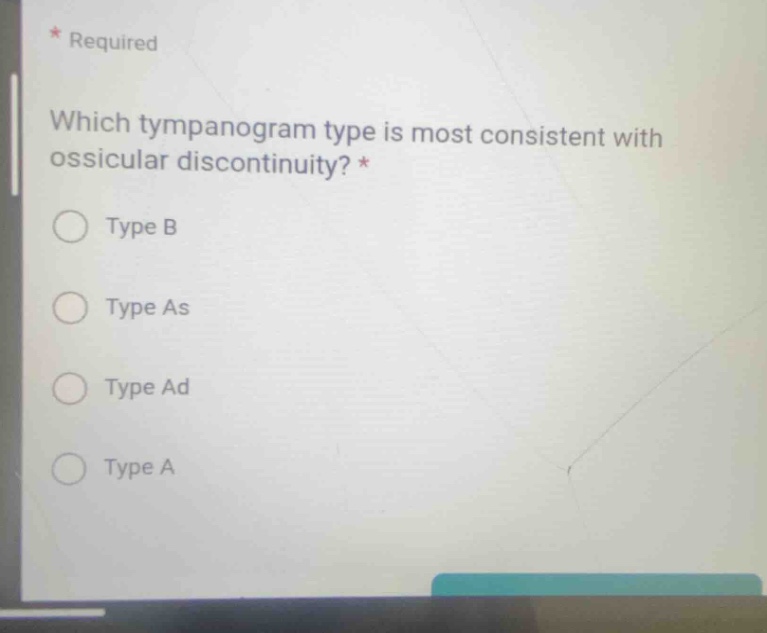
which tympanogram type is most consistent with ossicular discontinuity?

type b
type as
type ad
type a

Explanation:

Response

<pre_analysis>
{
"quality": "clear",
"question_count": 1,
"skills_matched": [
"direct_cot",
"multiple_choice_formatter",
"explain_then_answer",
"tutor"
],
"needs_drawing": false,
"concepts_used": [],
"new_concepts": [
"Tympanogram Types",
"Ossicular Discontinuity",
"Middle Ear Compliance"
],
"current_concepts": [
"Tympanogram Types",
"Ossicular Discontinuity",
"Middle Ear Compliance"
]
}
</pre_analysis>

<reasoning>

Understand tympanometry and ossicular discontinuity

Tympanometry measures the acoustic admittance (or compliance) of the middle ear system as air pressure in the external auditory canal is varied. Ossicular discontinuity refers to a physical break or separation in the chain of three tiny bones (ossicles) in the middle ear.

Analyze the mechanical effect of ossicular discontinuity

When the ossicular chain is disrupted, the tympanic membrane (eardrum) loses its normal mechanical connection to the cochlea. This lack of resistance makes the eardrum and the remaining attached structures highly mobile, resulting in an extremely high peak compliance (admittance) at or near normal atmospheric pressure.

Map the mechanical state to Jerger tympanogram classifications

  • Type A: Normal middle ear pressure and normal peak compliance.
  • Type As: Normal middle ear pressure but a shallow/stiff peak compliance (often associated with otosclerosis or tympanosclerosis).
  • Type Ad: Normal middle ear pressure with a deep, highly compliant, or hypermobile peak (where "d" stands for deep or disarticulation/discontinuity).
  • Type B: Flat tracing with no identifiable peak, indicating restricted mobility (e.g., middle ear effusion or a patent tympanostomy tube).

Match the clinical presentation

Because ossicular discontinuity causes a hypermobile middle ear system with normal pressure, it is classically represented by a Type Ad tympanogram.
</reasoning>

<answer>
<mcq-option>Type B</mcq-option>
<mcq-option>Type As</mcq-option>
<mcq-correct>Type Ad</mcq-correct>
<mcq-option>Type A</mcq-option>
</answer>

<post_analysis>
{
"subject": "Natural Science",
"question_type": "Multiple Choice",
"knowledge_point": [
"Natural Science",
"Medicine",
"Audiology"
]
}
</post_analysis>

Answer:

<pre_analysis>
{
"quality": "clear",
"question_count": 1,
"skills_matched": [
"direct_cot",
"multiple_choice_formatter",
"explain_then_answer",
"tutor"
],
"needs_drawing": false,
"concepts_used": [],
"new_concepts": [
"Tympanogram Types",
"Ossicular Discontinuity",
"Middle Ear Compliance"
],
"current_concepts": [
"Tympanogram Types",
"Ossicular Discontinuity",
"Middle Ear Compliance"
]
}
</pre_analysis>

<reasoning>

Understand tympanometry and ossicular discontinuity

Tympanometry measures the acoustic admittance (or compliance) of the middle ear system as air pressure in the external auditory canal is varied. Ossicular discontinuity refers to a physical break or separation in the chain of three tiny bones (ossicles) in the middle ear.

Analyze the mechanical effect of ossicular discontinuity

When the ossicular chain is disrupted, the tympanic membrane (eardrum) loses its normal mechanical connection to the cochlea. This lack of resistance makes the eardrum and the remaining attached structures highly mobile, resulting in an extremely high peak compliance (admittance) at or near normal atmospheric pressure.

Map the mechanical state to Jerger tympanogram classifications

  • Type A: Normal middle ear pressure and normal peak compliance.
  • Type As: Normal middle ear pressure but a shallow/stiff peak compliance (often associated with otosclerosis or tympanosclerosis).
  • Type Ad: Normal middle ear pressure with a deep, highly compliant, or hypermobile peak (where "d" stands for deep or disarticulation/discontinuity).
  • Type B: Flat tracing with no identifiable peak, indicating restricted mobility (e.g., middle ear effusion or a patent tympanostomy tube).

Match the clinical presentation

Because ossicular discontinuity causes a hypermobile middle ear system with normal pressure, it is classically represented by a Type Ad tympanogram.
</reasoning>

<answer>
<mcq-option>Type B</mcq-option>
<mcq-option>Type As</mcq-option>
<mcq-correct>Type Ad</mcq-correct>
<mcq-option>Type A</mcq-option>
</answer>

<post_analysis>
{
"subject": "Natural Science",
"question_type": "Multiple Choice",
"knowledge_point": [
"Natural Science",
"Medicine",
"Audiology"
]
}
</post_analysis>