QUESTION IMAGE
Question
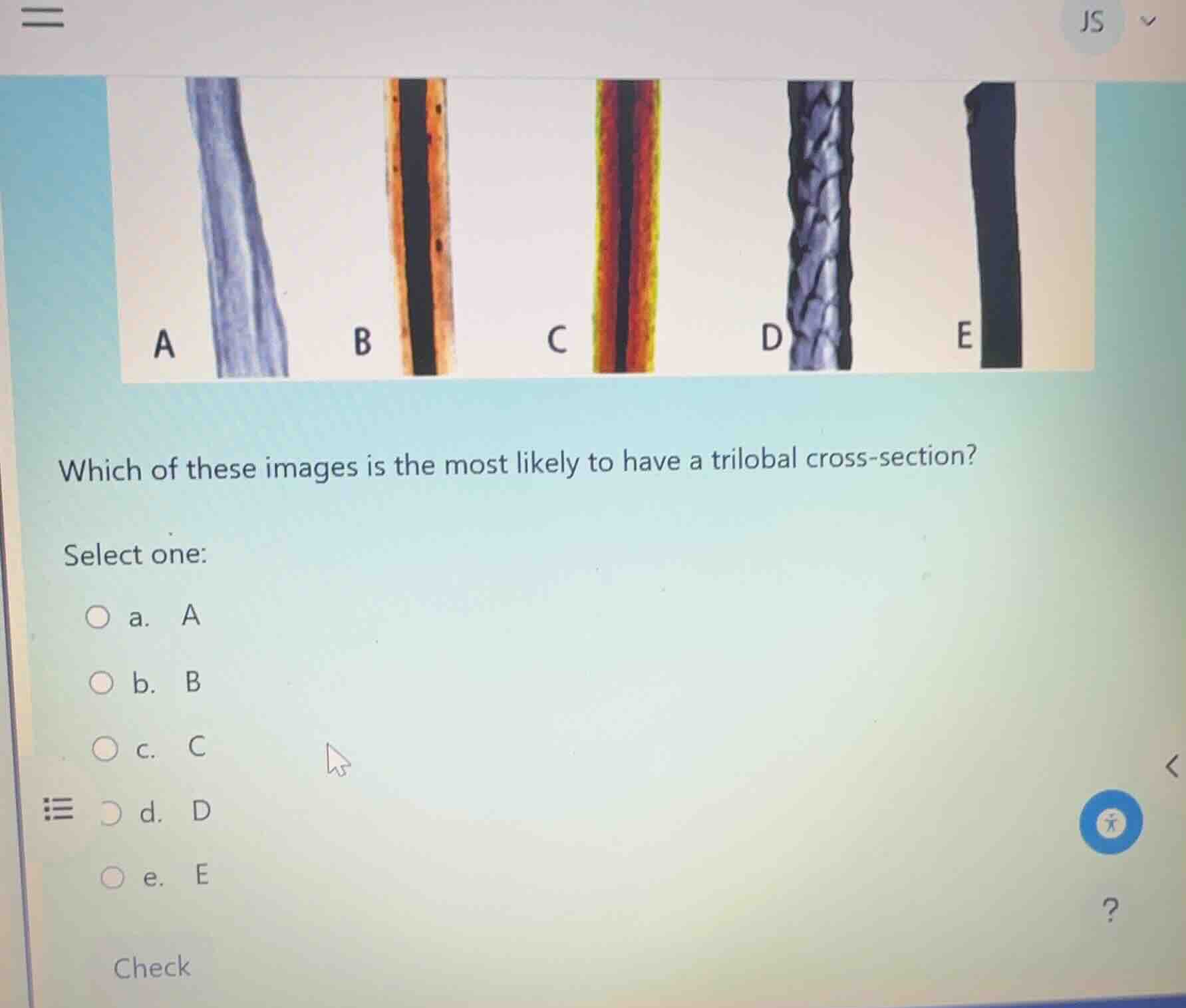
which of these images is the most likely to have a trilobal cross-section?
select one:
a. a
b. b
c. c
d. d
e. e
<pre_analysis>
{
"quality": "clear",
"question_count": 1,
"skills_matched": [
"direct_cot",
"multiple_choice_formatter",
"explain_then_answer",
"tutor"
],
"needs_drawing": false,
"concepts_used": [
"Forensic Fiber Analysis"
],
"new_concepts": [
"Synthetic Fiber Morphology",
"Fiber Cross-Sections"
],
"current_concepts": [
"Forensic Fiber Analysis",
"Synthetic Fiber Morphology",
"Fiber Cross-Sections"
]
}
</pre_analysis>
<reasoning>
Identify fiber types
The image displays five different fibers labeled A through E under microscopic view.
- A shows longitudinal striations characteristic of synthetic fibers like nylon or acetate.
- B and C show distinct internal structures (medullae), which are characteristic of animal hairs (e.g., Animal Hair Morphology).
- D shows a highly patterned, overlapping surface structure characteristic of wool (scales).
- E shows a smooth, uniform synthetic fiber.
Analyze trilobal cross-section
A trilobal cross-section is a common engineered shape for synthetic fibers, especially nylon.
- When viewed longitudinally under a light microscope, a trilobal fiber (like nylon) displays distinct, parallel longitudinal shadow lines or striations running along its length due to its three-lobed geometry reflecting light.
- Fiber A clearly shows these characteristic longitudinal striations/lines along its shaft, indicating a non-round, multi-lobed (trilobal) cross-section.
- Therefore, fiber A is the most likely to have a trilobal cross-section.
</reasoning>
<answer>
<mcq-correct>a. A</mcq-correct>
<mcq-option>b. B</mcq-option>
<mcq-option>c. C</mcq-option>
<mcq-option>d. D</mcq-option>
<mcq-option>e. E</mcq-option>
</answer>
<post_analysis>
{
"subject": "Natural Science",
"question_type": "Multiple Choice",
"knowledge_point": [
"Natural Science",
"Forensic Science",
"Trace Evidence Analysis"
]
}
</post_analysis>
Snap & solve any problem in the app
Get step-by-step solutions on Sovi AI
Photo-based solutions with guided steps
Explore more problems and detailed explanations
<pre_analysis>
{
"quality": "clear",
"question_count": 1,
"skills_matched": [
"direct_cot",
"multiple_choice_formatter",
"explain_then_answer",
"tutor"
],
"needs_drawing": false,
"concepts_used": [
"Forensic Fiber Analysis"
],
"new_concepts": [
"Synthetic Fiber Morphology",
"Fiber Cross-Sections"
],
"current_concepts": [
"Forensic Fiber Analysis",
"Synthetic Fiber Morphology",
"Fiber Cross-Sections"
]
}
</pre_analysis>
<reasoning>
Identify fiber types
The image displays five different fibers labeled A through E under microscopic view.
- A shows longitudinal striations characteristic of synthetic fibers like nylon or acetate.
- B and C show distinct internal structures (medullae), which are characteristic of animal hairs (e.g., Animal Hair Morphology).
- D shows a highly patterned, overlapping surface structure characteristic of wool (scales).
- E shows a smooth, uniform synthetic fiber.
Analyze trilobal cross-section
A trilobal cross-section is a common engineered shape for synthetic fibers, especially nylon.
- When viewed longitudinally under a light microscope, a trilobal fiber (like nylon) displays distinct, parallel longitudinal shadow lines or striations running along its length due to its three-lobed geometry reflecting light.
- Fiber A clearly shows these characteristic longitudinal striations/lines along its shaft, indicating a non-round, multi-lobed (trilobal) cross-section.
- Therefore, fiber A is the most likely to have a trilobal cross-section.
</reasoning>
<answer>
<mcq-correct>a. A</mcq-correct>
<mcq-option>b. B</mcq-option>
<mcq-option>c. C</mcq-option>
<mcq-option>d. D</mcq-option>
<mcq-option>e. E</mcq-option>
</answer>
<post_analysis>
{
"subject": "Natural Science",
"question_type": "Multiple Choice",
"knowledge_point": [
"Natural Science",
"Forensic Science",
"Trace Evidence Analysis"
]
}
</post_analysis>