QUESTION IMAGE
Question
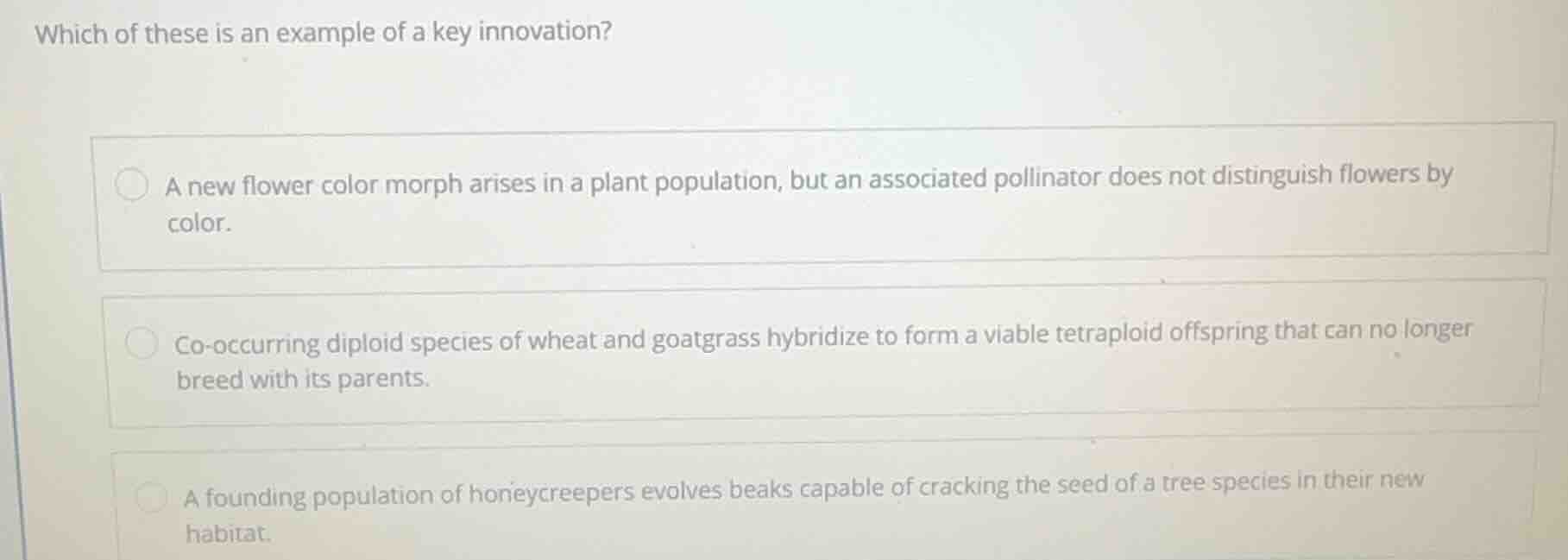
which of these is an example of a key innovation?
a new flower color morph arises in a plant population, but an associated pollinator does not distinguish flowers by color.
co-occurring diploid species of wheat and goatgrass hybridize to form a viable tetraploid offspring that can no longer breed with its parents.
a founding population of honeycreepers evolves beaks capable of cracking the seed of a tree species in their new habitat.
Define key innovation
A key innovation is a novel phenotypic trait that allows a species to exploit a previously incompatible or inaccessible resource, often triggering Adaptive Radiation by opening up new ecological niches.
Analyze the first option
The first option describes a new flower color morph that is not distinguished by its pollinator. Because this trait does not open up new ecological opportunities or resources, it is not a key innovation.
Analyze the second option
The second option describes hybridization and polyploidy leading to speciation. While this is a mechanism of sympatric speciation, it does not describe the acquisition of a novel functional trait that unlocks new niches.
Analyze the third option
The third option describes a founding population of honeycreepers evolving specialized beaks to crack seeds in a new habitat. This novel morphological adaptation directly allows them to exploit a new food source, facilitating Adaptive Radiation in their new environment. This is a classic example of a key innovation.

Snap & solve any problem in the app
Get step-by-step solutions on Sovi AI
Photo-based solutions with guided steps
Explore more problems and detailed explanations
- (A) A new flower color morph arises in a plant population, but an associated pollinator does not distinguish flowers by color.
- (B) Co-occurring diploid species of wheat and goatgrass hybridize to form a viable tetraploid offspring that can no longer breed with its parents.
- (C) A founding population of honeycreepers evolves beaks capable of cracking the seed of a tree species in their new habitat. (Correct answer)