QUESTION IMAGE
Question
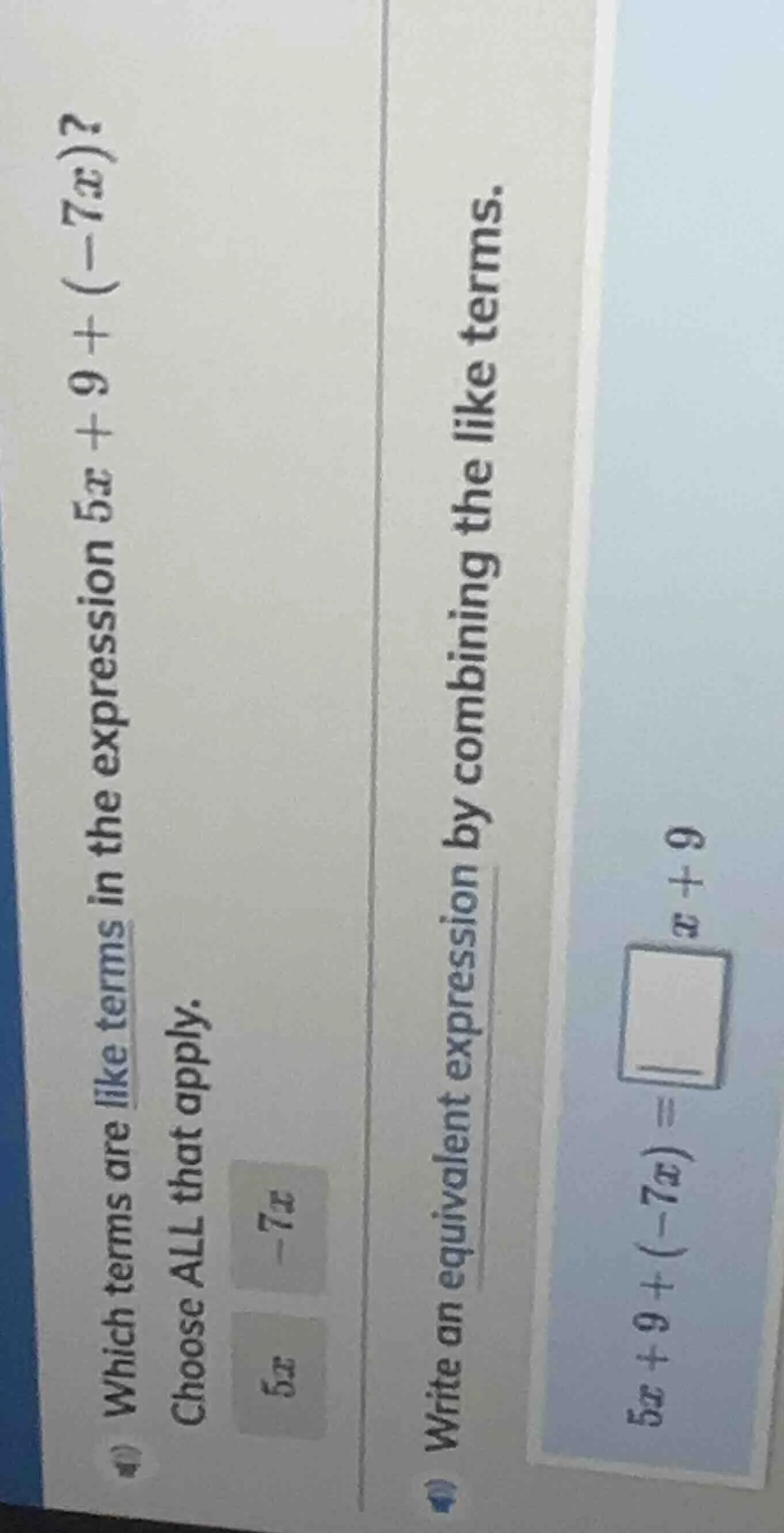
which terms are like terms in the expression ( 5x + 9 + (-7x) )?
choose all that apply.
( 5x )
( -7x )
write an equivalent expression by combining the like terms.
( 5x + 9 + (-7x) = square x + 9 )
Part 1: Identifying Like Terms
Like terms are terms with the same variable (or no variable) raised to the same power. In the expression \(5x + 9 + (-7x)\), the terms with \(x\) are \(5x\) and \(-7x\) (since they both have the variable \(x\) with exponent 1), while 9 is a constant term. So the like terms with \(5x\) are \(-7x\). Also, \(5x\) is a like term to itself in the context of combining, but the question asks which terms are like terms with \(5x\), so \(-7x\) (and \(5x\) itself, but from the options, \(5x\) and \(-7x\) are the like terms involving \(x\)). Wait, the options given are \(5x\) and \(-7x\)? Wait, the first part: "Which terms are like terms in the expression \(5x + 9 + (-7x)\)? Choose ALL that apply." The terms are \(5x\), \(9\), \(-7x\). Like terms with \(5x\) are terms with \(x\), so \(-7x\) (and \(5x\) is a like term to itself, but if the options are \(5x\) and \(-7x\), then both? Wait, no: like terms are terms that can be combined, so \(5x\) and \(-7x\) are like terms (same variable, same power). So the like terms with \(5x\) are \(-7x\) (and \(5x\) is a like term, but if the options are \(5x\) and \(-7x\), then both? Wait, the problem says "Which terms are like terms with \(5x\)"? Wait, the original problem: "Which terms are like terms in the expression \(5x + 9 + (-7x)\)? Choose ALL that apply." So the terms are \(5x\), \(9\), \(-7x\). Like terms are \(5x\) and \(-7x\) (both have \(x\) as the variable, degree 1). So the correct options are \(5x\) and \(-7x\)? Wait, but the first part: the options given are \(5x\) and \(-7x\) (the grayed boxes). So we need to choose all like terms with \(5x\), so \(5x\) (itself) and \(-7x\)? Wait, no, like terms are terms that can be combined, so \(5x\) and \(-7x\) are like terms. So the answer for the first part is \(5x\) and \(-7x\)? Wait, the problem says "Which terms are like terms in the expression... Choose ALL that apply." So the terms are \(5x\), \(9\), \(-7x\). So like terms are \(5x\) and \(-7x\) (since they have the same variable \(x\) with exponent 1). So we choose both \(5x\) and \(-7x\).
Part 2: Combining Like Terms
Step 1: Identify like terms
In \(5x + 9 + (-7x)\), the like terms with \(x\) are \(5x\) and \(-7x\).
Step 2: Combine the like terms
Combine \(5x\) and \(-7x\): \(5x + (-7x) = (5 - 7)x = -2x\)? Wait, no, wait: \(5x + (-7x) = 5x - 7x = (5 - 7)x = -2x\)? Wait, but the second part says "Write an equivalent expression by combining the like terms. \(5x + 9 + (-7x) = \square x + 9\)". Wait, so let's do that:
\(5x + (-7x) = (5 - 7)x = -2x\)? Wait, no, wait: \(5x + (-7x) = 5x - 7x = (5 - 7)x = -2x\)? But the box is for the coefficient of \(x\). Wait, wait, maybe I made a mistake. Wait, \(5x + (-7x) = 5x - 7x = (5 - 7)x = -2x\)? But the problem's second part is: \(5x + 9 + (-7x) = \square x + 9\). So combining \(5x\) and \(-7x\): \(5x + (-7x) = (5 + (-7))x = (5 - 7)x = -2x\)? Wait, no, wait: \(5 + (-7) = -2\), so \(5x + (-7x) = -2x\), so the expression becomes \(-2x + 9\). But the problem's box is for the coefficient of \(x\), so the square should be \(-2\)? Wait, but maybe I misread. Wait, the original expression: \(5x + 9 + (-7x)\). Let's rearrange using commutative property: \(5x + (-7x) + 9\). Then combine \(5x\) and \(-7x\): \( (5 - 7)x + 9 = -2x + 9\). So the coefficient of \(x\) is \(-2\). Wait, but maybe the problem has a typo, or I misread. Wait, no, let's check again:
\(5x + (-7x) = 5x - 7x = (5 - 7)x = -2x\). So \(5x + 9 + (-7x) = -2x + 9\), so the coefficient of \(x\) is \(-2\). But wait, the user's second part shows \(5x + 9 + (-7x) = \square x + 9\), so the square is the coefficient, so \(-2\). But wait, maybe I made a mistake. Wait, \(5x + (-7x) = 5x - 7x = (5 + (-7))x = -2x\), yes. So the equivalent expression is \(-2x + 9\), so the box is \(-2\).
But let's go back to the first part: the like terms with \(5x\) are \(-7x\) (and \(5x\) itself, but the options are \(5x\) and \(-7x\), so we choose both \(5x\) and \(-7x\) as like terms with \(5x\) (since they have the same variable \(x\)).
Final Answers
Part 1: Like Terms
The like terms with \(5x\) are \(5x\) (itself) and \(-7x\) (since they have the same variable \(x\) with exponent 1). So the correct options (from the given choices, assuming the choices are \(5x\) and \(-7x\)) are:
- \(5x\) (since it's a like term to itself in the context of combining, and has the same variable)
- \(-7x\) (since it has the same variable \(x\) as \(5x\))
Part 2: Combining Like Terms
Step 1: Identify like terms
In \(5x + 9 + (-7x)\), the like terms with \(x\) are \(5x\) and \(-7x\).
Step 2: Combine the like terms
Combine \(5x\) and \(-7x\): \(5x + (-7x) = (5 - 7)x = -2x\).
Step 3: Write the equivalent expression
Substitute the combined like terms back: \(5x + 9 + (-7x) = -2x + 9\), so the coefficient of \(x\) is \(-2\).

Snap & solve any problem in the app
Get step-by-step solutions on Sovi AI
Photo-based solutions with guided steps
Explore more problems and detailed explanations
(Part 1):
The like terms with \(5x\) are \(5x\) and \(-7x\) (so if the options are \(5x\) and \(-7x\), choose both. But based on the problem's first part, likely the answer is \(5x\) and \(-7x\); but if the options are presented as buttons, we select both \(5x\) and \(-7x\)).