QUESTION IMAGE
Question
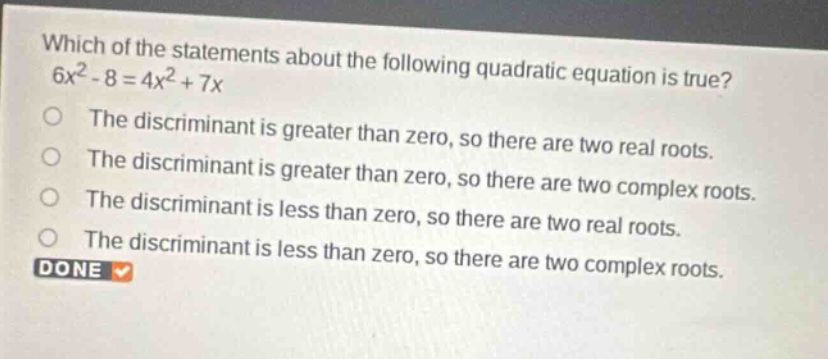
which of the statements about the following quadratic equation is true?
(6x^2 - 8 = 4x^2 + 7x)
- the discriminant is greater than zero, so there are two real roots.
- the discriminant is greater than zero, so there are two complex roots.
- the discriminant is less than zero, so there are two real roots.
- the discriminant is less than zero, so there are two complex roots.
⚡ Using what you learned: quadratic formula and its applications
Step 1: Write in standard form
Rearrange the given equation \( 6x^2 - 8 = 4x^2 + 7x \) into the standard quadratic form \( ax^2 + bx + c = 0 \):
$$
(6x^2 - 4x^2) - 7x - 8 = 0
$$
$$
2x^2 - 7x - 8 = 0
$$
Identify the coefficients:
- \( a = 2 \)
- \( b = -7 \)
- \( c = -8 \)
Step 2: Calculate the discriminant
The discriminant formula is \( D = b^2 - 4ac \):
$$
D = (-7)^2 - 4(2)(-8)
$$
$$
D = 49 - (-64)
$$
$$
D = 49 + 64 = 113
$$
Step 3: Determine the nature of the roots
Since the discriminant \( D = 113 \) is greater than zero (\( D > 0 \)), the quadratic equation has two distinct real roots.

Snap & solve any problem in the app
Get step-by-step solutions on Sovi AI
Photo-based solutions with guided steps
Explore more problems and detailed explanations
The discriminant is greater than zero, so there are two real roots.