QUESTION IMAGE
Question
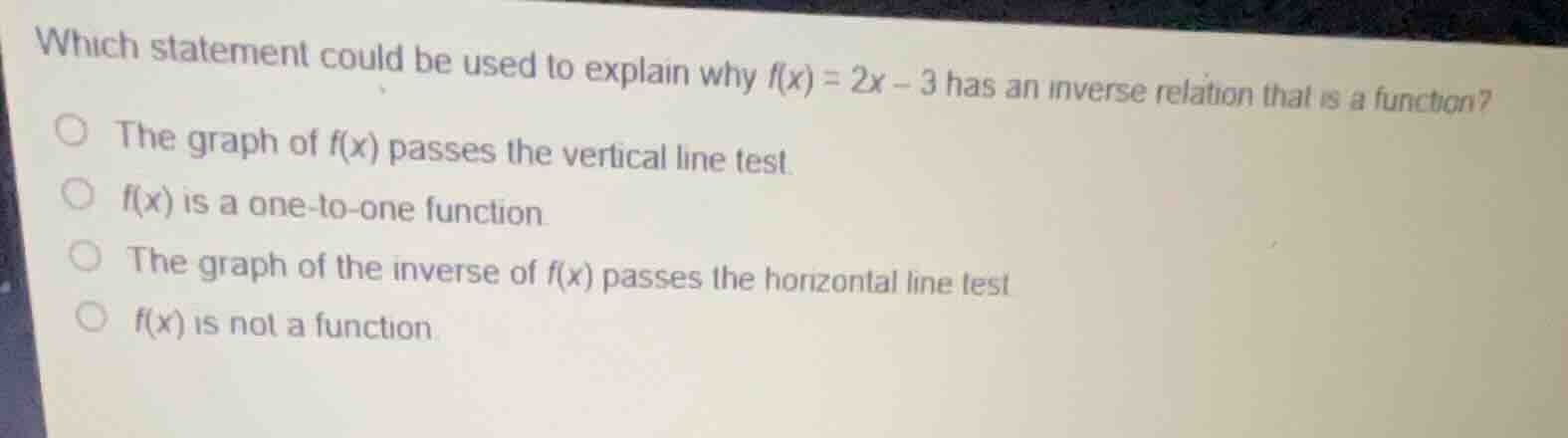
which statement could be used to explain why \\(f(x) = 2x - 3\\) has an inverse relation that is a function?
- the graph of \\(f(x)\\) passes the vertical line test.
- \\(f(x)\\) is a one-to-one function.
- the graph of the inverse of \\(f(x)\\) passes the horizontal line test.
- \\(f(x)\\) is not a function.
Analyze the definition of an inverse function
For a function \(f(x)\) to have an inverse relation that is also a function, every unique output value \(y\) must correspond to exactly one unique input value \(x\). This characteristic defines a one-to-one function. Using the Inverse Functions concept, we know that if a function is one-to-one, its inverse relation is guaranteed to be a function.
Evaluate the given options
- "The graph of \(f(x)\) passes the vertical line test": This only proves that \(f(x)\) itself is a function, not that its inverse is a function.
- "\(f(x)\) is a one-to-one function": This is the correct definition. If \(f(x)\) is one-to-one, its inverse relation is a function.
- "The graph of the inverse of \(f(x)\) passes the horizontal line test": For the inverse to be a function, the graph of the original function \(f(x)\) must pass the horizontal line test, or the graph of the inverse must pass the vertical line test.
- "\(f(x)\) is not a function": This is false, as \(f(x) = 2x - 3\) is a linear function.

Snap & solve any problem in the app
Get step-by-step solutions on Sovi AI
Photo-based solutions with guided steps
Explore more problems and detailed explanations
- The graph of \(f(x)\) passes the vertical line test.
- \(f(x)\) is a one-to-one function. (Correct answer)
- The graph of the inverse of \(f(x)\) passes the horizontal line test.
- \(f(x)\) is not a function.