QUESTION IMAGE
Question
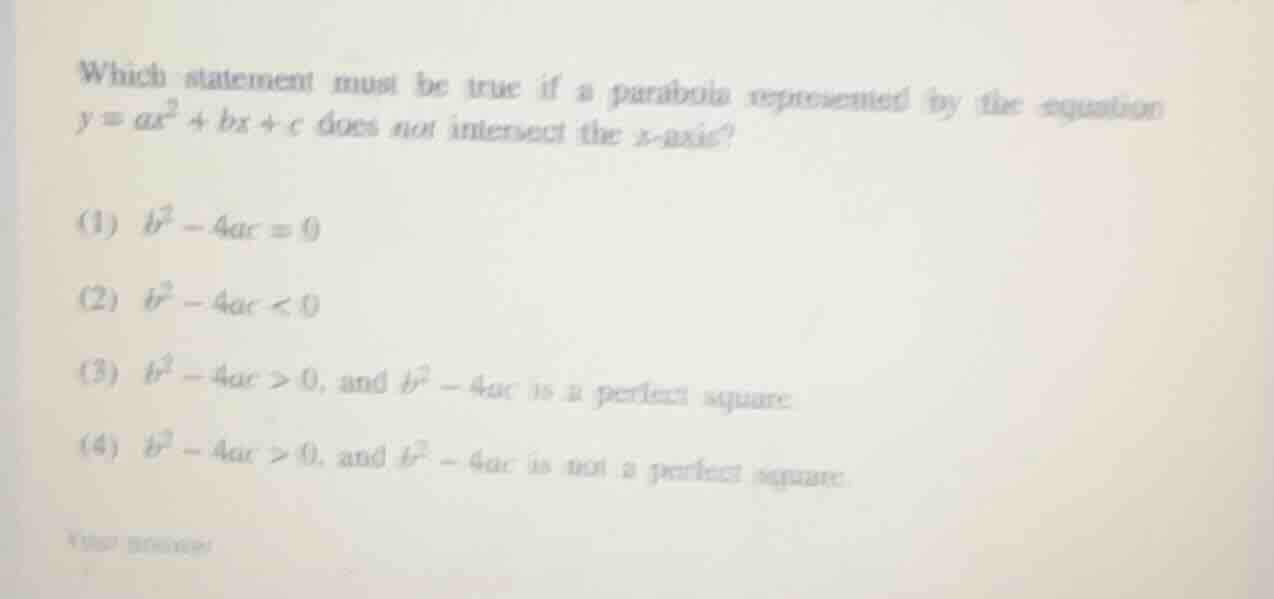
which statement must be true if a parabola represented by the equation $y = ax^2 + bx + c$ does not intersect the $x$-axis?
(1) $b^2 - 4ac = 0$
(2) $b^2 - 4ac < 0$
(3) $b^2 - 4ac > 0$, and $b^2 - 4ac$ is a perfect square.
(4) $b^2 - 4ac > 0$, and $b^2 - 4ac$ is not a perfect square.
Step1: Recall discriminant purpose
The discriminant $\Delta = b^2-4ac$ of $y=ax^2+bx+c$ tells the number of x-intercepts.
Step2: Match discriminant to no intercepts
If a parabola has no x-intercepts, it has no real roots, so $\Delta < 0$.
Step3: Evaluate each option
(1) $\Delta=0$ means one x-intercept; (3)(4) $\Delta>0$ means two x-intercepts; only (2) fits.

Snap & solve any problem in the app
Get step-by-step solutions on Sovi AI
Photo-based solutions with guided steps
Explore more problems and detailed explanations
(2) $b^2 - 4ac < 0$