QUESTION IMAGE
Question
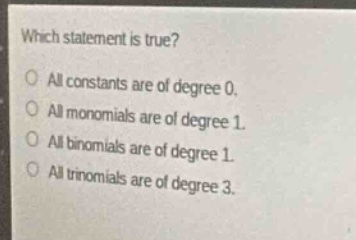
which statement is true?
- all constants are of degree 0.
- all monomials are of degree 1.
- all binomials are of degree 1.
- all trinomials are of degree 3.
🆕 New Concept Discovered: Degree of Polynomials
How to find the degree of different algebraic expressions.
Step 1: Understand the degree of a constant
A constant is a number without any variables, such as \( 5 \) or \( -12 \). We can write any non-zero constant \( c \) as:
$$ c = c \cdot x^0 $$
Since the exponent of the variable is \( 0 \), the degree of any non-zero constant is \( 0 \).
(Note: The constant \( 0 \) is a special case whose degree is either undefined or defined as \( -\infty \), but in high school algebra, the general rule is that non-zero constants have a degree of \( 0 \).)
Step 2: Analyze the other options
- "All monomials are of degree 1": A monomial is an expression with one term. For example, \( 5x^2 \) is a monomial, but its degree is \( 2 \). Thus, this statement is false.
- "All binomials are of degree 1": A binomial has two terms. For example, \( x^2 + 3 \) is a binomial, but its degree is \( 2 \). Thus, this statement is false.
- "All trinomials are of degree 3": A trinomial has three terms. For example, \( x^2 + 2x + 1 \) is a trinomial, but its degree is \( 2 \). Thus, this statement is false.

Snap & solve any problem in the app
Get step-by-step solutions on Sovi AI
Photo-based solutions with guided steps
Explore more problems and detailed explanations
All constants are of degree 0.