QUESTION IMAGE
Question
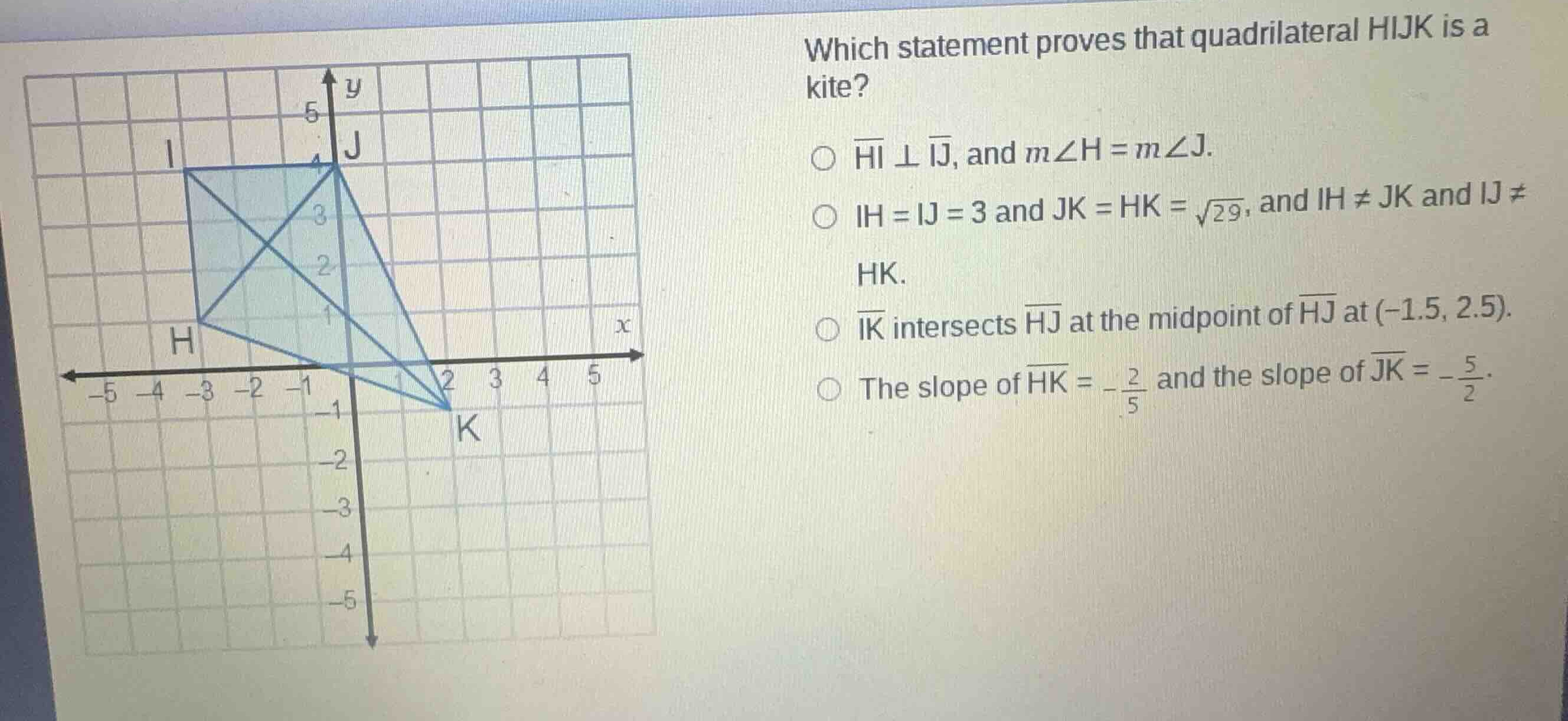
which statement proves that quadrilateral hijk is a kite?
\\(\overline{hi} \perp \overline{ij}\\), and \\(m\angle h = m\angle j\\).
\\(ih = ij = 3\\) and \\(jk = hk = \sqrt{29}\\), and \\(ih \
eq jk\\) and \\(ij \
eq hk\\).
\\(\overline{ik}\\) intersects \\(\overline{hj}\\) at the midpoint of \\(\overline{hj}\\) at \\((-1.5, 2.5)\\).
the slope of \\(\overline{hk} = -\frac{2}{5}\\) and the slope of \\(\overline{jk} = -\frac{5}{2}\\).
<pre_analysis>
{
"quality": "clear",
"question_count": 1,
"skills_matched": [
"step_cot",
"multiple_choice_formatter",
"explain_then_answer",
"tutor",
"mastery_adaptive_brevity"
],
"needs_drawing": false,
"concepts_used": [
"Kite Properties",
"Distance Formula"
],
"new_concepts": [
"Coordinate Proofs of Quadrilaterals"
],
"current_concepts": [
"Kite Properties",
"Distance Formula",
"Coordinate Proofs of Quadrilaterals"
]
}
</pre_analysis>
<reasoning>
Identify the definition of a kite
Using the Kite Properties knowledge point
A kite is defined as a quadrilateral with two distinct pairs of adjacent congruent sides. For quadrilateral \(HIJK\), this means we must show that one pair of adjacent sides is congruent (e.g., \(IH = IJ\)) and the other pair of adjacent sides is congruent (e.g., \(JK = HK\)), while ensuring that opposite sides are not congruent (\(IH
eq JK\) and \(IJ
eq HK\)) to distinguish it from a rhombus.
Find the coordinates of the vertices
We read the coordinates of the vertices from the given coordinate plane:
- \(H = (-3, 1)\)
- \(I = (-3, 4)\)
- \(J = (0, 4)\)
- \(K = (2, -1)\)
Calculate the side lengths
Using the Distance Formula knowledge point
\[
\]
Verify the conditions for a kite
Using the Kite Properties knowledge point
\[
\]
These calculations prove that \(HIJK\) has two distinct pairs of congruent adjacent sides, which matches the second option.
</reasoning>
<answer>
<mcq-option>(A) \(\overline{HI} \perp \overline{IJ}\), and \(m\angle H = m\angle J\).</mcq-option>
<mcq-correct>(B) \(IH = IJ = 3\) and \(JK = HK = \sqrt{29}\), and \(IH
eq JK\) and \(IJ
eq HK\).</mcq-correct>
<mcq-option>(C) \(\overline{IK}\) intersects \(\overline{HJ}\) at the midpoint of \(\overline{HJ}\) at \((-1.5, 2.5)\).</mcq-option>
<mcq-option>(D) The slope of \(\overline{HK} = -\frac{2}{5}\) and the slope of \(\overline{JK} = -\frac{5}{2}\).</mcq-option>
</answer>
<post_analysis>
{
"subject": "Mathematics",
"question_type": "Multiple Choice",
"knowledge_point": [
"Mathematics",
"Geometry",
"Coordinate Proofs of Quadrilaterals"
]
}
</post_analysis>
Snap & solve any problem in the app
Get step-by-step solutions on Sovi AI
Photo-based solutions with guided steps
Explore more problems and detailed explanations
<pre_analysis>
{
"quality": "clear",
"question_count": 1,
"skills_matched": [
"step_cot",
"multiple_choice_formatter",
"explain_then_answer",
"tutor",
"mastery_adaptive_brevity"
],
"needs_drawing": false,
"concepts_used": [
"Kite Properties",
"Distance Formula"
],
"new_concepts": [
"Coordinate Proofs of Quadrilaterals"
],
"current_concepts": [
"Kite Properties",
"Distance Formula",
"Coordinate Proofs of Quadrilaterals"
]
}
</pre_analysis>
<reasoning>
Identify the definition of a kite
Using the Kite Properties knowledge point
A kite is defined as a quadrilateral with two distinct pairs of adjacent congruent sides. For quadrilateral \(HIJK\), this means we must show that one pair of adjacent sides is congruent (e.g., \(IH = IJ\)) and the other pair of adjacent sides is congruent (e.g., \(JK = HK\)), while ensuring that opposite sides are not congruent (\(IH
eq JK\) and \(IJ
eq HK\)) to distinguish it from a rhombus.
Find the coordinates of the vertices
We read the coordinates of the vertices from the given coordinate plane:
- \(H = (-3, 1)\)
- \(I = (-3, 4)\)
- \(J = (0, 4)\)
- \(K = (2, -1)\)
Calculate the side lengths
Using the Distance Formula knowledge point
\[
\]
Verify the conditions for a kite
Using the Kite Properties knowledge point
\[
\]
These calculations prove that \(HIJK\) has two distinct pairs of congruent adjacent sides, which matches the second option.
</reasoning>
<answer>
<mcq-option>(A) \(\overline{HI} \perp \overline{IJ}\), and \(m\angle H = m\angle J\).</mcq-option>
<mcq-correct>(B) \(IH = IJ = 3\) and \(JK = HK = \sqrt{29}\), and \(IH
eq JK\) and \(IJ
eq HK\).</mcq-correct>
<mcq-option>(C) \(\overline{IK}\) intersects \(\overline{HJ}\) at the midpoint of \(\overline{HJ}\) at \((-1.5, 2.5)\).</mcq-option>
<mcq-option>(D) The slope of \(\overline{HK} = -\frac{2}{5}\) and the slope of \(\overline{JK} = -\frac{5}{2}\).</mcq-option>
</answer>
<post_analysis>
{
"subject": "Mathematics",
"question_type": "Multiple Choice",
"knowledge_point": [
"Mathematics",
"Geometry",
"Coordinate Proofs of Quadrilaterals"
]
}
</post_analysis>