Sovi.AI - AI Math Tutor

Scan to solve math questions

QUESTION IMAGE

which set of exercises would best help you increase your flexibility? *…

Question

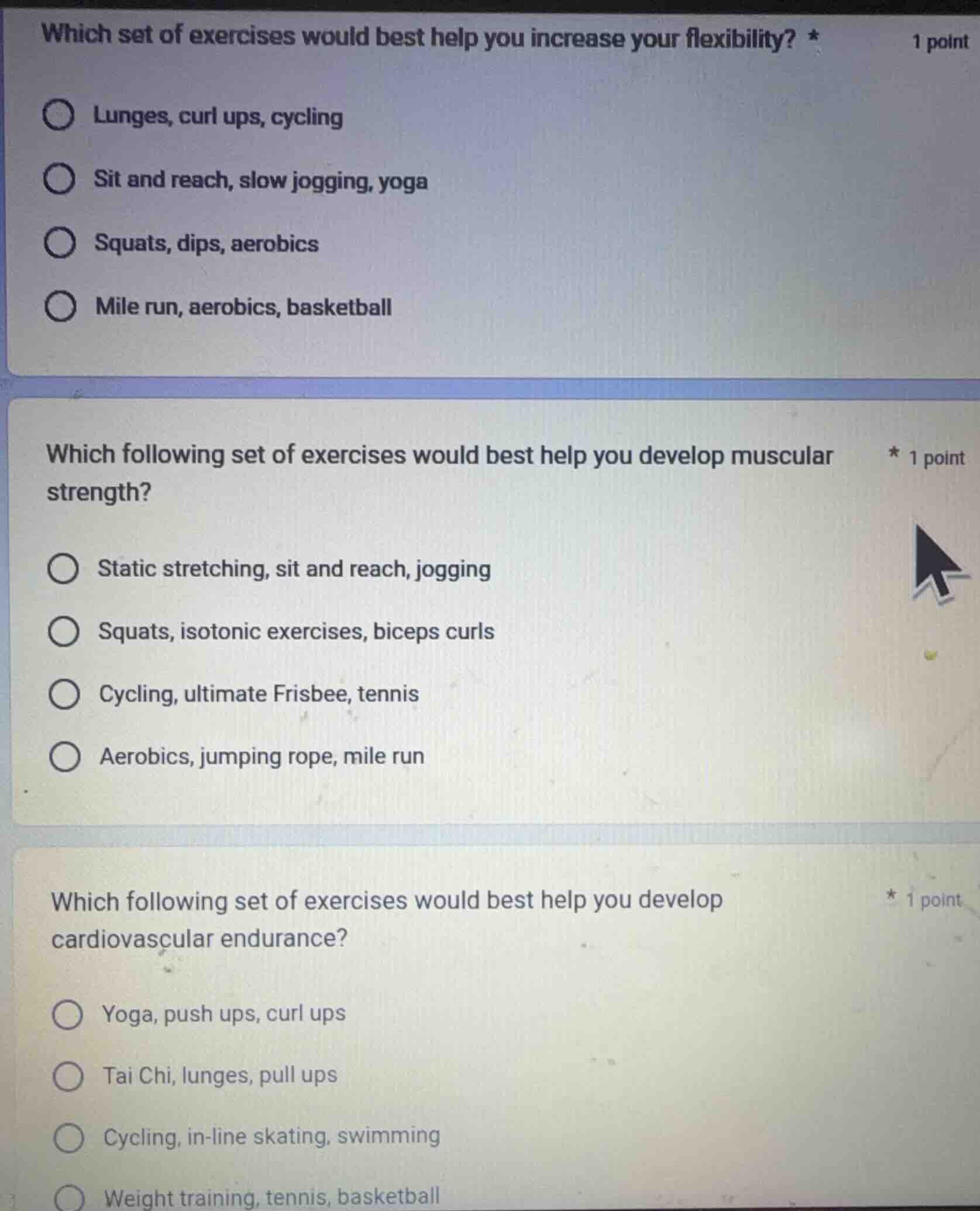
which set of exercises would best help you increase your flexibility? *
lunges, curl ups, cycling
sit and reach, slow jogging, yoga
squats, dips, aerobics
mile run, aerobics, basketball

which following set of exercises would best help you develop muscular strength? *
static stretching, sit and reach, jogging
squats, isotonic exercises, biceps curls
cycling, ultimate frisbee, tennis
aerobics, jumping rope, mile run

which following set of exercises would best help you develop cardiovascular endurance? *
yoga, push ups, curl ups
tai chi, lunges, pull ups
cycling, in-line skating, swimming
weight training, tennis, basketball

Explanation:

Response

<pre_analysis>
{
"quality": "clear",
"question_count": 3,
"skills_matched": [
"direct_cot",
"multiple_choice_formatter",
"explain_then_answer",
"tutor"
],
"needs_drawing": false,
"concepts_used": [
"Flexibility Training",
"Muscular Strength vs Endurance",
"Cardiovascular Endurance Benefits"
],
"new_concepts": [],
"current_concepts": [
"Flexibility Training",
"Muscular Strength vs Endurance",
"Cardiovascular Endurance Benefits"
]
}
</pre_analysis>

<reasoning>

Analyze flexibility exercises

To increase flexibility, we look for activities that stretch muscles and improve the range of motion of joints.

  • Flexibility Training includes activities like the sit and reach test (which measures hamstring and lower back flexibility) and yoga (which focuses on deep stretching and static holds).
  • Looking at the options for the first question, "Sit and reach, slow jogging, yoga" contains two major flexibility-focused activities.

Analyze muscular strength exercises

To develop muscular strength, we need resistance-based exercises that overload the muscles.

  • Muscular Strength vs Endurance principles show that resistance training like squats, biceps curls, and other isotonic exercises (where muscles contract and shorten against a constant load) are ideal for building strength.
  • The option "Squats, isotonic exercises, biceps curls" directly targets muscle resistance and strength development.

Analyze cardiovascular endurance exercises

To develop cardiovascular endurance, we need continuous, rhythmic aerobic activities that elevate the heart rate over an extended period.

  • Cardiovascular Endurance Benefits are achieved through sustained aerobic exercises that engage large muscle groups.
  • Activities like cycling, in-line skating, and swimming are classic aerobic exercises that keep the heart rate elevated and improve cardiorespiratory fitness.
  • The option "Cycling, in-line skating, swimming" consists entirely of excellent cardiovascular endurance exercises.

</reasoning>

<answer>

Question 1

<mcq-option>(A) Lunges, curl ups, cycling</mcq-option>
<mcq-correct>(B) Sit and reach, slow jogging, yoga</mcq-correct>
<mcq-option>(C) Squats, dips, aerobics</mcq-option>
<mcq-option>(D) Mile run, aerobics, basketball</mcq-option>

Question 2

<mcq-option>(A) Static stretching, sit and reach, jogging</mcq-option>
<mcq-correct>(B) Squats, isotonic exercises, biceps curls</mcq-correct>
<mcq-option>(C) Cycling, ultimate Frisbee, tennis</mcq-option>
<mcq-option>(D) Aerobics, jumping rope, mile run</mcq-option>

Question 3

<mcq-option>(A) Yoga, push ups, curl ups</mcq-option>
<mcq-option>(B) Tai Chi, lunges, pull ups</mcq-option>
<mcq-correct>(C) Cycling, in-line skating, swimming</mcq-correct>
<mcq-option>(D) Weight training, tennis, basketball</mcq-option>
</answer>

<post_analysis>
{
"subject": "Natural Science",
"question_type": "Multiple Choice",
"knowledge_point": [
"Natural Science",
"Others",
"Physical Education and Health"
]
}
</post_analysis>

Answer:

<pre_analysis>
{
"quality": "clear",
"question_count": 3,
"skills_matched": [
"direct_cot",
"multiple_choice_formatter",
"explain_then_answer",
"tutor"
],
"needs_drawing": false,
"concepts_used": [
"Flexibility Training",
"Muscular Strength vs Endurance",
"Cardiovascular Endurance Benefits"
],
"new_concepts": [],
"current_concepts": [
"Flexibility Training",
"Muscular Strength vs Endurance",
"Cardiovascular Endurance Benefits"
]
}
</pre_analysis>

<reasoning>

Analyze flexibility exercises

To increase flexibility, we look for activities that stretch muscles and improve the range of motion of joints.

  • Flexibility Training includes activities like the sit and reach test (which measures hamstring and lower back flexibility) and yoga (which focuses on deep stretching and static holds).
  • Looking at the options for the first question, "Sit and reach, slow jogging, yoga" contains two major flexibility-focused activities.

Analyze muscular strength exercises

To develop muscular strength, we need resistance-based exercises that overload the muscles.

  • Muscular Strength vs Endurance principles show that resistance training like squats, biceps curls, and other isotonic exercises (where muscles contract and shorten against a constant load) are ideal for building strength.
  • The option "Squats, isotonic exercises, biceps curls" directly targets muscle resistance and strength development.

Analyze cardiovascular endurance exercises

To develop cardiovascular endurance, we need continuous, rhythmic aerobic activities that elevate the heart rate over an extended period.

  • Cardiovascular Endurance Benefits are achieved through sustained aerobic exercises that engage large muscle groups.
  • Activities like cycling, in-line skating, and swimming are classic aerobic exercises that keep the heart rate elevated and improve cardiorespiratory fitness.
  • The option "Cycling, in-line skating, swimming" consists entirely of excellent cardiovascular endurance exercises.

</reasoning>

<answer>

Question 1

<mcq-option>(A) Lunges, curl ups, cycling</mcq-option>
<mcq-correct>(B) Sit and reach, slow jogging, yoga</mcq-correct>
<mcq-option>(C) Squats, dips, aerobics</mcq-option>
<mcq-option>(D) Mile run, aerobics, basketball</mcq-option>

Question 2

<mcq-option>(A) Static stretching, sit and reach, jogging</mcq-option>
<mcq-correct>(B) Squats, isotonic exercises, biceps curls</mcq-correct>
<mcq-option>(C) Cycling, ultimate Frisbee, tennis</mcq-option>
<mcq-option>(D) Aerobics, jumping rope, mile run</mcq-option>

Question 3

<mcq-option>(A) Yoga, push ups, curl ups</mcq-option>
<mcq-option>(B) Tai Chi, lunges, pull ups</mcq-option>
<mcq-correct>(C) Cycling, in-line skating, swimming</mcq-correct>
<mcq-option>(D) Weight training, tennis, basketball</mcq-option>
</answer>

<post_analysis>
{
"subject": "Natural Science",
"question_type": "Multiple Choice",
"knowledge_point": [
"Natural Science",
"Others",
"Physical Education and Health"
]
}
</post_analysis>