QUESTION IMAGE
Question
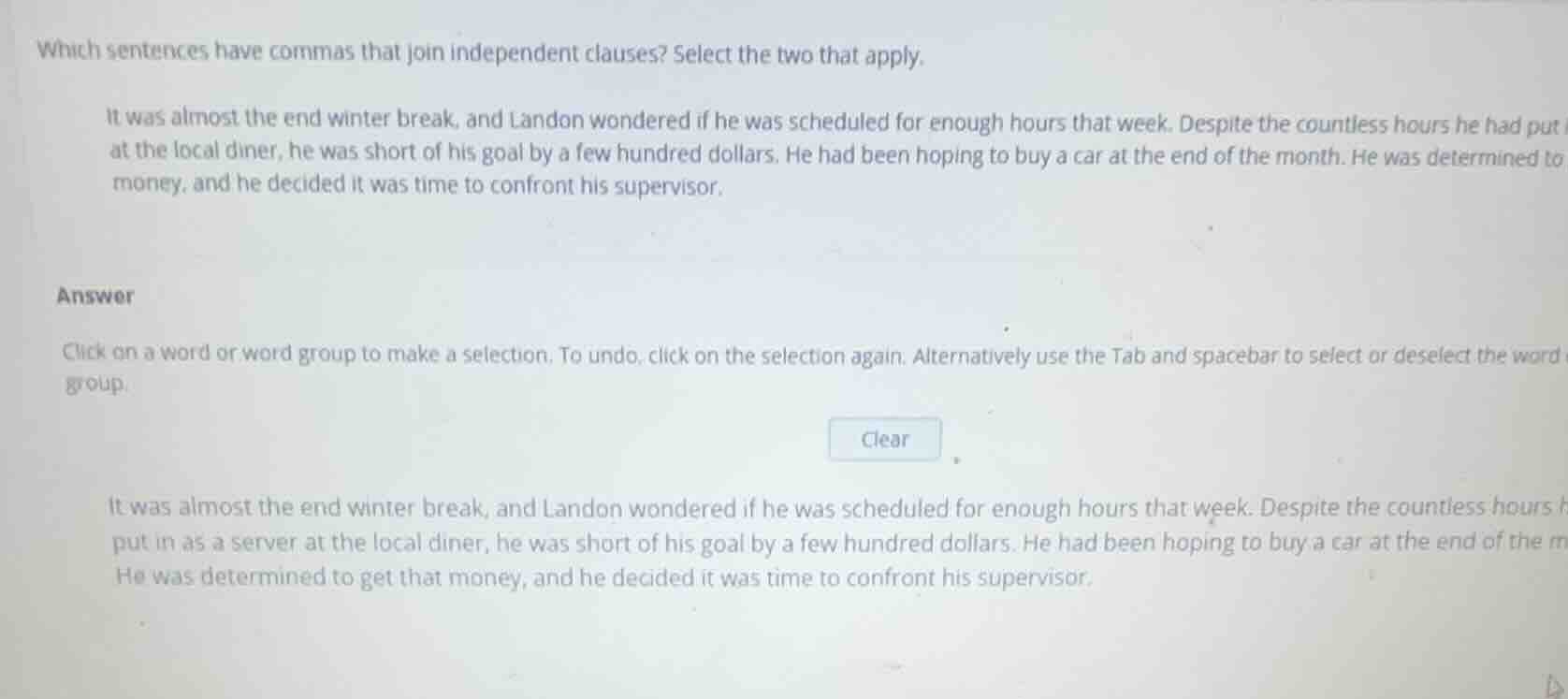
which sentences have commas that join independent clauses? select the two that apply.
it was almost the end winter break, and landon wondered if he was scheduled for enough hours that week. despite the countless hours he had put in at the local diner, he was short of his goal by a few hundred dollars. he had been hoping to buy a car at the end of the month. he was determined to get that money, and he decided it was time to confront his supervisor.
🆕 New Concept Discovered: Joining Independent Clauses
Connecting complete thoughts using commas and coordinating conjunctions.
Step 1: Understand the rule for joining independent clauses
An independent clause is a group of words that contains a subject and a verb and can stand alone as a complete sentence.
When you connect two independent clauses, you must use a comma followed by a coordinating conjunction (often remembered by the acronym FANBOYS: for, and, nor, but, or, yet, so).
If a comma is used without a coordinating conjunction to join two independent clauses, it is a comma splice (which is grammatically incorrect). If a comma is used after an introductory dependent clause or phrase, it is not joining two independent clauses.
Step 2: Analyze the first sentence
- Sentence: "It was almost the end winter break, and Landon wondered if he was scheduled for enough hours that week."
- Clause 1 before the comma: "It was almost the end winter break" (Independent clause: has a subject "It", verb "was", and is a complete thought).
- Clause 2 after the comma and "and": "Landon wondered if he was scheduled for enough hours that week" (Independent clause: has a subject "Landon", verb "wondered", and is a complete thought).
- Connection: The comma and the coordinating conjunction "and" are joining these two independent clauses.
This sentence fits the criteria.
Step 3: Analyze the second sentence
- Sentence: "Despite the countless hours he had put in as a server at the local diner, he was short of his goal by a few hundred dollars."
- Part 1 before the comma: "Despite the countless hours he had put in as a server at the local diner" (Dependent introductory prepositional phrase: cannot stand alone as a complete sentence).
- Part 2 after the comma: "he was short of his goal by a few hundred dollars" (Independent clause).
- Connection: The comma is used here to set off an introductory phrase, not to join two independent clauses.
This sentence does not fit the criteria.
Step 4: Analyze the third sentence
- Sentence: "He had been hoping to buy a car at the end of the month."
- Analysis: This is a single independent clause with no commas.
This sentence does not fit the criteria.
Step 5: Analyze the fourth sentence
- Sentence: "He was determined to get that money, and he decided it was time to confront his supervisor."
- Clause 1 before the comma: "He was determined to get that money" (Independent clause: has a subject "He", verb "was", and is a complete thought).
- Clause 2 after the comma and "and": "he decided it was time to confront his supervisor" (Independent clause: has a subject "he", verb "decided", and is a complete thought).
- Connection: The comma and the coordinating conjunction "and" are joining these two independent clauses.
This sentence fits the criteria.

Snap & solve any problem in the app
Get step-by-step solutions on Sovi AI
Photo-based solutions with guided steps
Explore more problems and detailed explanations
The two sentences that have commas joining independent clauses are:
- "It was almost the end winter break, and Landon wondered if he was scheduled for enough hours that week."
- "He was determined to get that money, and he decided it was time to confront his supervisor."