QUESTION IMAGE
Question
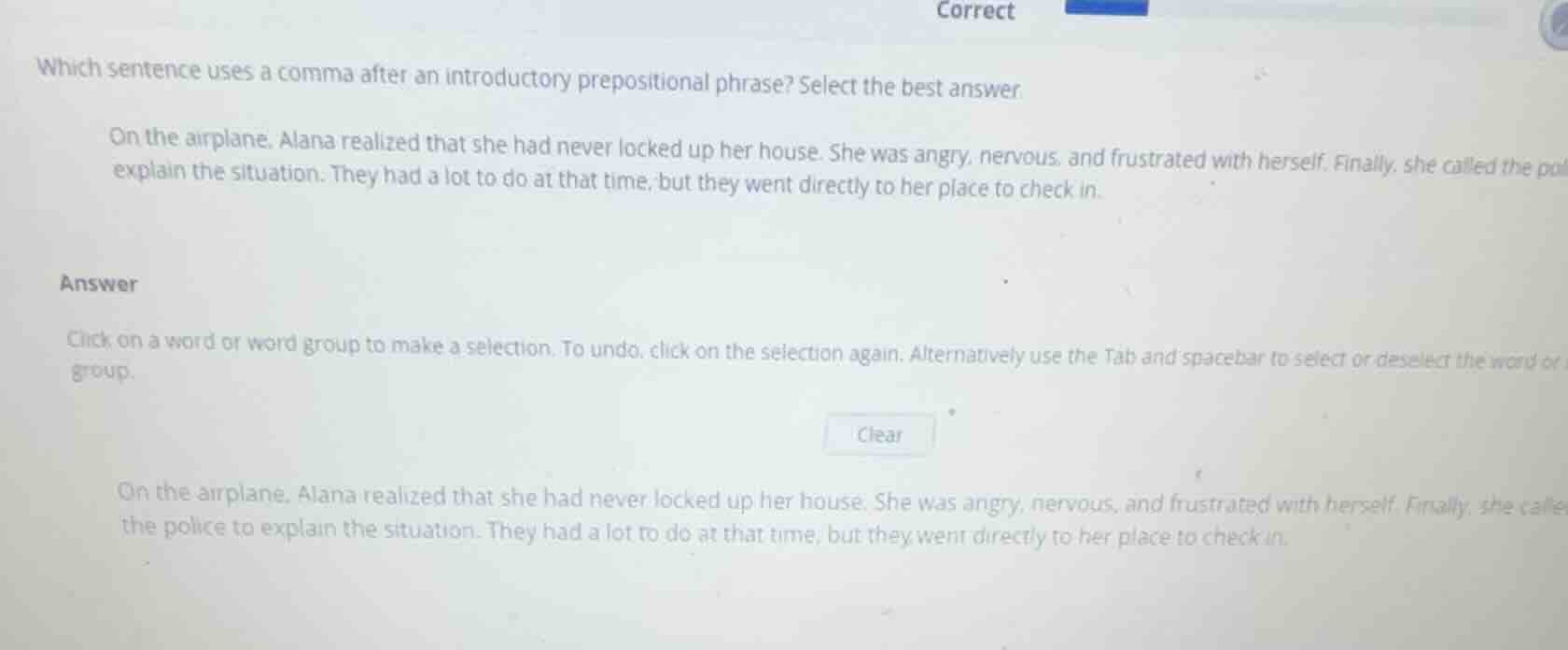
which sentence uses a comma after an introductory prepositional phrase? select the best answer.
on the airplane, alana realized that she had never locked up her house. she was angry, nervous, and frustrated with herself. finally, she called the police to explain the situation. they had a lot to do at that time, but they went directly to her place to check in.
🆕 New Concept Discovered: Introductory Prepositional Phrases
Setting the stage before the main clause.
Step 1: Define an introductory prepositional phrase
An introductory prepositional phrase is a group of words starting with a preposition (like on, in, under, after, through) that sets the scene (time, place, or condition) before the main part of the sentence. When it starts a sentence, it is often followed by a comma to separate it from the main independent clause.
Step 2: Analyze the sentences in the text
Let's look at each sentence to find a prepositional phrase at the beginning followed by a comma:
- "On the airplane, Alana realized that she had never locked up her house."
- "On the airplane" starts with the preposition "On" and functions as a prepositional phrase indicating location.
- It is followed immediately by a comma.
- The main clause is "Alana realized that she had never locked up her house."
- "She was angry, nervous, and frustrated with herself."
- This sentence uses commas to separate items in a list (serial commas), not after an introductory phrase.
- "Finally, she called the police to explain the situation."
- "Finally" is an introductory adverb, not a prepositional phrase.
- "They had a lot to do at that time, but they went directly to her place to check in."
- This sentence uses a comma before a coordinating conjunction ("but") to connect two independent clauses.
Step 3: Identify the correct sentence
The first sentence, "On the airplane, Alana realized that she had never locked up her house," is the only one that uses a comma directly after an introductory prepositional phrase.

Snap & solve any problem in the app
Get step-by-step solutions on Sovi AI
Photo-based solutions with guided steps
Explore more problems and detailed explanations
On the airplane, Alana realized that she had never locked up her house.