QUESTION IMAGE
Question
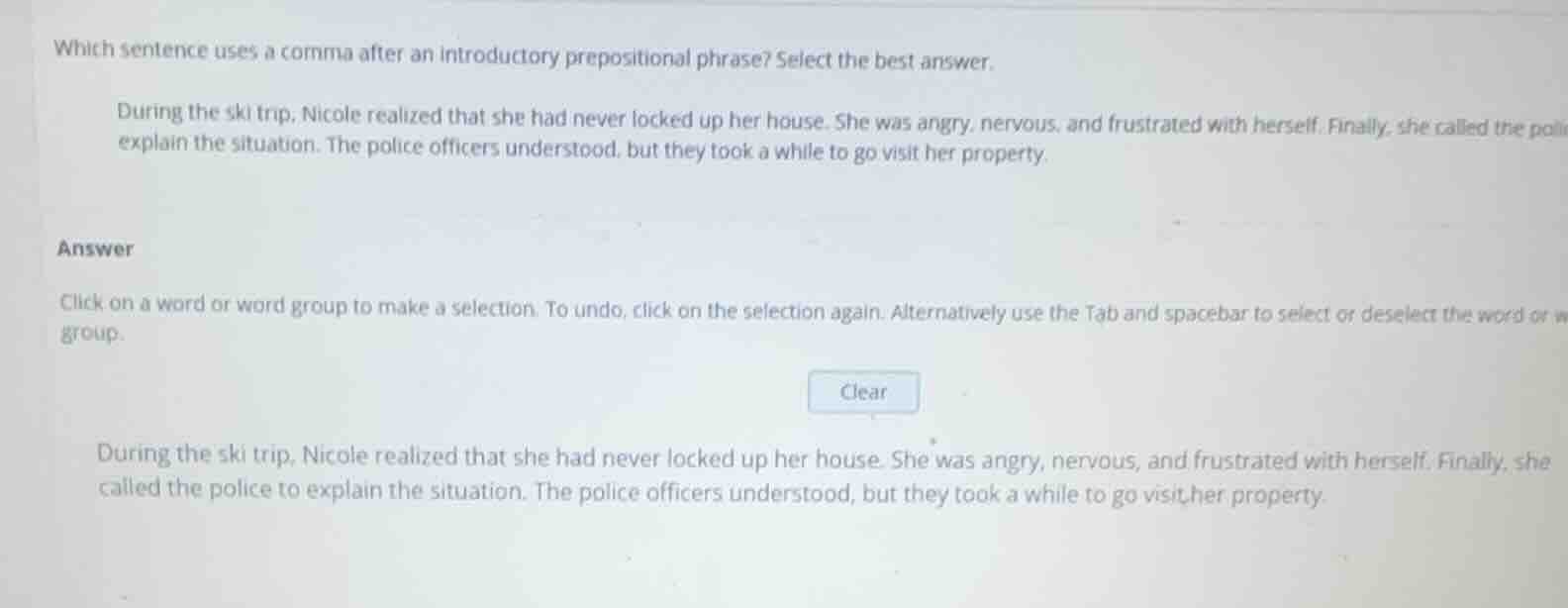
which sentence uses a comma after an introductory prepositional phrase? select the best answer.
during the ski trip, nicole realized that she had never locked up her house. she was angry, nervous, and frustrated with herself. finally, she called the police to explain the situation. the police officers understood, but they took a while to go visit her property.
answer
click on a word or word group to make a selection. to undo, click on the selection again. alternatively use the tab and spacebar to select or deselect the word or word group.
during the ski trip, nicole realized that she had never locked up her house. she was angry, nervous, and frustrated with herself. finally, she called the police to explain the situation. the police officers understood, but they took a while to go visit her property.
🆕 New Concept Discovered: Introductory Prepositional Phrases
Setting the scene before the main clause
Step 1: Understand introductory prepositional phrases
An introductory prepositional phrase is a group of words beginning with a preposition (like in, on, at, during, under, after) and ending with a noun or pronoun (the object of the preposition) that appears at the very beginning of a sentence.
When an introductory prepositional phrase is four or more words long (or to prevent confusion), it is followed by a comma before the main independent clause begins.
Step 2: Analyze each sentence in the passage
Let's look at each sentence to identify its structure and comma usage:
- "During the ski trip, Nicole realized that she had never locked up her house."
- "During the ski trip" starts with the preposition During and ends with the noun trip. It is a 4-word prepositional phrase at the start of the sentence, followed by a comma.
- "Nicole realized..." is the main independent clause.
- This sentence fits the criteria.
- "She was angry, nervous, and frustrated with herself."
- This sentence starts directly with the subject pronoun She. The commas here are used to separate items in a list (serial/Oxford commas).
- "Finally, she called the police to explain the situation."
- "Finally" is an introductory adverb, not a prepositional phrase.
- "The police officers understood, but they took a while to go visit her property."
- This sentence uses a comma before the coordinating conjunction but to connect two independent clauses.
Step 3: Identify the correct sentence
The first sentence is the only one that begins with an introductory prepositional phrase followed by a comma.

Snap & solve any problem in the app
Get step-by-step solutions on Sovi AI
Photo-based solutions with guided steps
Explore more problems and detailed explanations
During the ski trip, Nicole realized that she had never locked up her house.