QUESTION IMAGE
Question
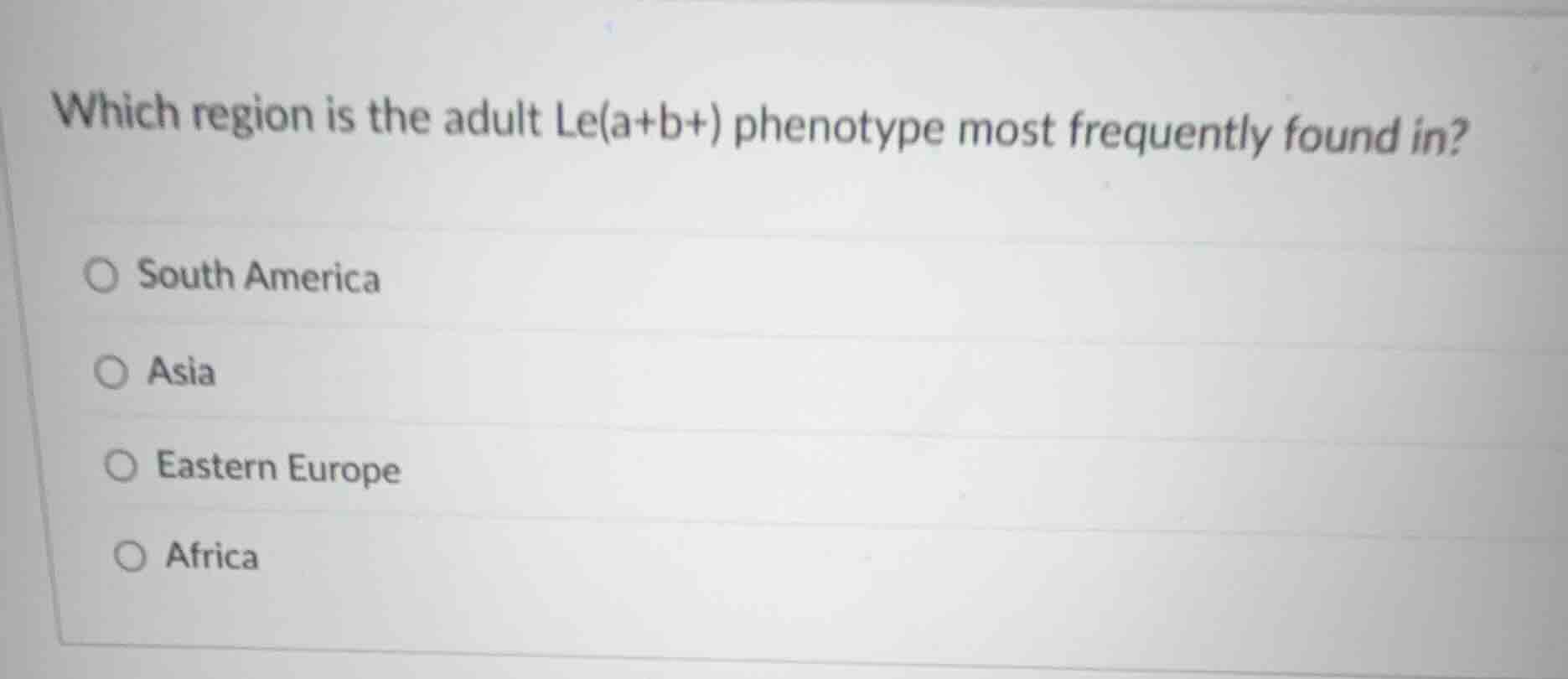
which region is the adult le(a+b+) phenotype most frequently found in?
south america
asia
eastern europe
africa
Understand the Lewis phenotype in adults
The question asks which geographic region has the highest frequency of the adult \(\text{Le(a+b+)}\) phenotype. In most global populations, the adult Lewis phenotypes are typically \(\text{Le(a+b-)}\), \(\text{Le(a-b+)}\), or \(\text{Le(a-b-)}\). The \(\text{Le(a+b+)}\) phenotype is extremely rare in adults of European and African descent but is observed with notable frequency in certain other populations.
Analyze population frequencies of Le(a+b+)
Using our understanding of Lewis Phenotypes, we recall that the \(\text{Le(a+b+)}\) phenotype is transiently seen in infants as they develop their Lewis antigens. However, in adults, it persists almost exclusively in individuals of Asian descent (particularly East Asian and Southeast Asian populations, such as Japanese, Chinese, and Taiwanese), where weak secretor alleles (\(\text{Se}^{w}\)) allow both \(\text{Le}^a\) and \(\text{Le}^b\) to be detected on red blood cells simultaneously.
Evaluate the given options
- South America: Very low frequency of adult \(\text{Le(a+b+)}\).
- Asia: High frequency of adult \(\text{Le(a+b+)}\) (up to 10–40% in certain East/Southeast Asian populations due to the \(\text{Se}^w\) gene).
- Eastern Europe: Extremely rare in adults (less than 1%).
- Africa: Extremely rare in adults (less than 1%).
Select the correct region
Therefore, the adult \(\text{Le(a+b+)}\) phenotype is most frequently found in Asia.

Snap & solve any problem in the app
Get step-by-step solutions on Sovi AI
Photo-based solutions with guided steps
Explore more problems and detailed explanations
- South America
- Asia (Correct answer)
- Eastern Europe
- Africa