QUESTION IMAGE
Question
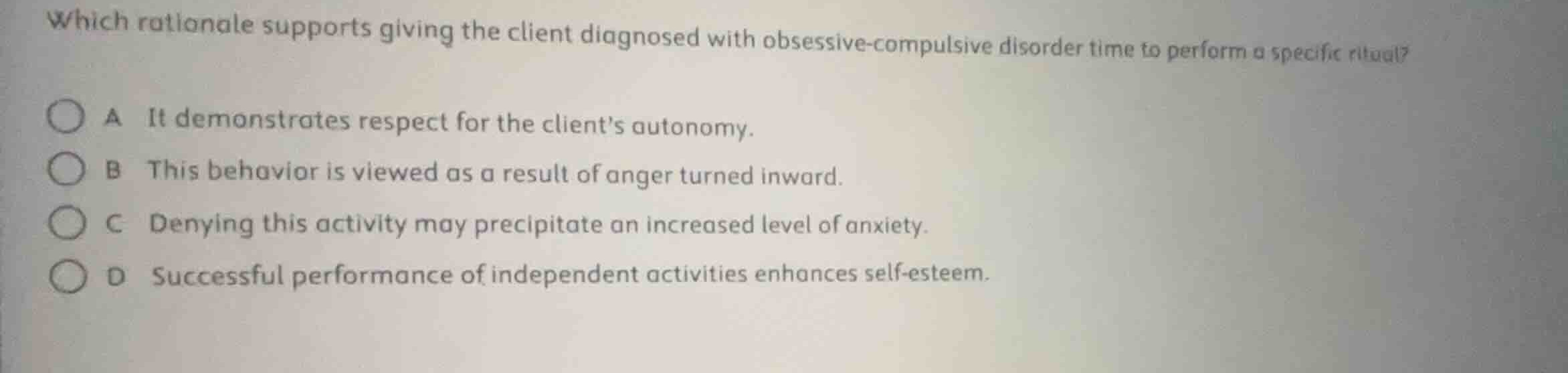
which rationale supports giving the client diagnosed with obsessive-compulsive disorder time to perform a specific ritual?
a it demonstrates respect for the clients autonomy.
b this behavior is viewed as a result of anger turned inward.
c denying this activity may precipitate an increased level of anxiety.
d successful performance of independent activities enhances self-esteem.
Analyze the clinical scenario
Using the Obsessive-Compulsive Disorder knowledge point
- The client has obsessive-compulsive disorder (OCD).
- The nursing action is allowing time for rituals.
Evaluate the purpose of rituals
Using the Ritualistic Behavior knowledge point
- Rituals serve as a defense mechanism.
- They help control or reduce severe anxiety.
Assess the impact of blocking rituals
Using the Anxiety Management knowledge point
- Preventing rituals increases anxiety significantly.
- Initial care plans must allow ritual time.
Compare the multiple-choice options
- Option A: Autonomy is not the primary clinical rationale.
- Option B: Anger turned inward describes depression, not OCD.
- Option C: Denying the ritual increases anxiety levels.
- Option D: Rituals are maladaptive, not self-esteem builders.
Select the correct rationale
- Option C directly aligns with clinical anxiety management.
- Allowing rituals prevents panic-level anxiety initially.

Snap & solve any problem in the app
Get step-by-step solutions on Sovi AI
Photo-based solutions with guided steps
Explore more problems and detailed explanations
- A It demonstrates respect for the client's autonomy.
- B This behavior is viewed as a result of anger turned inward.
- C Denying this activity may precipitate an increased level of anxiety. (Correct answer)
- D Successful performance of independent activities enhances self-esteem.