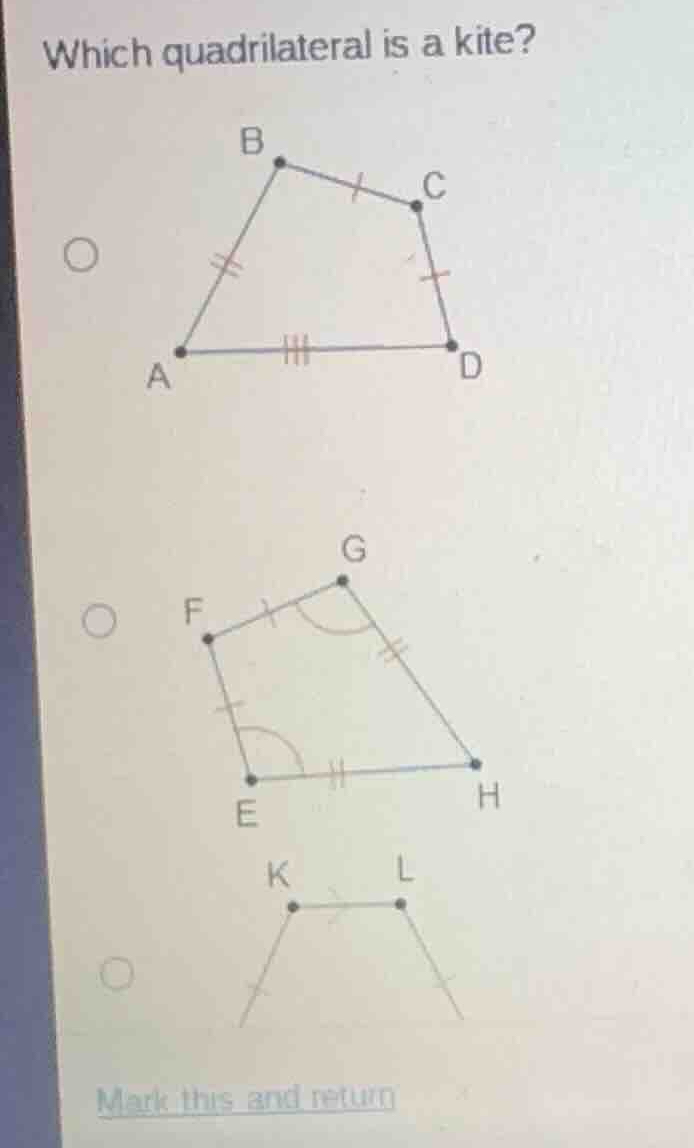
QUESTION IMAGE
Question
which quadrilateral is a kite?
mark this and return
<pre_analysis>
{
"quality": "clear",
"question_count": 1,
"skills_matched": [
"direct_cot",
"multiple_choice_formatter",
"explain_then_answer",
"tutor",
"mastery_adaptive_brevity"
],
"needs_drawing": false,
"concepts_used": [
"Kite Properties"
],
"new_concepts": [],
"current_concepts": [
"Kite Properties",
"Quadrilateral Classification"
]
}
</pre_analysis>
<reasoning>
Define a kite
Using the Kite Properties knowledge point
A kite is defined as a quadrilateral with two distinct pairs of equal-length adjacent sides.
Analyze the first quadrilateral ABCD
Using the Kite Properties knowledge point
- Side \(AB\) has a double tick mark.
- Side \(BC\) has a single tick mark.
- Side \(CD\) has a single tick mark.
- Side \(DA\) has a triple tick mark.
- Adjacent sides \(BC\) and \(CD\) are equal (\(BC = CD\)), but the other two adjacent sides \(AB\) and \(DA\) are not equal (\(AB
eq DA\)). Thus, \(ABCD\) is not a kite.
Analyze the second quadrilateral EFGH
Using the Kite Properties knowledge point
- Side \(EF\) has a single tick mark.
- Side \(FG\) has a single tick mark.
- Side \(GH\) has a double tick mark.
- Side \(HE\) has a double tick mark.
- This gives two distinct pairs of equal-length adjacent sides: \(EF = FG\) and \(GH = HE\). Thus, \(EFGH\) is a kite.
Analyze the third quadrilateral KL...
Using the Kite Properties knowledge point
- Side \(KL\) has a parallel arrow mark.
- The two non-parallel sides have single tick marks, indicating an isosceles trapezoid. Thus, this is not a kite.
</reasoning>
<answer>
<mcq-option>(A) Quadrilateral ABCD</mcq-option>
<mcq-correct>(B) Quadrilateral EFGH</mcq-correct>
<mcq-option>(C) Quadrilateral KL...</mcq-option>
</answer>
<post_analysis>
{
"subject": "Mathematics",
"question_type": "Multiple Choice",
"knowledge_point": [
"Mathematics",
"Geometry",
"Kite Properties"
]
}
</post_analysis>
Snap & solve any problem in the app
Get step-by-step solutions on Sovi AI
Photo-based solutions with guided steps
Explore more problems and detailed explanations
<pre_analysis>
{
"quality": "clear",
"question_count": 1,
"skills_matched": [
"direct_cot",
"multiple_choice_formatter",
"explain_then_answer",
"tutor",
"mastery_adaptive_brevity"
],
"needs_drawing": false,
"concepts_used": [
"Kite Properties"
],
"new_concepts": [],
"current_concepts": [
"Kite Properties",
"Quadrilateral Classification"
]
}
</pre_analysis>
<reasoning>
Define a kite
Using the Kite Properties knowledge point
A kite is defined as a quadrilateral with two distinct pairs of equal-length adjacent sides.
Analyze the first quadrilateral ABCD
Using the Kite Properties knowledge point
- Side \(AB\) has a double tick mark.
- Side \(BC\) has a single tick mark.
- Side \(CD\) has a single tick mark.
- Side \(DA\) has a triple tick mark.
- Adjacent sides \(BC\) and \(CD\) are equal (\(BC = CD\)), but the other two adjacent sides \(AB\) and \(DA\) are not equal (\(AB
eq DA\)). Thus, \(ABCD\) is not a kite.
Analyze the second quadrilateral EFGH
Using the Kite Properties knowledge point
- Side \(EF\) has a single tick mark.
- Side \(FG\) has a single tick mark.
- Side \(GH\) has a double tick mark.
- Side \(HE\) has a double tick mark.
- This gives two distinct pairs of equal-length adjacent sides: \(EF = FG\) and \(GH = HE\). Thus, \(EFGH\) is a kite.
Analyze the third quadrilateral KL...
Using the Kite Properties knowledge point
- Side \(KL\) has a parallel arrow mark.
- The two non-parallel sides have single tick marks, indicating an isosceles trapezoid. Thus, this is not a kite.
</reasoning>
<answer>
<mcq-option>(A) Quadrilateral ABCD</mcq-option>
<mcq-correct>(B) Quadrilateral EFGH</mcq-correct>
<mcq-option>(C) Quadrilateral KL...</mcq-option>
</answer>
<post_analysis>
{
"subject": "Mathematics",
"question_type": "Multiple Choice",
"knowledge_point": [
"Mathematics",
"Geometry",
"Kite Properties"
]
}
</post_analysis>