QUESTION IMAGE
Question
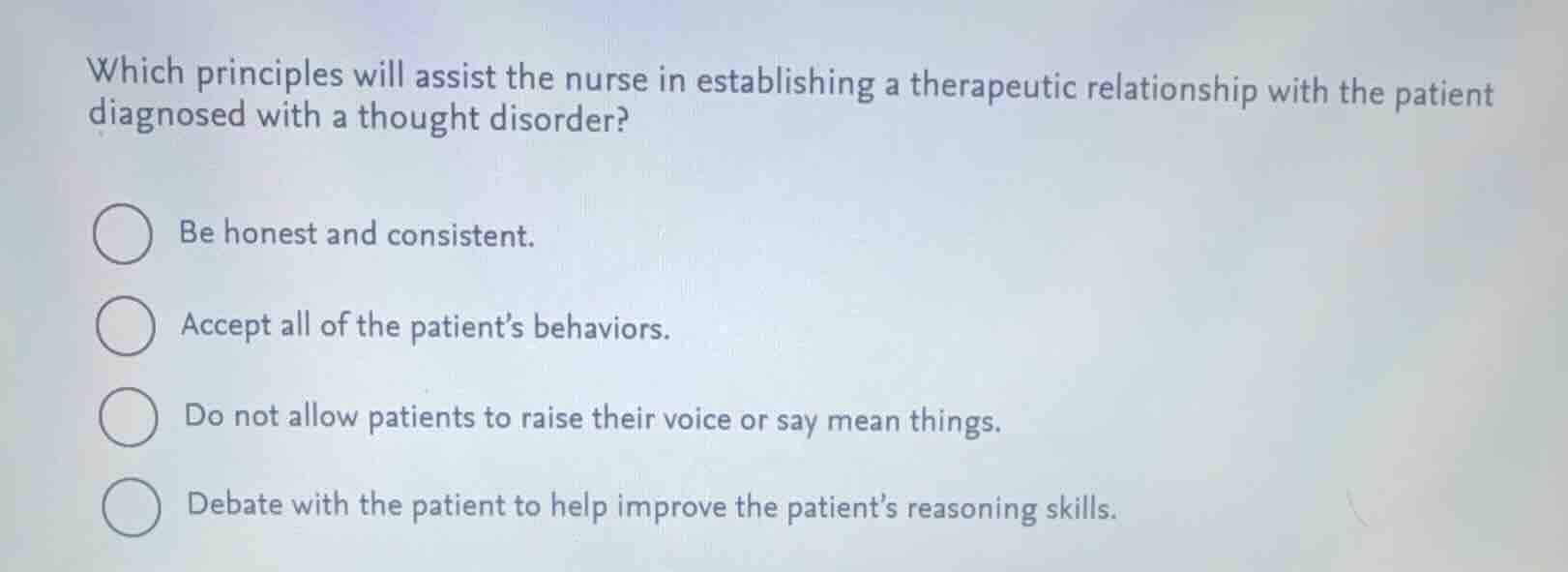
which principles will assist the nurse in establishing a therapeutic relationship with the patient diagnosed with a thought disorder?
be honest and consistent.
accept all of the patients behaviors.
do not allow patients to raise their voice or say mean things.
debate with the patient to help improve the patients reasoning skills.
Analyze the clinical needs of a patient with a thought disorder
Patients with thought disorders (such as schizophrenia) often experience paranoia, delusions, and difficulty trusting others, making trust-building the foundational priority.
Evaluate the options against therapeutic communication principles
- Be honest and consistent: Promotes trust, predictability, and safety, which are essential for patients with impaired reality testing.
- Accept all of the patient's behaviors: Incorrect; while the nurse accepts the patient as a person, harmful, aggressive, or highly inappropriate behaviors must have therapeutic boundaries.
- Do not allow patients to raise their voice or say mean things: Incorrect; this is overly punitive and unrealistic in acute psychiatric settings where patients may express distress verbally.
- Debate with the patient to help improve the patient's reasoning skills: Incorrect; debating or arguing with delusional beliefs is non-therapeutic and reinforces the delusion or increases paranoia.
Select the correct option
The principle that directly assists in establishing a therapeutic relationship is being honest and consistent.

Snap & solve any problem in the app
Get step-by-step solutions on Sovi AI
Photo-based solutions with guided steps
Explore more problems and detailed explanations
- Be honest and consistent. (Correct answer)
- Accept all of the patient’s behaviors.
- Do not allow patients to raise their voice or say mean things.
- Debate with the patient to help improve the patient’s reasoning skills.