QUESTION IMAGE
Question
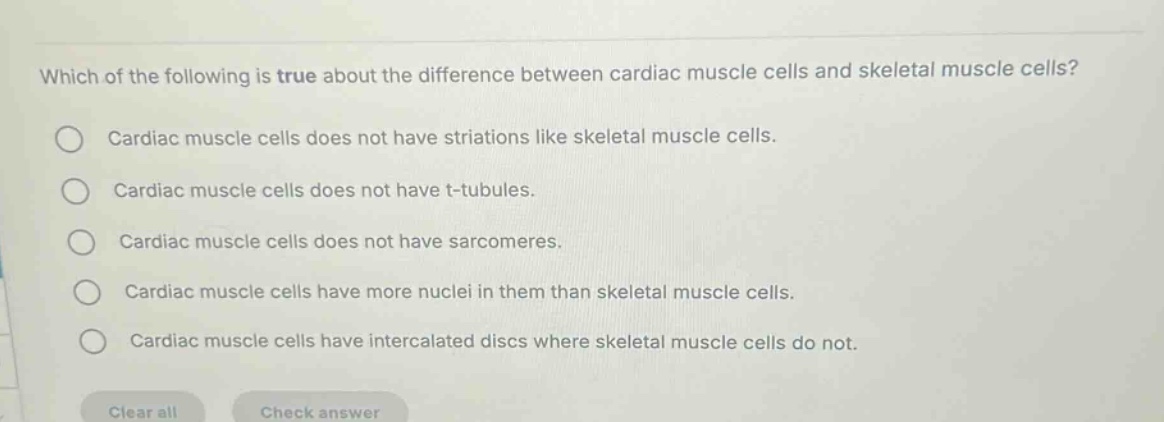
which of the following is true about the difference between cardiac muscle cells and skeletal muscle cells?
cardiac muscle cells does not have striations like skeletal muscle cells.
cardiac muscle cells does not have t-tubules.
cardiac muscle cells does not have sarcomeres.
cardiac muscle cells have more nuclei in them than skeletal muscle cells.
cardiac muscle cells have intercalated discs where skeletal muscle cells do not.
🆕 New Concept Discovered: Muscle Tissue Differentiation
Comparing structural features of muscle types.
Step 1: Analyze shared features of cardiac and skeletal muscle
Both cardiac and skeletal muscle cells are striated, meaning they contain organized repeating functional units called sarcomeres. Because they both have sarcomeres, they also both utilize transverse tubules (t-tubules) to help conduct electrical impulses deep into the cell.
This allows us to evaluate the first three options:
- “Cardiac muscle cells does not have striations...” is false (both are striated).
- “Cardiac muscle cells does not have t-tubules” is false (both have them).
- “Cardiac muscle cells does not have sarcomeres” is false (both have them).
Step 2: Compare nuclei count
Skeletal muscle cells are formed by the fusion of many precursor cells (myoblasts), making them highly multinucleated (containing many nuclei per cell). In contrast, cardiac muscle cells typically contain only one or two centrally located nuclei.
- “Cardiac muscle cells have more nuclei in them than skeletal muscle cells” is false (skeletal muscle cells have far more).
Step 3: Identify unique structures
Cardiac muscle cells must contract in a highly synchronized, wave-like fashion to pump blood effectively. To achieve this, individual cardiac cells are joined end-to-end by specialized junctional regions called intercalated discs. These discs contain gap junctions (for rapid electrical communication) and desmosomes (to hold the cells tightly together during contraction). Skeletal muscle fibers function independently and do not possess these discs.
- “Cardiac muscle cells have intercalated discs where skeletal muscle cells do not” is true.

Snap & solve any problem in the app
Get step-by-step solutions on Sovi AI
Photo-based solutions with guided steps
Explore more problems and detailed explanations
Cardiac muscle cells have intercalated discs where skeletal muscle cells do not.