QUESTION IMAGE
Question
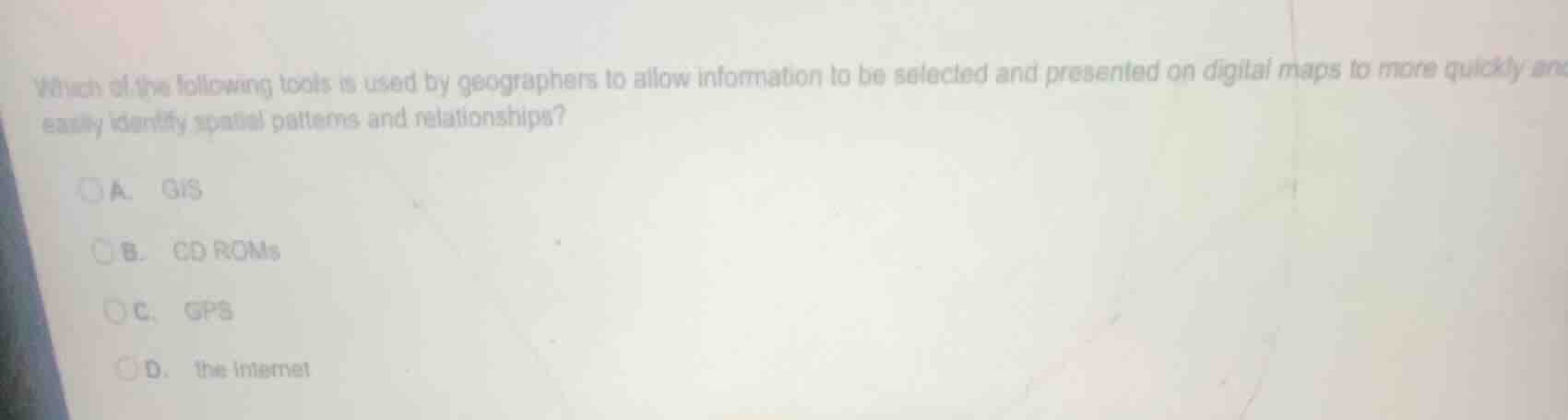
which of the following tools is used by geographers to allow information to be selected and presented on digital maps to more quickly and easily identify spatial patterns and relationships?
a. gis
b. cd roms
c. gps
d. the internet
<pre_analysis>
{
"quality": "clear",
"question_count": 1,
"skills_matched": [
"direct_cot",
"multiple_choice_formatter",
"explain_then_answer",
"tutor"
],
"needs_drawing": false,
"concepts_used": [
"Technological Evolution"
],
"new_concepts": [
"Geographic Information Systems",
"Geospatial Technology"
],
"current_concepts": [
"Technological Evolution",
"Geographic Information Systems",
"Geospatial Technology"
]
}
</pre_analysis>
<reasoning>
Analyze the question prompt
The question asks for a tool used by geographers to select and present information on digital maps to identify spatial patterns and relationships.
Evaluate the options
- GIS (Geographic Information Systems): This technology integrates, stores, edits, analyzes, shares, and displays geographic information on digital maps, specifically helping to identify spatial patterns.
- CD ROMs: These are physical storage media, not a mapping or spatial analysis tool.
- GPS (Global Positioning System): This is primarily used for determining precise absolute locations on Earth, rather than layering and analyzing complex spatial datasets.
- The Internet: This is a global network for sharing information, not a specific geographical tool for spatial analysis.
Connect to technological evolution
Using Technological Evolution, we see how geographic tools transitioned from static paper maps to dynamic digital databases like GIS.
Determine the correct answer
GIS is the specific tool designed for layering spatial data to analyze relationships.
</reasoning>
<answer>
<mcq-correct>(A) GIS</mcq-correct>
<mcq-option>(B) CD ROMs</mcq-option>
<mcq-option>(C) GPS</mcq-option>
<mcq-option>(D) the internet</mcq-option>
</answer>
<post_analysis>
{
"subject": "Social Science",
"question_type": "Multiple Choice",
"knowledge_point": [
"Social Science",
"Geography",
"Geographic Information Systems"
]
}
</post_analysis>
Snap & solve any problem in the app
Get step-by-step solutions on Sovi AI
Photo-based solutions with guided steps
Explore more problems and detailed explanations
<pre_analysis>
{
"quality": "clear",
"question_count": 1,
"skills_matched": [
"direct_cot",
"multiple_choice_formatter",
"explain_then_answer",
"tutor"
],
"needs_drawing": false,
"concepts_used": [
"Technological Evolution"
],
"new_concepts": [
"Geographic Information Systems",
"Geospatial Technology"
],
"current_concepts": [
"Technological Evolution",
"Geographic Information Systems",
"Geospatial Technology"
]
}
</pre_analysis>
<reasoning>
Analyze the question prompt
The question asks for a tool used by geographers to select and present information on digital maps to identify spatial patterns and relationships.
Evaluate the options
- GIS (Geographic Information Systems): This technology integrates, stores, edits, analyzes, shares, and displays geographic information on digital maps, specifically helping to identify spatial patterns.
- CD ROMs: These are physical storage media, not a mapping or spatial analysis tool.
- GPS (Global Positioning System): This is primarily used for determining precise absolute locations on Earth, rather than layering and analyzing complex spatial datasets.
- The Internet: This is a global network for sharing information, not a specific geographical tool for spatial analysis.
Connect to technological evolution
Using Technological Evolution, we see how geographic tools transitioned from static paper maps to dynamic digital databases like GIS.
Determine the correct answer
GIS is the specific tool designed for layering spatial data to analyze relationships.
</reasoning>
<answer>
<mcq-correct>(A) GIS</mcq-correct>
<mcq-option>(B) CD ROMs</mcq-option>
<mcq-option>(C) GPS</mcq-option>
<mcq-option>(D) the internet</mcq-option>
</answer>
<post_analysis>
{
"subject": "Social Science",
"question_type": "Multiple Choice",
"knowledge_point": [
"Social Science",
"Geography",
"Geographic Information Systems"
]
}
</post_analysis>