QUESTION IMAGE
Question
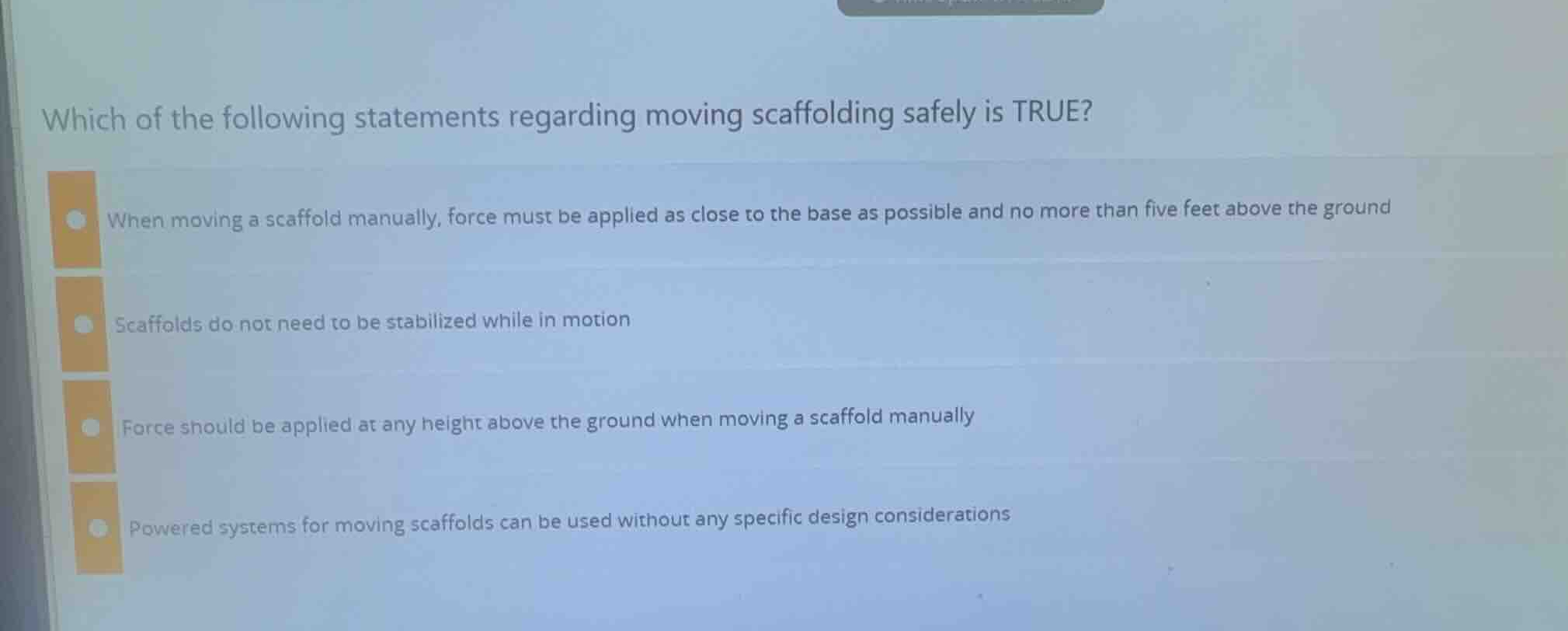
which of the following statements regarding moving scaffolding safely is true?
when moving a scaffold manually, force must be applied as close to the base as possible and no more than five feet above the ground
scaffolds do not need to be stabilized while in motion
force should be applied at any height above the ground when moving a scaffold manually
powered systems for moving scaffolds can be used without any specific design considerations
Analyze OSHA standards for moving mobile scaffolds
OSHA standard 29 CFR 1926.452(w)(3) requires that manual force used to move a scaffold must be applied as close to the base as possible, and not more than 5 feet (1.5 meters) above the supporting surface.
Evaluate the given options
- Option 1: Correctly states that force must be applied as close to the base as possible and no more than five feet above the ground to prevent tipping.
- Option 2: Incorrect, scaffolds must be stabilized to prevent tipping while in motion.
- Option 3: Incorrect, applying force at any height (especially high up) increases the risk of tipping.
- Option 4: Incorrect, powered systems require specific design considerations to ensure safe movement.

Snap & solve any problem in the app
Get step-by-step solutions on Sovi AI
Photo-based solutions with guided steps
Explore more problems and detailed explanations
- (A) When moving a scaffold manually, force must be applied as close to the base as possible and no more than five feet above the ground (Correct answer)
- (B) Scaffolds do not need to be stabilized while in motion
- (C) Force should be applied at any height above the ground when moving a scaffold manually
- (D) Powered systems for moving scaffolds can be used without any specific design considerations