QUESTION IMAGE
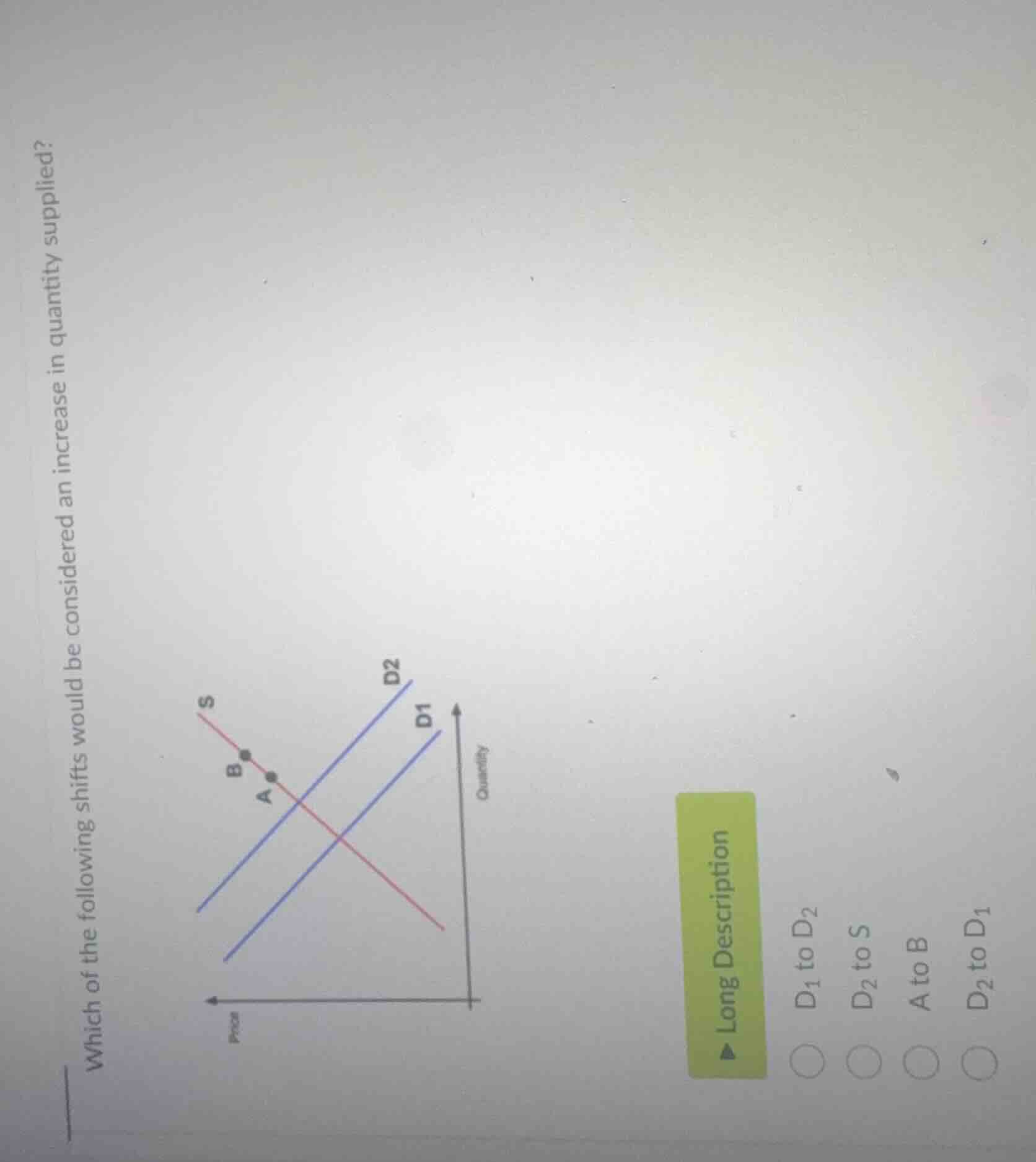
Question
which of the following shifts would be considered an increase in quantity supplied?
- \\(d_1\\) to \\(d_2\\)
- \\(d_2\\) to \\(s\\)
- a to b
- \\(d_2\\) to \\(d_1\\)
Distinguish supply shifts from quantity supplied changes
An increase in "quantity supplied" is a movement along a fixed supply curve \(S\) to a higher price and quantity. This is distinct from a shift of the supply curve itself. We must look for a change that causes price to rise, inducing producers to move upward along the existing supply curve \(S\).
Analyze the effect of demand shifts on supply
Using the Demand Shift concept, when demand shifts rightward from \(D_1\) to \(D_2\), the market equilibrium moves along the stable supply curve \(S\). This rightward shift in demand increases the equilibrium price.
Apply the law of supply to find the movement
Using the Law of Supply concept, the higher market price resulting from the demand shift from \(D_1\) to \(D_2\) incentivizes producers to increase their output. This causes an upward movement along the supply curve \(S\) (from point A toward point B), which represents an increase in quantity supplied.
Evaluate the given multiple-choice options
- \(D_1\) to \(D_2\): This rightward shift in demand increases price, causing a movement along the supply curve \(S\) (an increase in quantity supplied). This is correct.
- \(D_2\) to \(S\): This compares two different curves and does not represent a market shift.
- A to B: This movement along the supply curve \(S\) is a decrease in quantity supplied because it moves to a lower quantity.
- \(D_2\) to \(D_1\): This leftward shift in demand decreases price, leading to a decrease in quantity supplied.

Snap & solve any problem in the app
Get step-by-step solutions on Sovi AI
Photo-based solutions with guided steps
Explore more problems and detailed explanations
- (A) \(D_1\) to \(D_2\) (Correct answer)
- (B) \(D_2\) to S
- (C) A to B
- (D) \(D_2\) to \(D_1\)