QUESTION IMAGE
Question
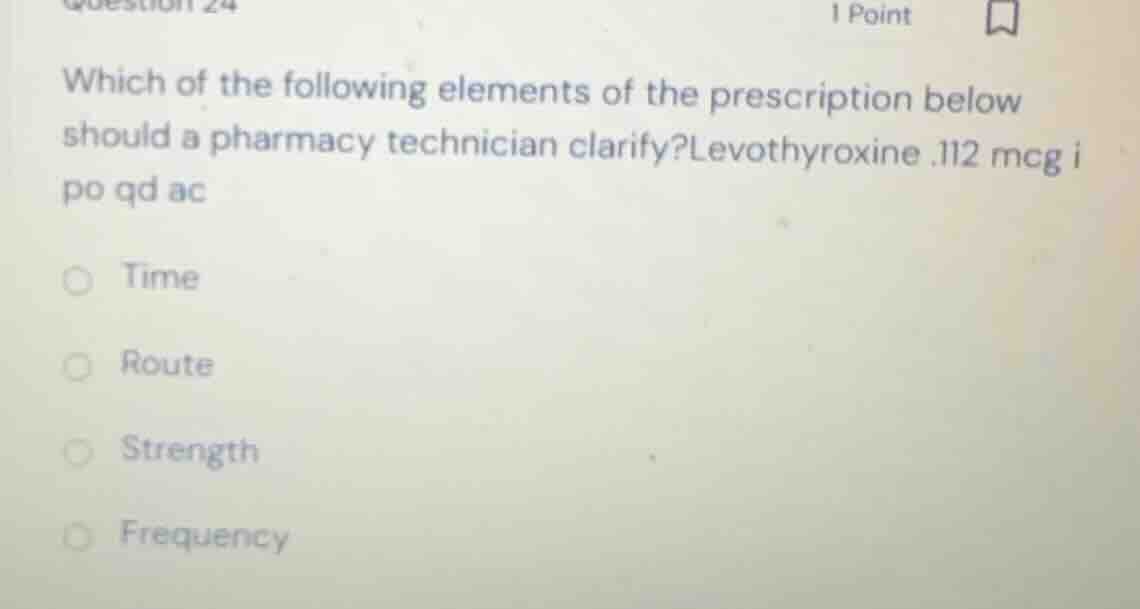
which of the following elements of the prescription below should a pharmacy technician clarify? levothyroxine .112 mcg i po qd ac
time
route
strength
frequency
Analyze the prescription elements
The prescription text is: "Levothyroxine .112 mcg i po qd ac".
We examine each component:
- Drug: Levothyroxine
- Strength: ".112 mcg"
- Quantity/Dose: "i" (one)
- Route: "po" (by mouth)
- Frequency: "qd" (every day)
- Timing: "ac" (before meals)
Identify safety risks
Using the Medication Safety and ISMP Guidelines knowledge points, we evaluate the safety of each written element:
- The strength is written as ".112 mcg". Writing a decimal without a leading zero (a naked decimal point) is highly error-prone. It can easily be misread as "112 mcg" if the decimal point is overlooked, which is a common source of dosing errors.
- Furthermore, levothyroxine is typically dosed in micrograms (mcg), with common strengths being 112 mcg (0.112 mg). Writing ".112 mcg" is clinically highly unusual and likely a transcription error for "0.112 mg" (which equals 112 mcg) or "112 mcg".
Evaluate the options
Using the Error-Prone Abbreviations knowledge point:
- Time: "ac" (before meals) is clear.
- Route: "po" (by mouth) is clear.
- Strength: ".112 mcg" contains a naked decimal point and an extremely unusual dose value, requiring immediate clarification.
- Frequency: "qd" is on the joint commission's do-not-use list, but the most critical, immediate safety risk regarding the numerical value itself lies in the strength.
Determine the best answer
The strength ".112 mcg" is highly ambiguous and dangerous due to the naked decimal and incorrect unit/value combination, making "Strength" the primary element to clarify.

Snap & solve any problem in the app
Get step-by-step solutions on Sovi AI
Photo-based solutions with guided steps
Explore more problems and detailed explanations
- Time
- Route
- Strength (Correct answer)
- Frequency