QUESTION IMAGE
Question
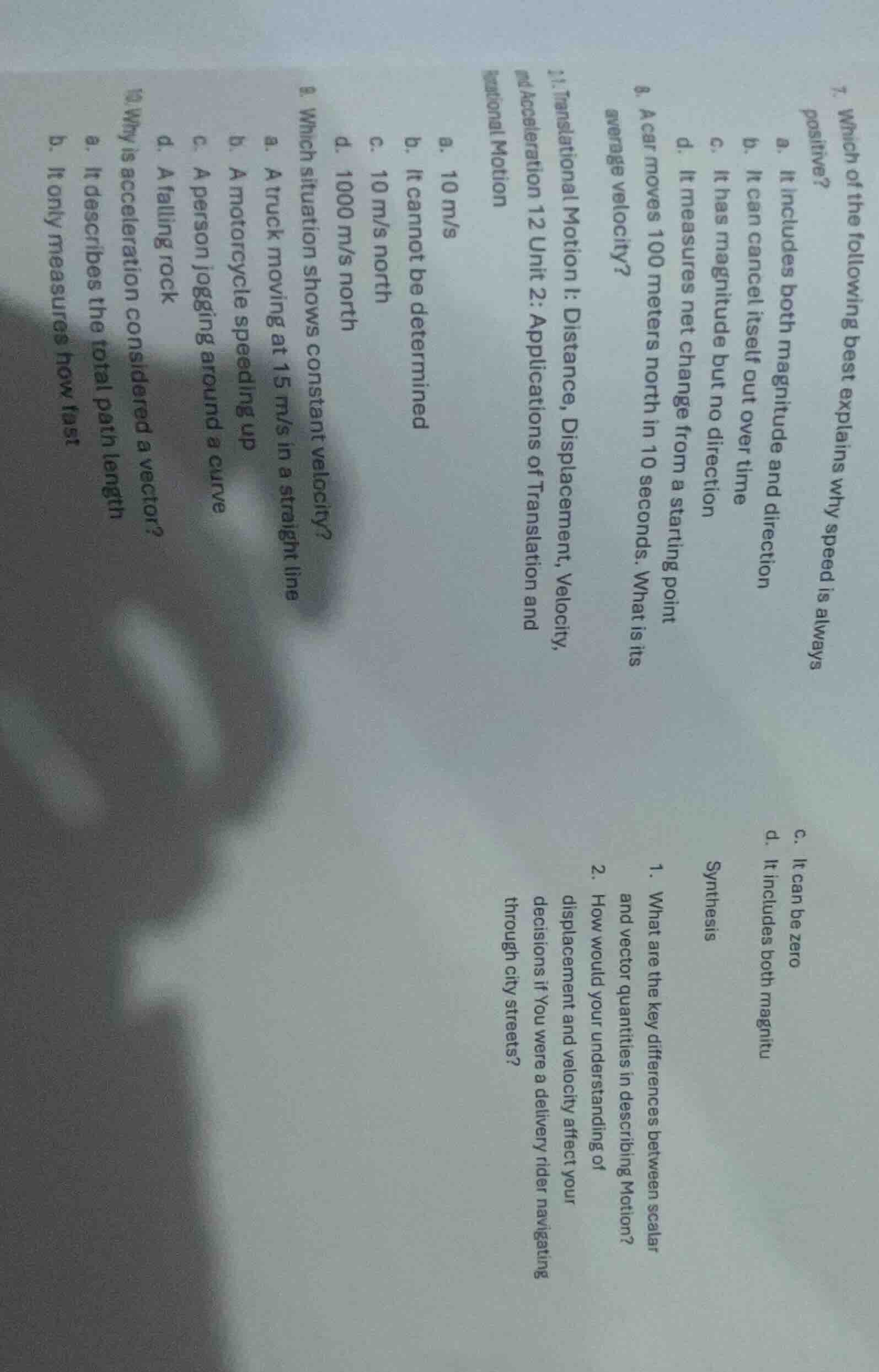
- which of the following best explains why speed is always positive?
a. it includes both magnitude and direction
b. it can cancel itself out over time
c. it can be zero
d. it includes both magnitude
- a car moves 100 meters north in 10 seconds. what is its average velocity?
a. 10 m/s
b. it cannot be determined
c. 10 m/s north
d. 1000 m/s north
- which situation shows constant velocity?
a. a truck moving at 15 m/s in a straight line
b. a motorcycle speeding up
c. a person jogging around a curve
d. a falling rock
- why is acceleration considered a vector?
a. it describes the total path length
b. it only measures how fast
synthesis
- what are the key differences between scalar and vector quantities in describing motion?
- how would your understanding of displacement and velocity affect your decisions if you were a delivery rider navigating through city streets?
Analyze speed properties
Speed is a scalar quantity. It represents the magnitude of the rate of change of position. Since magnitude is always non-negative, speed is always positive (or zero when stationary). Looking at the options for Question 7:
- Option (a) describes a vector.
- Option (b) is incorrect.
- Option (c) is incorrect.
- Option (d) states "It includes both magnitude" (cut off, but refers to magnitude only). Thus, speed is always positive because it only measures the magnitude of motion, not direction.
Calculate average velocity
Using the SI Units of Motion and velocity definitions:
Average velocity is displacement divided by time:
Given:
- Displacement \(\Delta \vec{x} = 100\text{ meters north}\)
- Time \(\Delta t = 10\text{ seconds}\)
This matches option (c).
Identify constant velocity
Constant velocity requires both constant speed and constant direction (straight-line motion).
- Option (a): "A truck moving at 15 m/s in a straight line" has both constant speed and constant direction.
- Option (b): "A motorcycle speeding up" has changing speed.
- Option (c): "A person jogging around a curve" has changing direction.
- Option (d): "A falling rock" is accelerating due to gravity (changing speed).
Thus, option (a) represents constant velocity.
Explain acceleration vector nature
Using the Acceleration Definition knowledge point:
Acceleration is a vector quantity because it is defined as the rate of change of velocity over time:
Since velocity is a vector (having both magnitude and direction), any change in its magnitude or direction results in acceleration. Therefore, acceleration must have both magnitude and direction.
- Option (a) states "It describes the total path length" (incorrect).
- Option (b) states "It only measures how fast" (incorrect).
- Option (c) (cut off) or the definition of a vector explains that it includes both magnitude and direction.

Snap & solve any problem in the app
Get step-by-step solutions on Sovi AI
Photo-based solutions with guided steps
Explore more problems and detailed explanations
Question 7
- a. It includes both magnitude and direction
- b. It can cancel itself out over time
- c. It can be zero
- d. It includes both magnitude (only) (Correct answer)
Question 8
- a. 10 m/s
- b. It cannot be determined
- c. 10 m/s north (Correct answer)
- d. 1000 m/s north
Question 9
- a. A truck moving at 15 m/s in a straight line (Correct answer)
- b. A motorcycle speeding up
- c. A person jogging around a curve
- d. A falling rock
Question 10
- c. It includes both magnitude and direction (Correct answer)
- a. It describes the total path length
- b. It only measures how fast
Synthesis Question 1
Scalar quantities are fully described by a magnitude (numerical value) alone, such as speed or distance. Vector quantities require both a magnitude and a specific direction to be fully described, such as velocity or displacement.
Synthesis Question 2
A delivery rider must navigate real street grids where the actual path traveled (distance, a scalar) is longer than the straight-line route (displacement, a vector). Understanding velocity (speed with direction) allows the rider to optimize routes through one-way streets and anticipate changes in direction at intersections.