QUESTION IMAGE
Question
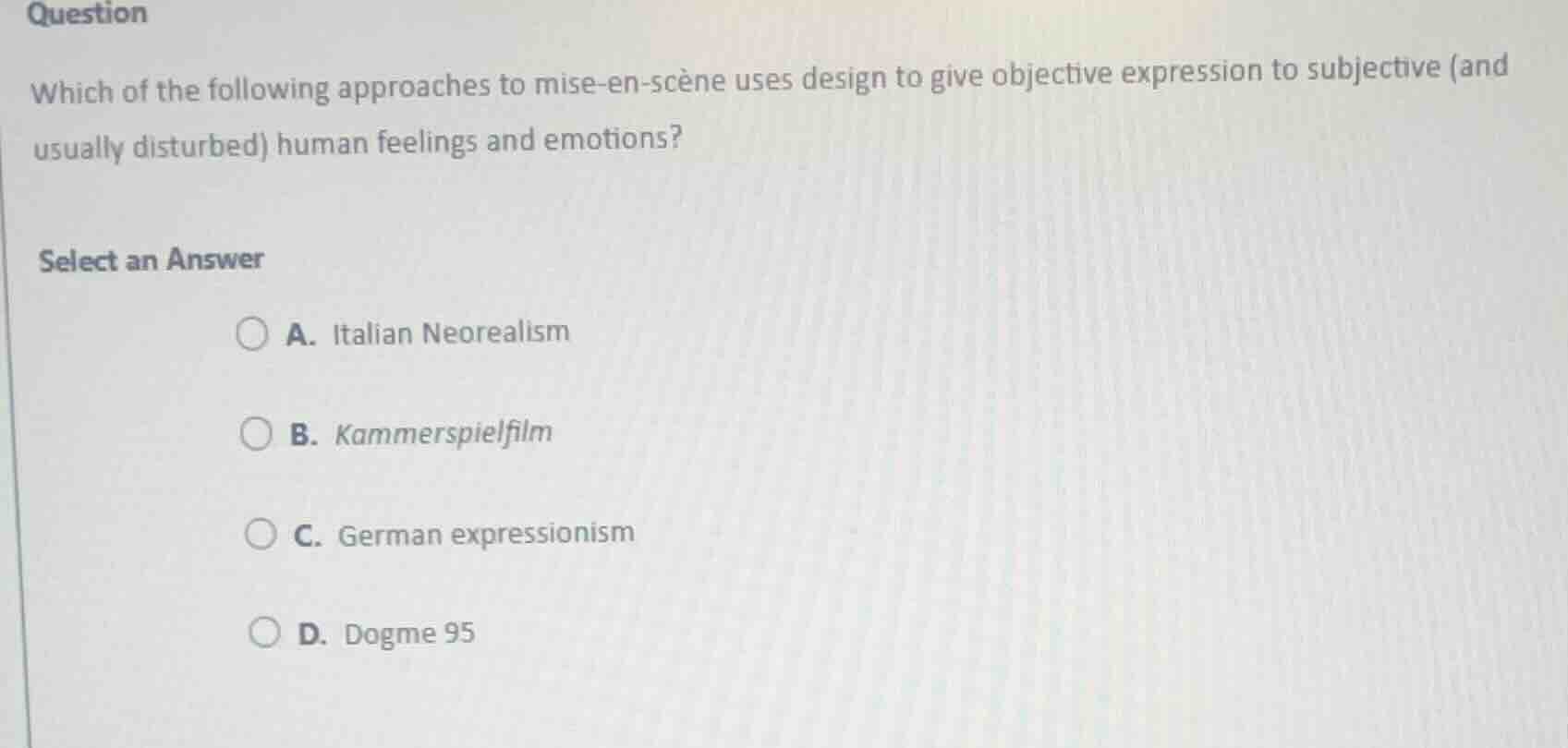
which of the following approaches to mise-en-scène uses design to give objective expression to subjective (and usually disturbed) human feelings and emotions?
select an answer
a. italian neorealism
b. kammerspielfilm
c. german expressionism
d. dogme 95
<pre_analysis>
{
"quality": "clear",
"question_count": 1,
"skills_matched": [
"direct_cot",
"multiple_choice_formatter",
"explain_then_answer",
"tutor"
],
"needs_drawing": false,
"concepts_used": [
"Mise-en-scène",
"Film Analysis"
],
"new_concepts": [
"German Expressionism",
"Film Movements"
],
"current_concepts": [
"Mise-en-scène",
"Film Analysis",
"German Expressionism",
"Film Movements"
]
}
</pre_analysis>
<reasoning>
Identify the core question
The question asks for a specific approach to Mise-en-scène that uses design to give objective expression to subjective, often disturbed, human feelings and emotions.
Analyze the definition
The key phrase is "objective expression to subjective (and usually disturbed) human feelings." This is the literal definition of expressionism in art and film, where the external world (the mise-en-scène, including sets, lighting, and angles) is distorted to reflect the internal psychological state of the characters.
Evaluate the options
- A. Italian Neorealism: Focuses on realistic, on-location filming and everyday working-class life, avoiding highly stylized design.
- B. Kammerspielfilm: "Chamber drama" films focusing on intimate, realistic character psychology, but not characterized primarily by highly distorted, expressive design.
- C. German expressionism: Famous for using highly stylized, distorted sets, dramatic shadows, and non-realistic design to represent inner psychological states and disturbed emotions.
- D. Dogme 95: A movement with strict rules promoting realism, natural light, and no artificial sets or props.
Connect to mastered concepts
Using Film Analysis and our understanding of Mise-en-scène, we can conclude that German expressionism perfectly matches the description of using external design elements to project internal, subjective emotions.
</reasoning>
<answer>
<mcq-option>A. Italian Neorealism</mcq-option>
<mcq-option>B. Kammerspielfilm</mcq-option>
<mcq-correct>C. German expressionism</mcq-correct>
<mcq-option>D. Dogme 95</mcq-option>
</answer>
<post_analysis>
{
"subject": "Arts",
"question_type": "Multiple Choice",
"knowledge_point": [
"Arts",
"Film Studies",
"German Expressionism"
]
}
</post_analysis>
Snap & solve any problem in the app
Get step-by-step solutions on Sovi AI
Photo-based solutions with guided steps
Explore more problems and detailed explanations
<pre_analysis>
{
"quality": "clear",
"question_count": 1,
"skills_matched": [
"direct_cot",
"multiple_choice_formatter",
"explain_then_answer",
"tutor"
],
"needs_drawing": false,
"concepts_used": [
"Mise-en-scène",
"Film Analysis"
],
"new_concepts": [
"German Expressionism",
"Film Movements"
],
"current_concepts": [
"Mise-en-scène",
"Film Analysis",
"German Expressionism",
"Film Movements"
]
}
</pre_analysis>
<reasoning>
Identify the core question
The question asks for a specific approach to Mise-en-scène that uses design to give objective expression to subjective, often disturbed, human feelings and emotions.
Analyze the definition
The key phrase is "objective expression to subjective (and usually disturbed) human feelings." This is the literal definition of expressionism in art and film, where the external world (the mise-en-scène, including sets, lighting, and angles) is distorted to reflect the internal psychological state of the characters.
Evaluate the options
- A. Italian Neorealism: Focuses on realistic, on-location filming and everyday working-class life, avoiding highly stylized design.
- B. Kammerspielfilm: "Chamber drama" films focusing on intimate, realistic character psychology, but not characterized primarily by highly distorted, expressive design.
- C. German expressionism: Famous for using highly stylized, distorted sets, dramatic shadows, and non-realistic design to represent inner psychological states and disturbed emotions.
- D. Dogme 95: A movement with strict rules promoting realism, natural light, and no artificial sets or props.
Connect to mastered concepts
Using Film Analysis and our understanding of Mise-en-scène, we can conclude that German expressionism perfectly matches the description of using external design elements to project internal, subjective emotions.
</reasoning>
<answer>
<mcq-option>A. Italian Neorealism</mcq-option>
<mcq-option>B. Kammerspielfilm</mcq-option>
<mcq-correct>C. German expressionism</mcq-correct>
<mcq-option>D. Dogme 95</mcq-option>
</answer>
<post_analysis>
{
"subject": "Arts",
"question_type": "Multiple Choice",
"knowledge_point": [
"Arts",
"Film Studies",
"German Expressionism"
]
}
</post_analysis>