Sovi.AI - AI Math Tutor

Scan to solve math questions

QUESTION IMAGE

which factor contributed to the growth of the middle class in the late …

Question

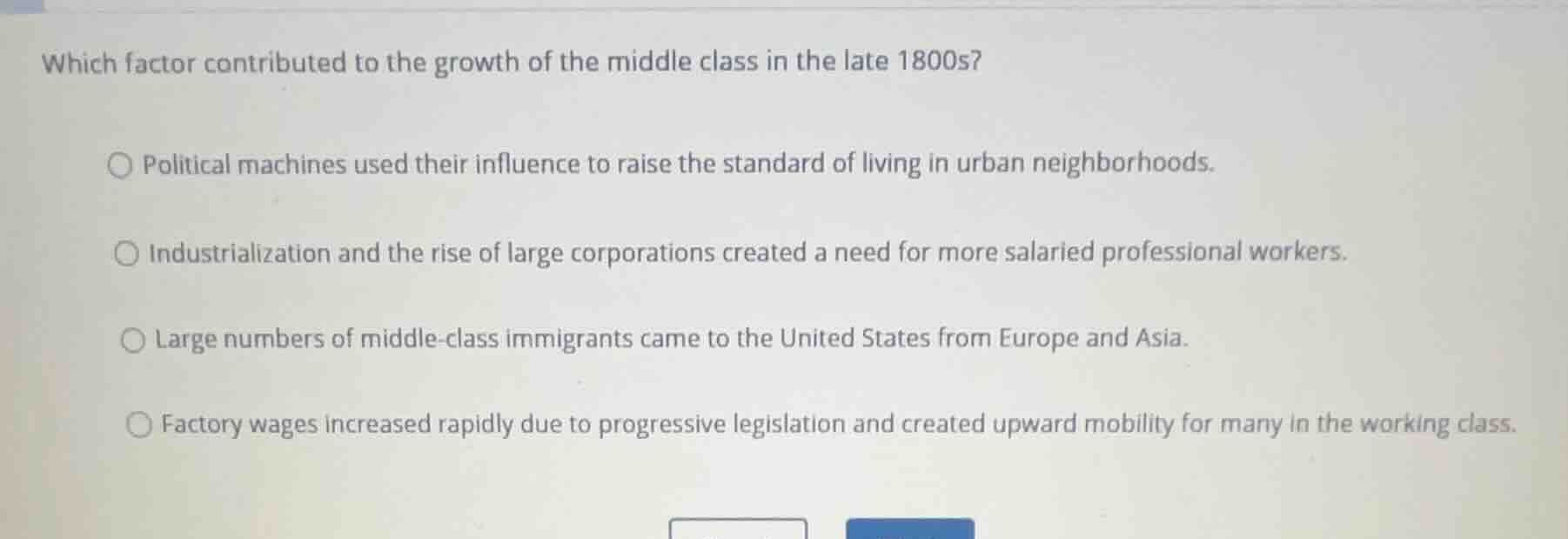
which factor contributed to the growth of the middle class in the late 1800s?

political machines used their influence to raise the standard of living in urban neighborhoods.

industrialization and the rise of large corporations created a need for more salaried professional workers.

large numbers of middle-class immigrants came to the united states from europe and asia.

factory wages increased rapidly due to progressive legislation and created upward mobility for many in the working class.

Explanation:

Response

<pre_analysis>
{
"quality": "clear",
"question_count": 1,
"skills_matched": [
"direct_cot",
"multiple_choice_formatter",
"explain_then_answer",
"tutor"
],
"needs_drawing": false,
"concepts_used": [],
"new_concepts": [
"Gilded Age Economy",
"Rise of Middle Class"
],
"current_concepts": [
"Gilded Age Economy",
"Rise of Middle Class"
]
}
</pre_analysis>

<reasoning>

Analyze the historical context of the late 1800s

During the late 19th century, the United States underwent rapid industrialization and urbanization, a period often referred to as the Gilded Age. This era was characterized by the rise of massive corporations, monopolies, and heavy industries.

Evaluate the impact of industrialization on employment

The expansion of large-scale corporations created a complex administrative structure. Businesses needed managers, accountants, clerks, salespeople, and other salaried professionals to oversee operations, manage distribution, and handle finances. This structural shift significantly expanded the white-collar workforce, which formed the core of the growing American middle class.

Assess the incorrect options

  • Political machines: While influential in urban areas, political machines focused on maintaining political power through patronage and did not systematically raise the general standard of living to build a middle class.
  • Middle-class immigrants: Most immigrants arriving in the late 1800s were working-class laborers seeking industrial jobs, rather than established middle-class individuals.
  • Factory wages and progressive legislation: Significant progressive labor legislation did not take widespread effect until the early 2000s (Progressive Era), and factory workers generally faced low wages and harsh conditions rather than rapid upward mobility during the late 1800s.

</reasoning>

<answer>
<mcq-option>Political machines used their influence to raise the standard of living in urban neighborhoods.</mcq-option>
<mcq-correct>Industrialization and the rise of large corporations created a need for more salaried professional workers.</mcq-correct>
<mcq-option>Large numbers of middle-class immigrants came to the United States from Europe and Asia.</mcq-option>
<mcq-option>Factory wages increased rapidly due to progressive legislation and created upward mobility for many in the working class.</mcq-option>
</answer>

<post_analysis>
{
"subject": "Social Science",
"question_type": "Multiple Choice",
"knowledge_point": [
"Social Science",
"US History",
"Gilded Age Economy"
]
}
</post_analysis>

Answer:

<pre_analysis>
{
"quality": "clear",
"question_count": 1,
"skills_matched": [
"direct_cot",
"multiple_choice_formatter",
"explain_then_answer",
"tutor"
],
"needs_drawing": false,
"concepts_used": [],
"new_concepts": [
"Gilded Age Economy",
"Rise of Middle Class"
],
"current_concepts": [
"Gilded Age Economy",
"Rise of Middle Class"
]
}
</pre_analysis>

<reasoning>

Analyze the historical context of the late 1800s

During the late 19th century, the United States underwent rapid industrialization and urbanization, a period often referred to as the Gilded Age. This era was characterized by the rise of massive corporations, monopolies, and heavy industries.

Evaluate the impact of industrialization on employment

The expansion of large-scale corporations created a complex administrative structure. Businesses needed managers, accountants, clerks, salespeople, and other salaried professionals to oversee operations, manage distribution, and handle finances. This structural shift significantly expanded the white-collar workforce, which formed the core of the growing American middle class.

Assess the incorrect options

  • Political machines: While influential in urban areas, political machines focused on maintaining political power through patronage and did not systematically raise the general standard of living to build a middle class.
  • Middle-class immigrants: Most immigrants arriving in the late 1800s were working-class laborers seeking industrial jobs, rather than established middle-class individuals.
  • Factory wages and progressive legislation: Significant progressive labor legislation did not take widespread effect until the early 2000s (Progressive Era), and factory workers generally faced low wages and harsh conditions rather than rapid upward mobility during the late 1800s.

</reasoning>

<answer>
<mcq-option>Political machines used their influence to raise the standard of living in urban neighborhoods.</mcq-option>
<mcq-correct>Industrialization and the rise of large corporations created a need for more salaried professional workers.</mcq-correct>
<mcq-option>Large numbers of middle-class immigrants came to the United States from Europe and Asia.</mcq-option>
<mcq-option>Factory wages increased rapidly due to progressive legislation and created upward mobility for many in the working class.</mcq-option>
</answer>

<post_analysis>
{
"subject": "Social Science",
"question_type": "Multiple Choice",
"knowledge_point": [
"Social Science",
"US History",
"Gilded Age Economy"
]
}
</post_analysis>