QUESTION IMAGE
Question
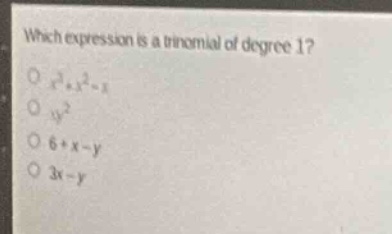
which expression is a trinomial of degree 1?
\\(x^3 + x^2 - x\\)
\\(y^2\\)
\\(6 + x - y\\)
\\(3x - y\\)
🆕 New Concept Discovered: Classifying Polynomials
Identifying polynomials by their number of terms and degree.
Step 1: Understand "Trinomial"
A trinomial is an algebraic expression containing exactly three terms separated by addition or subtraction signs. Let's count the terms in each option:
- \( x^3 + x^2 - x \): Three terms (\( x^3 \), \( x^2 \), and \( -x \)) \(
ightarrow\) Trinomial
- \( y^2 \): One term \(
ightarrow\) Monomial
- \( 6 + x - y \): Three terms (\( 6 \), \( x \), and \( -y \)) \(
ightarrow\) Trinomial
- \( 3x - y \): Two terms (\( 3x \), and \( -y \)) \(
ightarrow\) Binomial
This leaves us with \( x^3 + x^2 - x \) and \( 6 + x - y \) as our trinomial candidates.
Step 2: Understand "Degree 1"
The degree of a polynomial is the highest exponent of its variable(s) in any single term.
- For \( x^3 + x^2 - x \): The highest exponent is \( 3 \) (from the \( x^3 \) term). This is a degree 3 (cubic) trinomial.
- For \( 6 + x - y \): The variables \( x \) and \( y \) both have an implicit exponent of \( 1 \) (since \( x = x^1 \) and \( y = y^1 \)). The highest exponent is \( 1 \). This is a degree 1 (linear) trinomial.
Therefore, \( 6 + x - y \) is a trinomial of degree 1.

Snap & solve any problem in the app
Get step-by-step solutions on Sovi AI
Photo-based solutions with guided steps
Explore more problems and detailed explanations
\( 6 + x - y \)