QUESTION IMAGE
Question
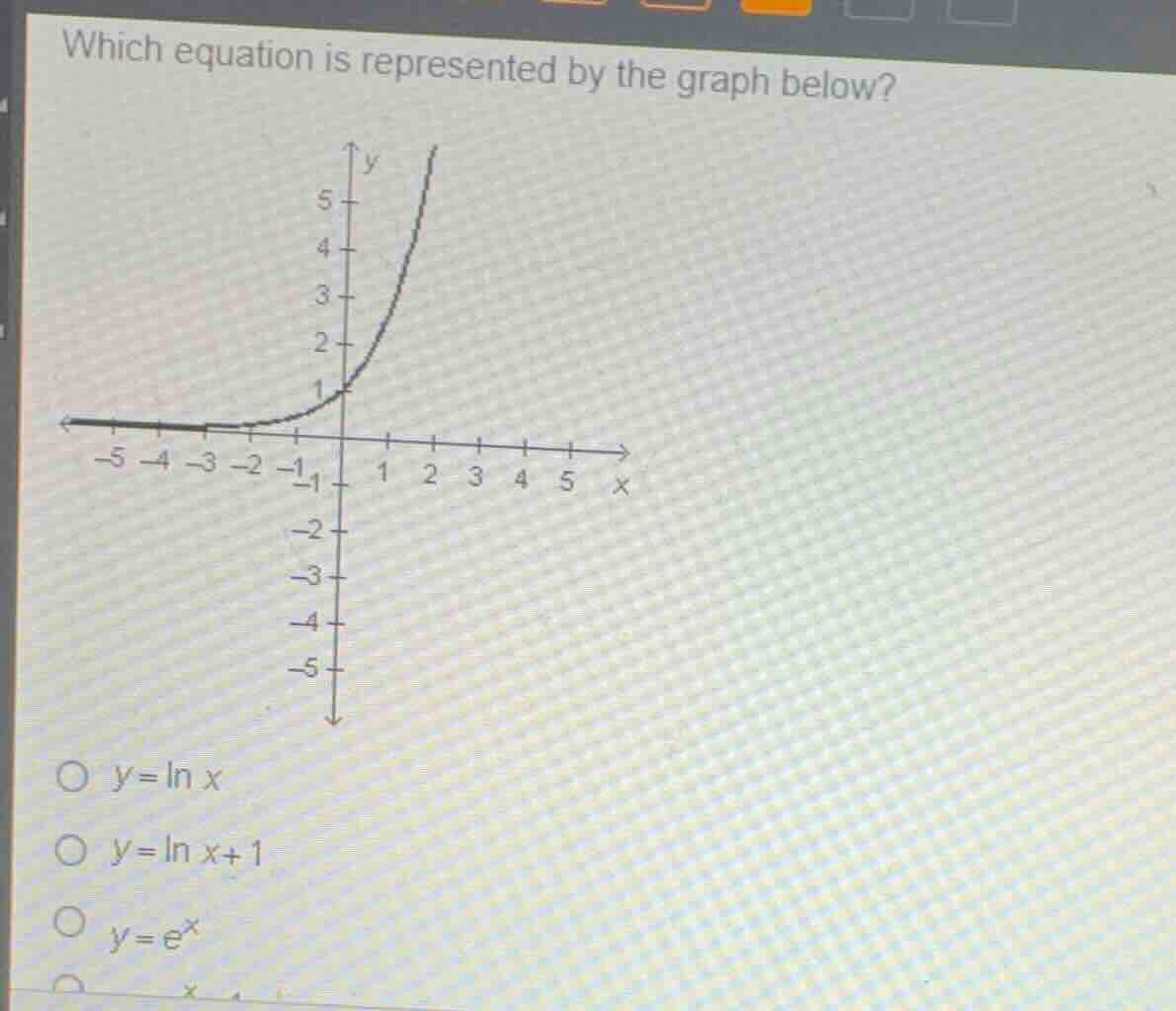
which equation is represented by the graph below?
\\(y = \ln x\\)
\\(y = \ln x + 1\\)
\\(y = e^x\\)
\\(y = e^x + 1\\)
Identify key features of the graph
Using the Exponential Function Graphs knowledge point
- The graph has a horizontal asymptote at \(y = 0\) as \(x \to -\infty\).
- The graph passes through the \(y\)-intercept at \((0, 1)\).
- The graph passes through the point \((1, e)\) where \(e \approx 2.718\), and \((2, e^2)\) where \(e^2 \approx 7.389\).
- The domain is \((-\infty, \infty)\) and the range is \((0, \infty)\).
Evaluate the given options
- \(y = \ln x\): The domain of logarithmic functions is \(x > 0\), which does not match the graph.
- \(y = \ln x + 1\): The domain is also restricted to \(x > 0\).
- \(y = e^x\): This exponential function has a domain of \((-\infty, \infty)\), a horizontal asymptote at \(y = 0\), and passes through \((0, 1)\) and \((1, e)\). This matches the graph perfectly.
- \(y = e^x + 1\): This would have a \(y\)-intercept at \((0, 2)\) and a horizontal asymptote at \(y = 1\), which does not match.

Snap & solve any problem in the app
Get step-by-step solutions on Sovi AI
Photo-based solutions with guided steps
Explore more problems and detailed explanations
- (A) \(y = \ln x\)
- (B) \(y = \ln x + 1\)
- (C) \(y = e^x\) (Correct answer)
- (D) \(y = e^x + 1\)