QUESTION IMAGE
Question
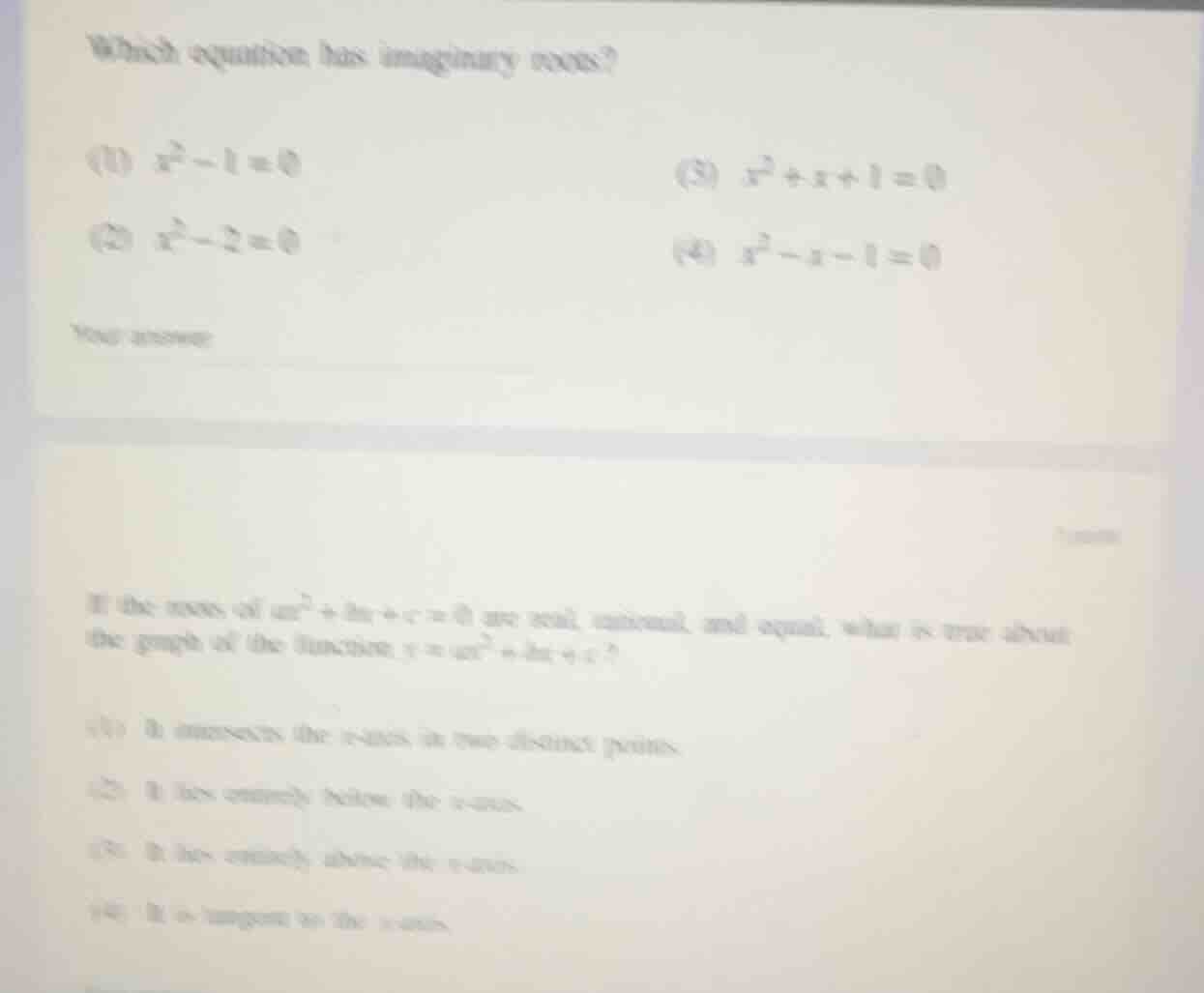
which equation has imaginary roots?
(1) $x^2 - 1 = 0$ (3) $x^2 + x + 1 = 0$
(2) $x^2 - 2 = 0$ (4) $x^2 - x - 1 = 0$
your answer:
if the roots of $ax^2 + bx + c = 0$ are real, rational, and equal, what is true about the graph of the function $y = ax^2 + bx + c$?
(1) it intersects the x - axis in two distinct points.
(2) it lies entirely below the x - axis.
(3) it lies entirely above the x - axis.
(4) it is tangent to the x - axis.
First Question
Step1: Recall discriminant formula
For quadratic $ax^2+bx+c=0$, discriminant $\Delta = b^2-4ac$. If $\Delta<0$, roots are imaginary.
Step2: Calculate $\Delta$ for (1)
$x^2-1=0$, $a=1,b=0,c=-1$:
$\Delta = 0^2-4(1)(-1)=4$
Step3: Calculate $\Delta$ for (2)
$x^2-2=0$, $a=1,b=0,c=-2$:
$\Delta = 0^2-4(1)(-2)=8$
Step4: Calculate $\Delta$ for (3)
$x^2+x+1=0$, $a=1,b=1,c=1$:
$\Delta = 1^2-4(1)(1)=1-4=-3$
Step5: Calculate $\Delta$ for (4)
$x^2-x-1=0$, $a=1,b=-1,c=-1$:
$\Delta = (-1)^2-4(1)(-1)=1+4=5$
For a quadratic $y=ax^2+bx+c$, the discriminant $\Delta=b^2-4ac$ determines the graph's relation to the x-axis:
- $\Delta>0$: crosses x-axis at 2 distinct points
- $\Delta=0$: touches (is tangent to) x-axis at 1 point (matches real, equal roots)
- $\Delta<0$: lies entirely above/below x-axis (no real roots)

Snap & solve any problem in the app
Get step-by-step solutions on Sovi AI
Photo-based solutions with guided steps
Explore more problems and detailed explanations
(3) $x^2 + x + 1 = 0$
---