QUESTION IMAGE
Question
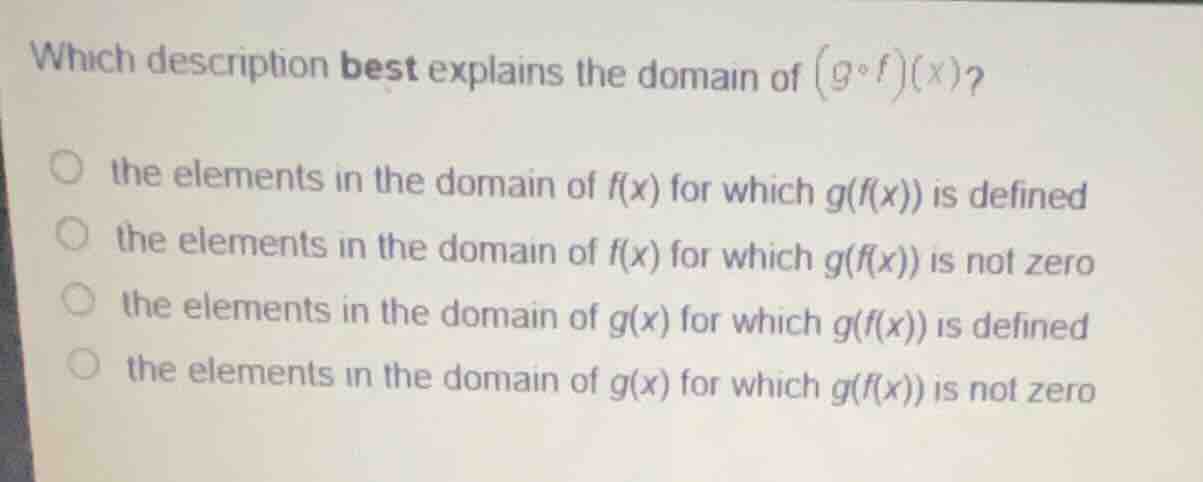
which description best explains the domain of \\((g \circ f)(x)\\)?
- the elements in the domain of \\(f(x)\\) for which \\(g(f(x))\\) is defined
- the elements in the domain of \\(f(x)\\) for which \\(g(f(x))\\) is not zero
- the elements in the domain of \\(g(x)\\) for which \\(g(f(x))\\) is defined
- the elements in the domain of \\(g(x)\\) for which \\(g(f(x))\\) is not zero
Analyze the definition of composite function domain
The composite function \((g \circ f)(x)\) is defined as \(g(f(x))\). For this expression to be defined, two conditions must be met:
- The input \(x\) must be in the domain of the inner function \(f(x)\).
- The output of the inner function, \(f(x)\), must be in the domain of the outer function \(g(x)\), which means \(g(f(x))\) must be defined.
Evaluate the given options
- Option 1: "the elements in the domain of \(f(x)\) for which \(g(f(x))\) is defined" matches the definition perfectly.
- Option 2: Mentions "is not zero", which is only relevant for division, not general composition.
- Option 3: Incorrectly starts with "the elements in the domain of \(g(x)\)".
- Option 4: Incorrectly starts with "the elements in the domain of \(g(x)\)".

Snap & solve any problem in the app
Get step-by-step solutions on Sovi AI
Photo-based solutions with guided steps
Explore more problems and detailed explanations
- (A) the elements in the domain of \(f(x)\) for which \(g(f(x))\) is defined (Correct answer)
- (B) the elements in the domain of \(f(x)\) for which \(g(f(x))\) is not zero
- (C) the elements in the domain of \(g(x)\) for which \(g(f(x))\) is defined
- (D) the elements in the domain of \(g(x)\) for which \(g(f(x))\) is not zero