QUESTION IMAGE
Question
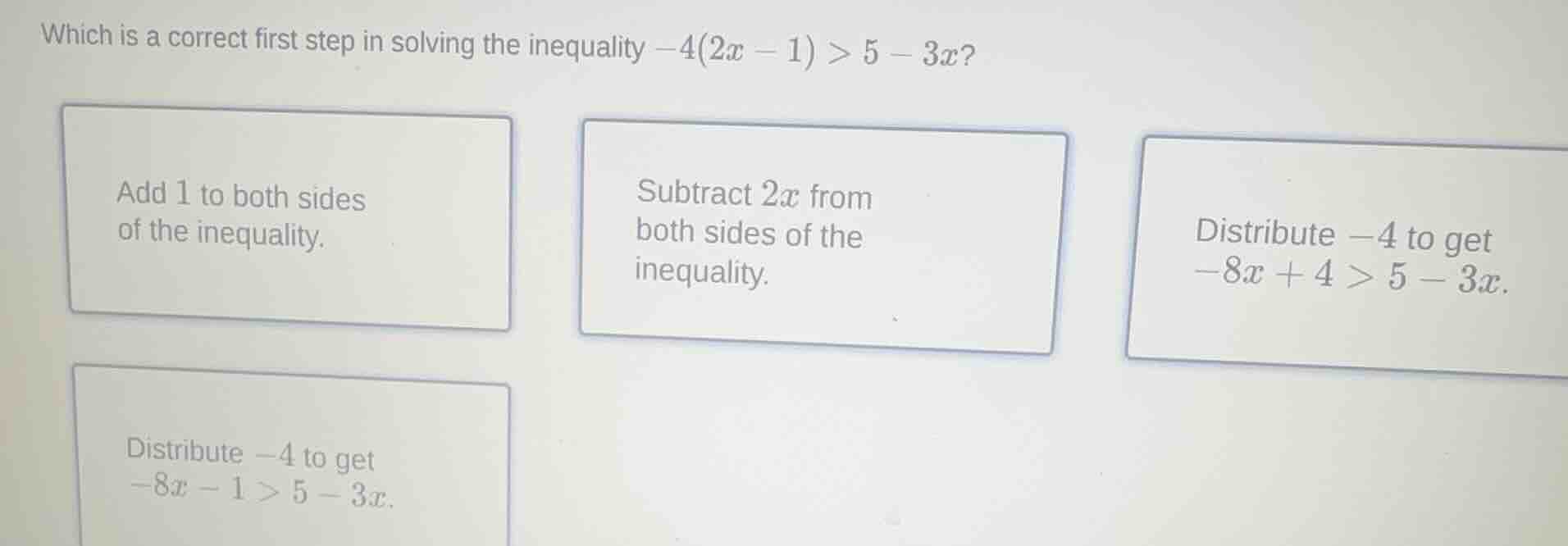
which is a correct first step in solving the inequality \\(-4(2x - 1) > 5 - 3x\\)?
- add 1 to both sides of the inequality.
- subtract \\(2x\\) from both sides of the inequality.
- distribute \\(-4\\) to get \\(-8x + 4 > 5 - 3x\\).
- distribute \\(-4\\) to get \\(-8x - 1 > 5 - 3x\\).
Identify the given inequality
We are given the following linear inequality to solve:
$$-4(2x - 1) > 5 - 3x$$
Apply the distributive property
Using the Distributive Property knowledge point
$$
LATEXBLOCK0
$$
Substitute back into the inequality
Using the Solving Linear Inequalities knowledge point
$$
-8x + 4 > 5 - 3x
$$
Evaluate the given options
- "Add 1 to both sides of the inequality": Incorrect, as \(1\) is inside the parentheses and multiplied by \(-4\).
- "Subtract \(2x\) from both sides of the inequality": Incorrect, as \(2x\) is inside the parentheses.
- "Distribute \(-4\) to get \(-8x - 1 > 5 - 3x\)": Incorrect, because \(-4 \times -1 = +4\), not \(-1\).
- "Distribute \(-4\) to get \(-8x + 4 > 5 - 3x\)": Correct, as shown in our distribution step.

Snap & solve any problem in the app
Get step-by-step solutions on Sovi AI
Photo-based solutions with guided steps
Explore more problems and detailed explanations
- Add 1 to both sides of the inequality.
- Subtract \(2x\) from both sides of the inequality.
- Distribute \(-4\) to get \(-8x + 4 > 5 - 3x\). (Correct answer)
- Distribute \(-4\) to get \(-8x - 1 > 5 - 3x\).