QUESTION IMAGE
Question
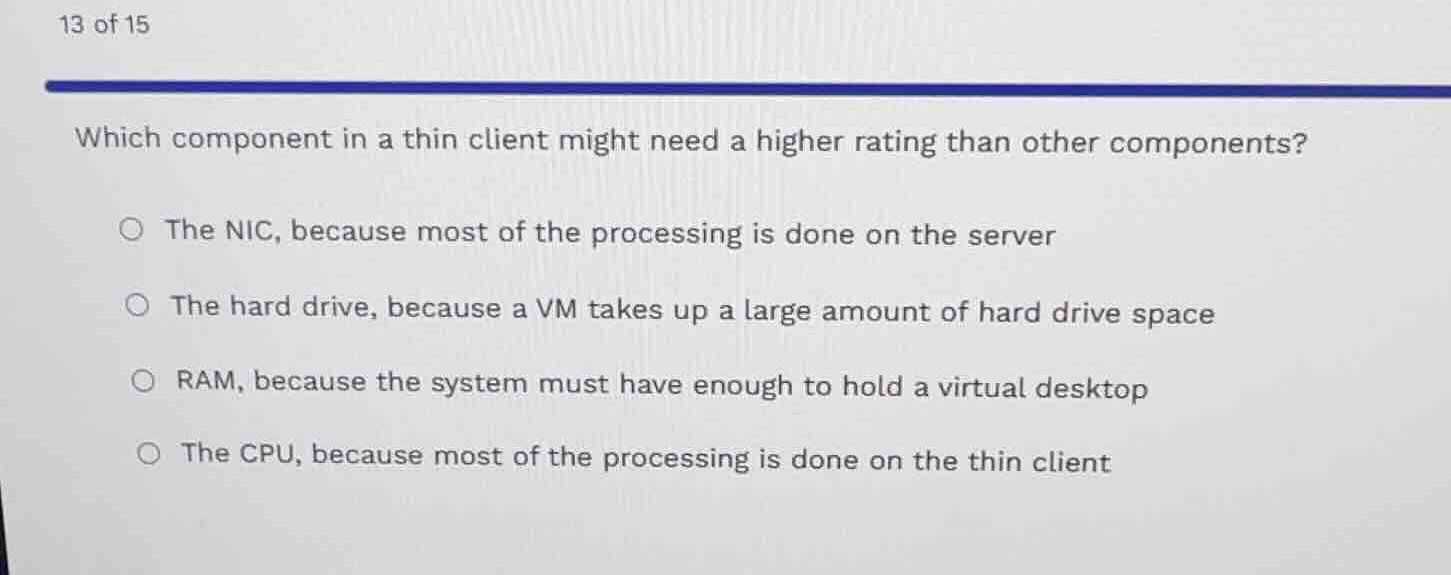
which component in a thin client might need a higher rating than other components?
- the nic, because most of the processing is done on the server
- the hard drive, because a vm takes up a large amount of hard drive space
- ram, because the system must have enough to hold a virtual desktop
- the cpu, because most of the processing is done on the thin client
Analyze thin client architecture
Using the Network Interface Card knowledge point
A thin client is a lightweight computer optimized for establishing a remote connection with a server-based computing environment. Because almost all computational processing, data storage, and application execution occur on the centralized server rather than the local machine, the local hardware requirements for the CPU, RAM, and storage (hard drive) are minimal.
Evaluate component requirements
Since the thin client relies entirely on constant communication with the server to transmit user inputs and receive display updates, its network connection is its most critical link. Therefore, the Network Interface Card (NIC) requires a higher relative performance rating (such as Gigabit Ethernet or fast wireless) compared to its low-end CPU, minimal RAM, and small or non-existent local storage.
Assess the given options
- Option 1 (The NIC, because most of the processing is done on the server): Correct. Since processing is offloaded, network throughput and reliability are paramount.
- Option 2 (The hard drive...): Incorrect. Thin clients often use minimal flash storage or boot directly from the network, as VMs run on the server.
- Option 3 (RAM...): Incorrect. The virtual desktop is hosted and held in the server's RAM, not the local thin client's RAM.
- Option 4 (The CPU...): Incorrect. Most processing is done on the server, not the thin client.

Snap & solve any problem in the app
Get step-by-step solutions on Sovi AI
Photo-based solutions with guided steps
Explore more problems and detailed explanations
- (A) The NIC, because most of the processing is done on the server (Correct answer)
- (B) The hard drive, because a VM takes up a large amount of hard drive space
- (C) RAM, because the system must have enough to hold a virtual desktop
- (D) The CPU, because most of the processing is done on the thin client