QUESTION IMAGE
Question
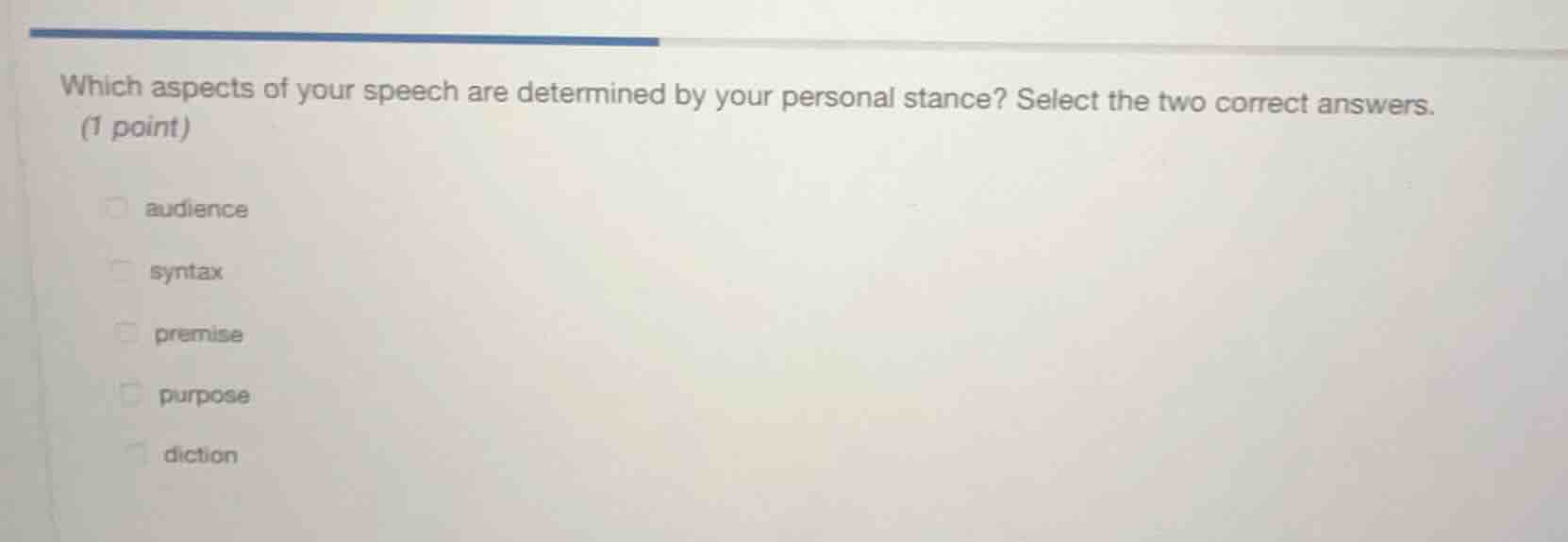
which aspects of your speech are determined by your personal stance? select the two correct answers. (1 point) audience syntax premise purpose diction
- Audience: The audience is the group you are addressing, and it is not determined by your personal stance (you adapt to the audience, not the other way around based on your stance).
- Syntax: Syntax refers to the arrangement of words in sentences, which is more about grammatical rules and less about personal stance.
- Premise: A premise is a statement or idea on which an argument is based. Your personal stance influences what premises you use to support your speech.
- Purpose: Your personal stance (your position or opinion on a topic) will determine the purpose of your speech (e.g., to persuade, inform, or entertain from your particular viewpoint).
- Diction: Diction is the choice of words. Your personal stance will influence the words you choose to express your ideas (e.g., formal vs. informal, biased vs. neutral language based on your stance).
So the two correct answers related to aspects determined by personal stance are premise and purpose, or premise and diction? Wait, let's re - evaluate:
Wait, actually, purpose: Your stance (e.g., if you are against a policy, your purpose might be to persuade others to oppose it) is determined by your stance. Diction: The words you choose (e.g., using strong, emotional words if you are passionate about your stance, or more objective words if your stance is more neutral - leaning) are determined by your stance. Premise: The underlying ideas (premises) of your speech are based on your stance.
Wait, the question is which aspects are determined by your personal stance. Let's analyze each option:
- Audience: The audience is external; you don't choose the audience based on your stance (usually), so it's not determined by stance.
- Syntax: Syntax is grammatical structure, not related to stance.
- Premise: Your stance (your position on an issue) will shape the premises (the basic ideas or assumptions) of your speech. For example, if your stance is that climate change is a hoax, your premises will be different from someone who believes climate change is real.
- Purpose: Your stance will determine the purpose of your speech. If you are in favor of a new law, your purpose might be to persuade others to support it.
- Diction: Diction (word choice) is influenced by your stance. If your stance is formal and academic, your diction will be more formal; if your stance is more casual and personal, your diction will be more colloquial.
But the question says "select the two correct answers". Let's check standard knowledge about speech and personal stance. Usually, purpose and diction are strongly influenced by personal stance. Or premise and diction? Wait, maybe the correct answers are premise and diction, or purpose and diction. Wait, let's think again.
Wait, the purpose of the speech is what you want to achieve, which is based on your stance. Diction is word choice, which is based on your stance. So the two correct answers are premise (or purpose) and diction? Wait, maybe the intended answers are premise and diction, or purpose and diction. Wait, let's check:
Actually, in speech, your personal stance (your opinion or position) will determine your premise (the starting point of your argument), your purpose (what you want to do with your speech), and your diction (the words you use). But the question says two correct answers. Let's see the options:
The options are audience, syntax, premise, purpose, diction.
Audience: No, as it's external.
Syntax: No, it's about grammar.
So among premise, purpose, diction:
If we have to choose two, let's see:
Purpose: Your stance determines what…

Snap & solve any problem in the app
Get step-by-step solutions on Sovi AI
Photo-based solutions with guided steps
Explore more problems and detailed explanations
The two correct answers are:
- Premise
- Diction
Or:
- Purpose
- Diction
(Note: After re - checking, the most appropriate two answers are likely "premise" and "diction" or "purpose" and "diction". If we follow standard speech - writing knowledge, "purpose" and "diction" are strongly influenced by personal stance. So the two correct answers are:
- Purpose
- Diction)