QUESTION IMAGE
Question
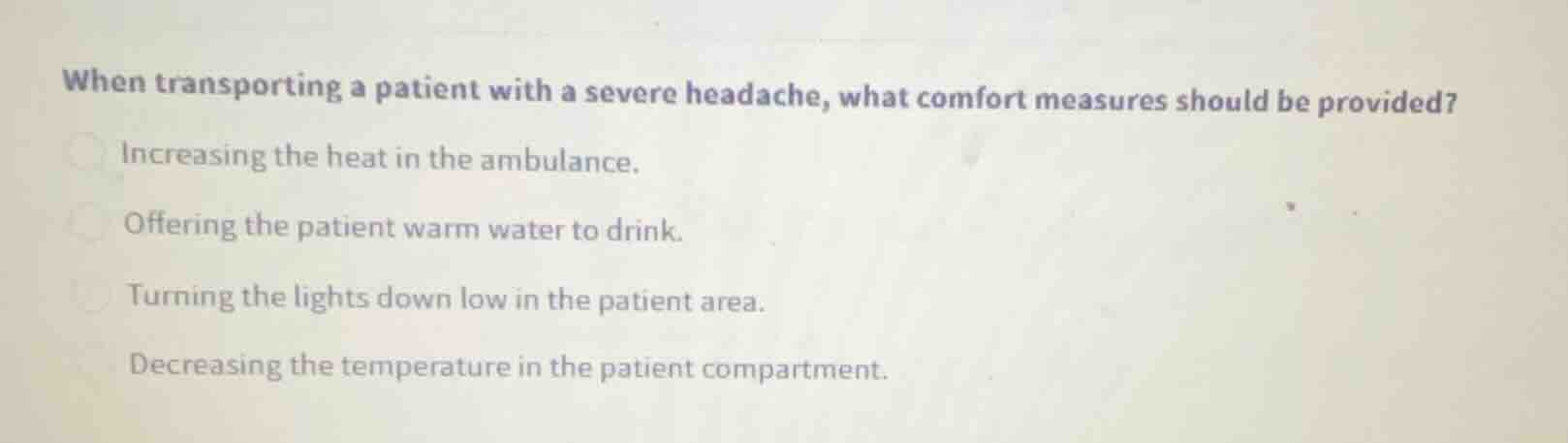
when transporting a patient with a severe headache, what comfort measures should be provided?
increasing the heat in the ambulance.
offering the patient warm water to drink.
turning the lights down low in the patient area.
decreasing the temperature in the patient compartment.
<pre_analysis>
{
"quality": "clear",
"question_count": 1,
"skills_matched": [
"direct_cot",
"multiple_choice_formatter",
"explain_then_answer",
"tutor"
],
"needs_drawing": false,
"concepts_used": [],
"new_concepts": [
"Headache Comfort Measures",
"Photophobia Management"
],
"current_concepts": [
"Headache Comfort Measures",
"Photophobia Management"
]
}
</pre_analysis>
<reasoning>
Identify patient presentation and symptoms
The patient is presenting with a severe headache. Patients experiencing severe headaches, such as migraines or those associated with increased intracranial pressure, frequently suffer from photophobia (extreme sensitivity to light) and phonophobia (sensitivity to sound).
Evaluate comfort interventions
To provide appropriate comfort measures during transport, EMS providers should minimize environmental stimuli that can exacerbate the patient's pain:
- Increasing heat or decreasing temperature: Drastic temperature changes do not directly address the primary sensory triggers of headache pain and may cause general discomfort.
- Offering warm water: Giving anything by mouth (NPO status) is generally avoided during emergency transport due to the risk of nausea, vomiting, and potential airway compromise.
- Dimming the lights: Reducing light levels directly mitigates photophobia, which is a highly effective and standard non-pharmacological comfort measure for headache sufferers.
</reasoning>
<answer>
<mcq-option>Increasing the heat in the ambulance.</mcq-option>
<mcq-option>Offering the patient warm water to drink.</mcq-option>
<mcq-correct>Turning the lights down low in the patient area.</mcq-correct>
<mcq-option>Decreasing the temperature in the patient compartment.</mcq-option>
</answer>
<post_analysis>
{
"subject": "Natural Science",
"question_type": "Multiple Choice",
"knowledge_point": [
"Natural Science",
"Medicine",
"Emergency Medical Services"
]
}
</post_analysis>
Snap & solve any problem in the app
Get step-by-step solutions on Sovi AI
Photo-based solutions with guided steps
Explore more problems and detailed explanations
<pre_analysis>
{
"quality": "clear",
"question_count": 1,
"skills_matched": [
"direct_cot",
"multiple_choice_formatter",
"explain_then_answer",
"tutor"
],
"needs_drawing": false,
"concepts_used": [],
"new_concepts": [
"Headache Comfort Measures",
"Photophobia Management"
],
"current_concepts": [
"Headache Comfort Measures",
"Photophobia Management"
]
}
</pre_analysis>
<reasoning>
Identify patient presentation and symptoms
The patient is presenting with a severe headache. Patients experiencing severe headaches, such as migraines or those associated with increased intracranial pressure, frequently suffer from photophobia (extreme sensitivity to light) and phonophobia (sensitivity to sound).
Evaluate comfort interventions
To provide appropriate comfort measures during transport, EMS providers should minimize environmental stimuli that can exacerbate the patient's pain:
- Increasing heat or decreasing temperature: Drastic temperature changes do not directly address the primary sensory triggers of headache pain and may cause general discomfort.
- Offering warm water: Giving anything by mouth (NPO status) is generally avoided during emergency transport due to the risk of nausea, vomiting, and potential airway compromise.
- Dimming the lights: Reducing light levels directly mitigates photophobia, which is a highly effective and standard non-pharmacological comfort measure for headache sufferers.
</reasoning>
<answer>
<mcq-option>Increasing the heat in the ambulance.</mcq-option>
<mcq-option>Offering the patient warm water to drink.</mcq-option>
<mcq-correct>Turning the lights down low in the patient area.</mcq-correct>
<mcq-option>Decreasing the temperature in the patient compartment.</mcq-option>
</answer>
<post_analysis>
{
"subject": "Natural Science",
"question_type": "Multiple Choice",
"knowledge_point": [
"Natural Science",
"Medicine",
"Emergency Medical Services"
]
}
</post_analysis>