QUESTION IMAGE
Question
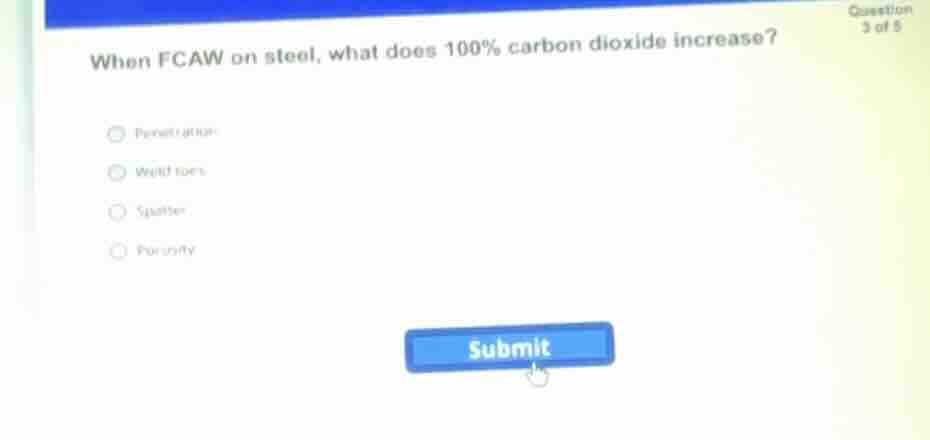
when fcaw on steel, what does 100% carbon dioxide increase?
penetration
weld toes
spatter
porosity
Analyze shielding gas characteristics
Using the Shielding Gas Mechanical Properties and FCAW knowledge points
- Carbon dioxide (\(\text{CO}_2\)) is a reactive shielding gas commonly used in Flux-Cored Arc Welding (FCAW) on carbon steel.
- Under the high temperature of the welding arc, \(\text{CO}_2\) dissociates into carbon monoxide (\(\text{CO}\)) and oxygen (\(\text{O}_2\)).
- This dissociation and subsequent recombination release significant thermal energy, which increases the heat input to the weld pool.
Determine the effect on weld bead profile
Using the Shielding Gas Mechanical Properties knowledge point
- The high heat input and intense arc energy associated with \(100\%\) \(\text{CO}_2\) shielding gas result in deep joint penetration.
- Compared to argon-rich gas mixtures (which tend to have shallower, wider penetration profiles), pure \(\text{CO}_2\) provides a deep, broad, finger-like penetration profile.
- Therefore, increasing the concentration of \(\text{CO}_2\) to \(100\%\) increases penetration.

Snap & solve any problem in the app
Get step-by-step solutions on Sovi AI
Photo-based solutions with guided steps
Explore more problems and detailed explanations
- (A) Penetration (Correct answer)
- (B) Weld toes
- (C) Spatter
- (D) Porosity